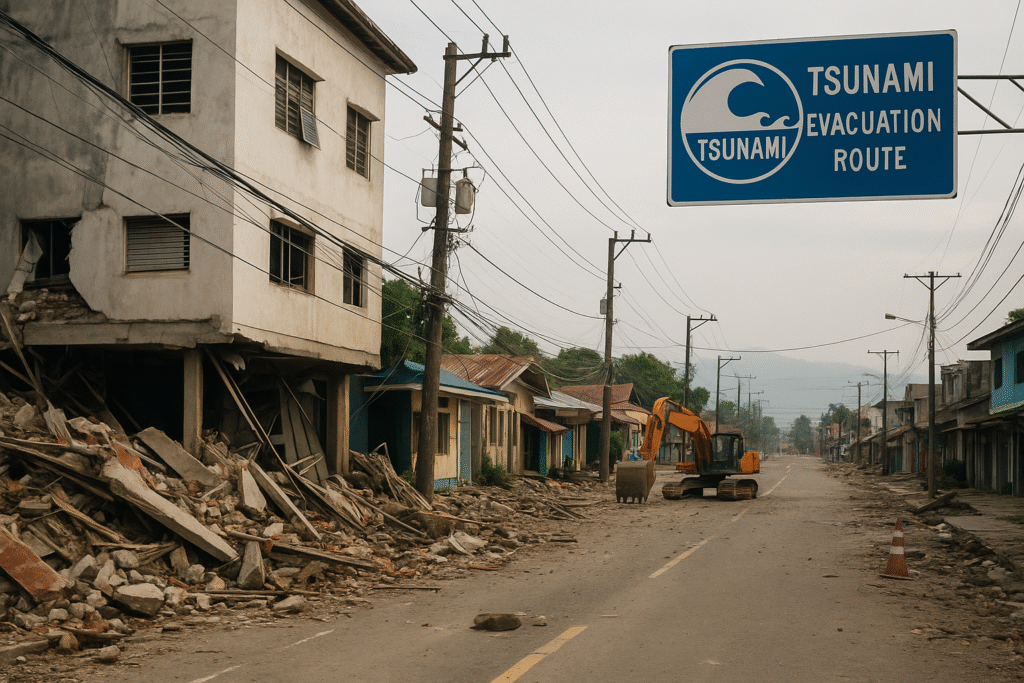
On October 10, 2025, a massive earthquake struck the southern Philippines. The tremor, recorded at a magnitude of 7.5, hit offshore near Davao Oriental. The quake was shallow, with a depth of just 20 kilometers, intensifying its impact. Residents across Mindanao felt the violent shaking as buildings rattled and streets filled with panicked crowds. The epicenter was located close to Manay town, about 80 kilometers from Davao City. This densely populated city quickly reported power outages and disruptions. Hospitals moved patients outside as a precaution. Emergency sirens warned communities to evacuate coastal towns at risk of rising seas.
Tsunami Warning Issued
Minutes after the earthquake, the Philippine Institute of Volcanology and Seismology (PHIVOLCS) issued a tsunami warning. The alert covered coastal provinces within 300 kilometers of the epicenter. Authorities ordered residents in low-lying areas to move to higher ground. Waves of dangerous height were expected within two hours of the quake.
Local officials confirmed swift evacuations in Davao Oriental, Davao del Sur, and Surigao del Norte. Police and soldiers assisted families in reaching evacuation centers. Schools, churches, and sports arenas were converted into temporary shelters.
The warning was also extended internationally. Indonesia, Palau, and other Pacific islands prepared for possible incoming waves. Although waves outside the Philippines were expected to be smaller, the threat remained serious.
International Travel Advisories
The scale of the disaster prompted immediate global reactions. The United States, the United Kingdom, and Canada all issued urgent travel advisories. These nations urged citizens to avoid travel to Mindanao and nearby provinces.
United States
The US Department of State warned travelers to avoid coastal Mindanao. They highlighted the risks of aftershocks and potential tsunamis. Americans in the region were told to follow local evacuation orders.
United Kingdom
The UK Foreign Office advised against all travel to Mindanao. Their notice cited not only the earthquake but also ongoing security risks in the region. British nationals were urged to stay in contact with consular services.
Canada
Canada issued a high-level warning for its citizens. The government urged avoidance of non-essential travel to southern Philippines. Canadians were advised to monitor local updates and prepare for emergencies.
Tsunami Threat Extends Across Asia
The Pacific Ocean carried the tsunami threat far beyond the Philippines. Indonesia’s North Sulawesi and Papua provinces were placed under advisory. Authorities urged residents in at-risk areas to stay away from the coast.
In Palau, officials urged both locals and tourists to move inland. Smaller Pacific island nations, including Micronesia, also prepared for potential waves. This broad extension of alerts emphasized the scale of the earthquake. Even distant nations felt the ripple effects of the disaster.
Aftershocks and Ongoing Risks
PHIVOLCS warned of possible aftershocks in the coming days. These secondary quakes could cause further damage to weakened structures. Authorities stressed the need for vigilance, especially in urban centers.
Search-and-rescue teams were deployed to hard-hit areas. Rural villages in mountainous terrain reported landslides blocking roads. Emergency crews faced difficulties in reaching remote communities.
The National Disaster Risk Reduction and Management Council (NDRRMC) activated full response operations. Relief teams distributed water, food packs, and medical supplies to evacuees.
Damage to Infrastructure
The earthquake caused widespread damage across Mindanao. Schools and hospitals reported cracks and collapsed walls. Government offices in Davao City were temporarily closed for inspections.
Power outages darkened much of Davao and General Santos City. Cellular and internet networks were disrupted, complicating communication.
Landslides blocked major highways, isolating several towns. Engineers began assessing bridges and airports to restore transport routes.
Why the Philippines is at High Risk
The Philippines lies along the Pacific “Ring of Fire.” This zone is one of the most seismically active regions on Earth. Earthquakes and volcanic eruptions are frequent in this area.
Experts have long warned about the risk of strong earthquakes in Mindanao. The government has invested in early warning systems, but challenges remain. Calls for stronger earthquake-resistant buildings have grown louder.
What Travelers Should Know
Tourists in the Philippines are urged to remain cautious. Travelers should follow all official advisories and avoid coastal areas. It is critical to stay updated on evacuation orders and emergency alerts.
Visitors should prepare for aftershocks and possible flight disruptions. Travel insurance covering natural disasters is highly recommended. Those in tsunami-risk zones should know the nearest evacuation routes.
For those planning future trips, northern and central Philippines remain unaffected. However, caution is advised until seismic activity subsides.
Global Lessons and Preparedness
The Mindanao earthquake has once again highlighted the need for preparedness. Disasters in the Pacific can affect multiple nations within hours. Strong cooperation between governments and aid agencies is vital.
Tourism authorities stress that safety comes first. While the Philippines remains a top travel destination, its vulnerability to natural disasters must be acknowledged. Investments in safer infrastructure and community training will play a key role in future resilience.
Conclusion
The October 10 earthquake in Mindanao has left thousands displaced. The tsunami warning triggered swift international concern and travel restrictions. As rescue and recovery continue, both residents and travelers must remain alert.
The Philippines, though resilient, faces ongoing challenges as part of the Pacific Ring of Fire. Global advisories underline the importance of prioritizing safety when natural disasters strike. For now, Mindanao remains under watch as the world follows developments closely.
For more travel news like this, keep reading Global Travel Wire