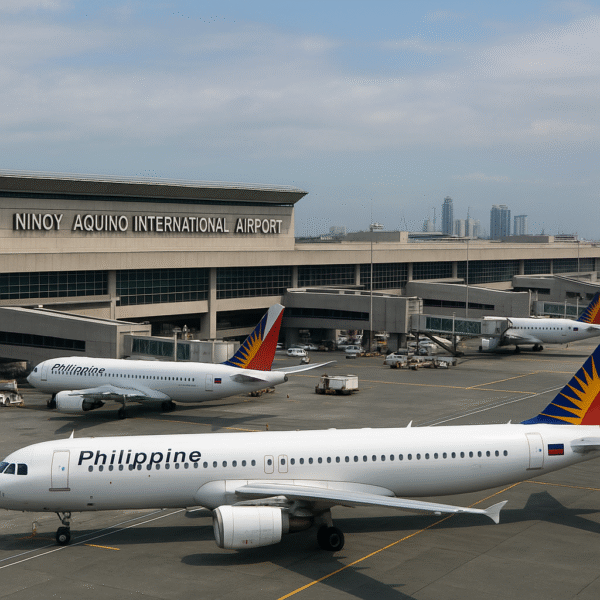
The Philippine aviation sector is at a crossroads. With Manila’s main hub overburdened and other airports underutilized, Philippine Airlines (PAL) is calling for a sweeping, unified national airport master plan. The goal: boost growth, streamline operations, and restore the country’s competitiveness in Asia’s aviation race.
Urgent Call for Integration
Speaking at the 2025 Philippine Aviation Summit, PAL’s Executive Vice President and COO Carlos Luis Fernandez stressed that the Philippines needs a “whole-of-nation” strategy. The plan should coordinate all major airports and optimize infrastructure. Without it, the country risks being left behind in both passenger and cargo traffic.
Manila’s Ninoy Aquino International Airport (NAIA) faces severe congestion. Terminals are overcrowded and runways stretched. At the same time, airports outside Manila operate below capacity. A coordinated master plan can shift the load, improve routing, and reduce duplication.
Bridging the Infrastructure Gap
Aircraft traffic in Asia is booming. Neighboring countries have capitalized on that with large, modern airport systems. But the Philippines lags behind. Its nine international gateways handled around 60 million passengers in the past year — far below Indonesia’s 156 million, Thailand’s 119 million, and Vietnam’s 109 million.
PAL executives argue this disparity stems not just from flights, but from ineffective network planning. A national master plan could help secondary airports grow as mini hubs through runway extensions, upgraded navigation systems, and night-operation capability.
A Phased Roadmap to Efficiency
The plan PAL proposes begins with near-term upgrades at NAIA: expanding terminal capacity, improving check-in and security flows, and increasing runway capacity. These steps will ease immediate pressure and set the stage for longer-term reform.
However, the vision is broader. The master plan must define the roles of Clark International Airport and the future New Manila International Airport in Bulacan. These airports should complement, not compete with, each other. Their coordinated development can shift excess traffic away from Manila, enabling a smoother national network.
Secondary airports must also be standardized. That means consistent protocols for instrumentation, night operations, safety systems, and support infrastructure. With better alignment, flights can connect more directly, cargo can move faster, and travelers can avoid unnecessary transfers.
Seamless Network, Stronger Economy
Fernandez emphasizes that the strength of a hub lies not just in quantity of flights, but in operational resilience, seamless transfers, and network efficiency. A unified system would help reduce delays, improve reliability, and increase route coverage.
For the economy, the benefits are vast. Tourism can expand as more international visitors gain access to regional destinations without long detours. Trade can flourish when cargo moves faster and more predictably. PAL points out that the Philippines currently handles under 700,000 tonnes of air cargo annually—far behind hubs like Hong Kong, which manages over 5 million tonnes.
A national airport plan can also support disaster response and national resilience. Integrated airports with redundant systems can better handle emergencies and ensure continuity in times of crisis.
Tackling Manila’s Bottleneck
NAIA’s congestion has long troubled airlines and passengers alike. The airport operates beyond its design capacity, causing delays, long queues, and logistical strain. PAL argues that meaningful expansion and process improvements are overdue.
To help, the master plan would expand terminals, increase security infrastructure, and optimize gate allocation. Smarter scheduling and runway use would allow more flights without compromising safety or reliability.
Aligning National Policy and Investment
Such a plan requires more than construction—it demands policy alignment. PAL calls for harmonizing investments, fuel tax regimes, and sustainability policies to make the Philippines’ airports more cost-competitive. Without coordinated incentives, improvements may fail to attract new airlines or cargo routes.
Surface connectivity is another layer. Highways, rail links, and express transit must link major airports to their catchment areas. Airports can’t just sit in isolation; they must integrate into regional transport networks so that travelers and cargo can move seamlessly from city cores to airport hubs.
Local Airport Developments Point the Way
Beyond Manila, several provincial airports are under development or expansion, signaling support for broader connectivity. For example, Bukidnon Airport in Northern Mindanao is under construction to serve regional flights and reduce travel time in that region. The push to build more domestic and regional facilities underscores the need for a master plan to tie them all together.
Other planned airports, such as those in Quirino or Libmanan, are also in early stages. Without a guiding national strategy, each airport risk operating in isolation rather than as part of a concerted network.
The Stakes for the Philippines
Philippine Airlines argues that a national airport master plan is not just infrastructure—it’s a pillar for national growth. With Asia projected to welcome nearly 187 million international tourist arrivals by 2030, the Philippines must capture a fair share. Doing so requires a modern, efficient air network.
Moreover, the Philippines must meet four key goals: tourism dispersion, trade competitiveness, diaspora connectivity, and national resilience. A unified airport plan touches all of them.
The Path Forward
PAL has offered to partner with government bodies to develop the plan. But official agencies such as the Civil Aviation Authority of the Philippines (CAAP) acknowledge that no full master plan exists today. Priorities are often fragmented, and funding is distributed across many competing proposals.
Developing a unified plan will require political will, stakeholder coordination, and strategic funding. But the payoff could be transformative: turning a congested hub and underused regional airports into an integrated, resilient, competitive national aviation network.
If the Philippines is serious about becoming an aviation hub in Southeast Asia, the time to act is now. A unified national airport master plan could be the catalyst that propels the country into the next era of growth, connectivity, and prosperity.
For more travel news like this, keep reading Global Travel Wire