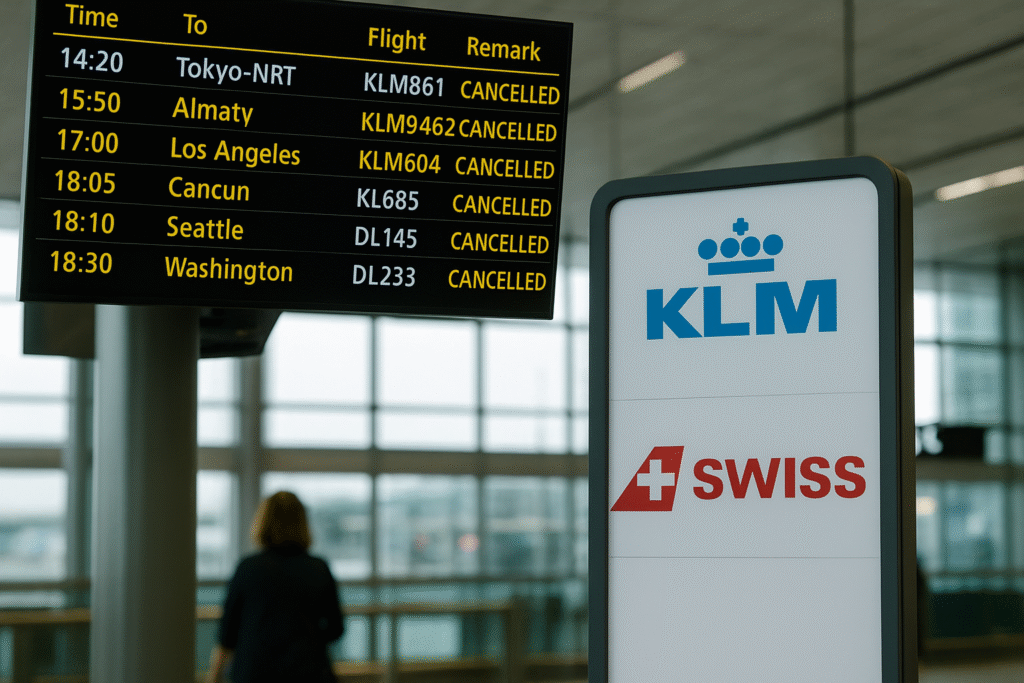
KLM Royal Dutch Airlines and Swiss International Air Lines have caused widespread travel chaos after canceling key flights on routes from Los Angeles, Almaty, and Geneva. The sudden cancellations, attributed to operational reasons, left hundreds of passengers stranded and many others facing hours—sometimes days—of delays.
These disruptions come at a time when global air travel demand is soaring, testing the resilience of airlines already strained by crew shortages, maintenance delays, and increasing passenger volumes. The affected travelers expressed frustration over limited rebooking options and inconsistent communication from airline staff.
KLM’s Flight Cancellations and Their Impact
KLM Royal Dutch Airlines canceled three major flights, impacting international travelers heading to and from Amsterdam.
- Los Angeles (KLAX) to Amsterdam (AMS) – Flight KLM604 was canceled on Saturday, disrupting travel for hundreds of passengers booked on the Boeing 787-9 Dreamliner.
- Almaty (ALA) to Amsterdam (AMS) – Flight KLM9462 was canceled on Sunday, leaving many travelers stranded in Kazakhstan.
- Amsterdam (AMS) to Tokyo Narita (NRT) – Flight KLM861 was canceled due to aircraft and crew availability issues, delaying passengers bound for Japan.
These cancellations caused ripple effects across the KLM network. Connecting flights faced delays as stranded passengers struggled to secure alternative travel options. Many travelers reported spending long hours at airports, waiting for updates or rebookings, with some forced to reschedule entire travel itineraries.
Swiss Airlines Faces Similar Operational Challenges
Swiss International Air Lines also faced operational issues, leading to the cancellation of a domestic flight from Zurich to Geneva (Flight SWR2816). The aircraft, a Bombardier CS300, was grounded on Sunday evening due to staffing and scheduling problems.
This cancellation affected several connecting flights, increasing travel times for many passengers across Europe. Some travelers were redirected through alternative hubs like Munich and Frankfurt, extending their journeys by several hours.
Swiss Airlines faced criticism for its communication lapses, with passengers reporting a lack of timely updates and limited rebooking support during the disruption.
Reasons Behind the Widespread Disruptions
The cancellations by KLM and Swiss Airlines highlight broader operational challenges affecting the global aviation industry. Multiple factors have converged to create a perfect storm for airlines:
- Staff Shortages: The industry continues to face shortages of pilots, cabin crew, and ground staff. Many employees left the aviation sector during the pandemic, and airlines are still struggling to rebuild full teams.
- Maintenance Delays: Increased flight demand has stretched maintenance schedules. Delays in aircraft repairs and safety checks have forced airlines to ground planes unexpectedly.
- Air Traffic and Weather Challenges: Congested airports and adverse weather conditions in Europe and North America have also led to last-minute cancellations and rerouting.
According to aviation authorities, these operational hurdles have led to thousands of canceled flights across Europe in recent months. The rising demand for travel, coupled with limited staff and infrastructure, continues to strain airline operations.
Global Airline Disruption: A Growing Concern
KLM and Swiss Airlines are not isolated cases. Other major airlines like British Airways, Lufthansa, Delta, and United Airlines have also struggled to maintain stable schedules amid surging passenger numbers.
In Europe, many carriers are adjusting flight frequencies and crew schedules to manage the strain. Meanwhile, U.S. airlines have reported record passenger volumes but are hampered by similar operational issues.
Industry experts note that these problems could persist into 2026 unless airlines significantly increase staffing, upgrade fleet management systems, and improve communication with passengers. The International Air Transport Association (IATA) has urged airlines to enhance contingency planning to avoid large-scale disruptions.
Passenger Frustration and Communication Breakdown
Travelers affected by the cancellations have expressed frustration over what they describe as a lack of transparency. Many passengers reported learning about cancellations only at the airport, with few receiving advance notifications.
Social media has been flooded with posts under hashtags such as #KLMChaos and #SwissAirDelay, as stranded travelers share their experiences. Some passengers noted that customer service hotlines were overwhelmed, making it difficult to get assistance.
Families on holiday, business travelers, and those on connecting flights faced added stress, as many were forced to pay extra for hotel stays or alternative routes.
Calls for Better Contingency Planning
The aviation industry is under pressure to adapt to evolving challenges. Experts suggest that airlines should prioritize:
- Enhanced Staffing Plans: Recruiting and retaining trained staff is essential to prevent future cancellations.
- Improved Communication: Passengers expect timely updates and assistance during disruptions.
- Investment in Infrastructure: Airports and airlines must expand operational capacity to meet rising travel demands.
Government regulators are also urging airlines to improve passenger compensation policies. European Union air travel regulations require carriers to reimburse passengers for cancellations under most circumstances unless they are due to extraordinary factors like extreme weather.
Outlook: Recovery in Progress but Challenges Persist
Despite the ongoing disruptions, global air travel continues to rebound strongly. The World Tourism Organization (UNWTO) recently reported that international travel has reached nearly 90% of pre-pandemic levels. However, the strain on airlines remains significant as they attempt to balance demand with limited operational capacity.
KLM and Swiss Airlines’ recent cancellations are a reminder that the aviation industry’s recovery, while promising, is still fragile. Passengers planning upcoming trips are advised to monitor flight schedules closely and allow extra time for connections.
As the industry moves forward, greater transparency, stronger operational planning, and better passenger care will be key to rebuilding traveler confidence and ensuring smoother journeys across international routes.
For more travel news like this, keep reading Global Travel Wire