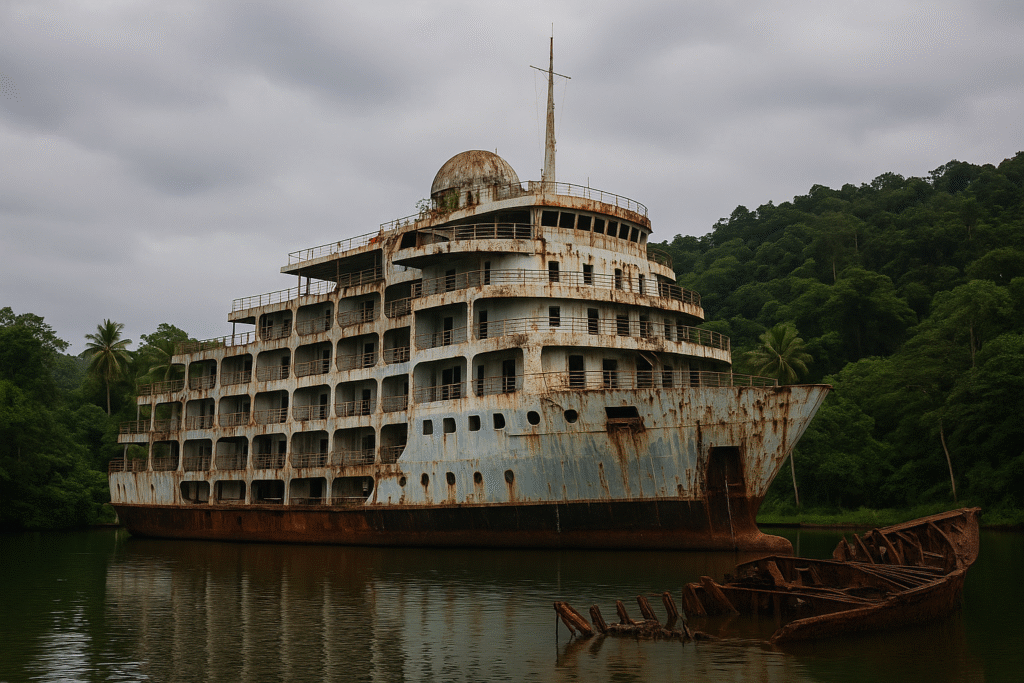
On the lush island of Koh Chang in Thailand, once stood a marvel of ambition and luxury: a seven-storey floating hotel known as The Galaxy. Nestled in dense jungle surroundings and anchored in a lagoon near the sea, the structure promised a novel version of tropical indulgence. Over time however, it succumbed to a mix of financial troubles, environmental challenges and local lore—leaving behind a haunting relic of what might have been.
A Grand Vision
The hotel began with high expectations. Built around a ship formerly used by the U.S. Navy and later acquired with the intention of conversion into an extraordinary resort, The Galaxy was designed to host guests in style. The structure featured opulent rooms, chandeliers, plush carpeting, meeting areas, and a restaurant that spanned the upper floors with views of jungle and sea alike. It was positioned as a one-of-a-kind experience—luxury afloat in an island setting.
In its early years, potential guests flocked to the site. Tourists visiting Koh Chang found in The Galaxy a dramatic alternative to conventional beachfront stays: stay inside what felt like a cruise ship moored in tropical foliage, combine comfort with adventure, and enjoy a sense of exclusivity in a place off the beaten path.
The Golden Era and Early Success
During the late 1990s and early 2000s the resort moored around The Galaxy achieved enough recognition to be a unique draw for island visitors. With its seven decks housing roughly two hundred guest rooms, and dedicated meeting and dining levels below, the sensation of staying in a floating hotel amused and enchanted many. The property boasted a mix of bungalows, ship-based rooms and villa-style accommodation, presenting itself as both an island escape and an exotic stage.
The resort marketed itself as five-star, prompting comparisons to cruise-liner opulence, yet grounded in a secluded tropical lagoon. For a time, it delivered a rare travel experience – combining mammoth ship-scale architecture with jungle setting and private lagoon access.
Cracks in the Picture: Location and Logistics
Yet the very qualities that made The Galaxy special also planted the seeds of its difficulties. Being situated in a humid, tropical environment meant serious maintenance demands: heat and moisture easily corrode metal, rust can accelerate, and the logistics of keeping a ship-hotel safe and comfortable in a jungle lagoon are more complex than seaside flats on firm ground. Guests reportedly complained of oppressive humidity, insufficient ventilation, insect infestation, and mosquitoes carrying diseases such as dengue or malaria—common challenges on tropical islands.
Operational costs for such a unique structure were enormous. The sheer footprint of a former navy vessel repurposed for luxury hospitality required considerable upkeep. The land-based lagoon channel, the floating bungalows, the large sail-ship-type architecture—all combined into a complex that was expensive to sustain, especially when competing destinations offered simpler, lower-cost stays under palm trees.
Financial Collapse and Sudden Closure
By around the early 2010s, the resort’s financial pressures forced the hotel to cease normal operations. What began in luxury ended in abandonment. The Galaxy was locked up, while still drawing curiosity from those intrigued by its ghost-ship status. Visitors began arriving not as guests inside plush rooms, but as explorers of rusting corridors and peeling décor.
It became clear that the dream had failed to match the market realities. The cost burden, the environmental burdens, and perhaps an under-estimation of the niche appeal all combined to create unsustainable operations. The hotel remained shuttered, yet not completely forgotten.
Folklore, Curse and Local Legend
Beyond financial and technical challenges, The Galaxy became wrapped in layers of local legend. One narrative holds that the removal of a sacred banyan tree during construction angered local spirits and disrupted elephant habitats in the area. Thailand’s cultural reverence for elephants and sacred trees gave rise to stories of a curse: unexplained accidents, worker illnesses, and a persistent sense of wrong-doing allegedly haunted the site. Some locals say that after the tree was cut, wild elephants ceased to roam freely nearby, and strange mishaps began to accumulate.
While these stories cannot be verified in strict legal terms, they gained traction among urban explorers and travel bloggers. The abandoned hotel acquired the moniker “ghost ship” of Koh Chang, a fitting label for a stranded luxury vessel turned derelict.
A Blaze and Final Demise
In December 2024 a devastating fire swept through the structure. Flames spread rapidly—driven by wind and the deteriorated materials of the ship-hotel—with emergency workers struggling to contain the blaze. The cause remains officially undetermined. The damage was extensive: by mid-2025 much of the upper structure had been dismantled, cut up and scrapped. Only the hull remained, a charred skeleton of the ambitious project.
Following the fire and dismantling, the site’s future became even more uncertain. The once-shining icon of tropical luxury now serves as a cautionary tale of ambition meeting harsh realities in an unforgiving environment.
Legacy: A Sight for the Curious Traveler
Today The Galaxy stands in the memory of Koh Chang as part myth, part ruin. For adventurous visitors, its decaying decks and rust-eaten hull offer a slice of urban-exploration travel: eerie, photogenic, and laden with stories. It reminds us that even the grandest projects can collapse under environmental, financial and cultural pressures.
The floating hotel that promised luxury in the jungle is now reclaimed by nature and time. Jungle vines snake around metal frames, paint peels in humid air, and the quiet lagoon laps against the hull of a vessel that never fulfilled its destiny.
For tourists planning a visit to Koh Chang, The Galaxy offers both a sense of discovery and a reminder: check local access rules—parts of the property may still be restricted—and approach with respect for both the environment and local culture. The story of The Galaxy is not just one of decay, but of the intersection between dream, nature and local tradition.
From its stunning inception to its ignominious decline, The Galaxy remains a compelling chapter in Thailand’s tourism history. It warns future resort-builders: the dream may be grand, but success in tropical settings demands more than novelty—it demands adaptation, sustainable support and respect for local context.
For more travel news like this, keep reading Global Travel Wire