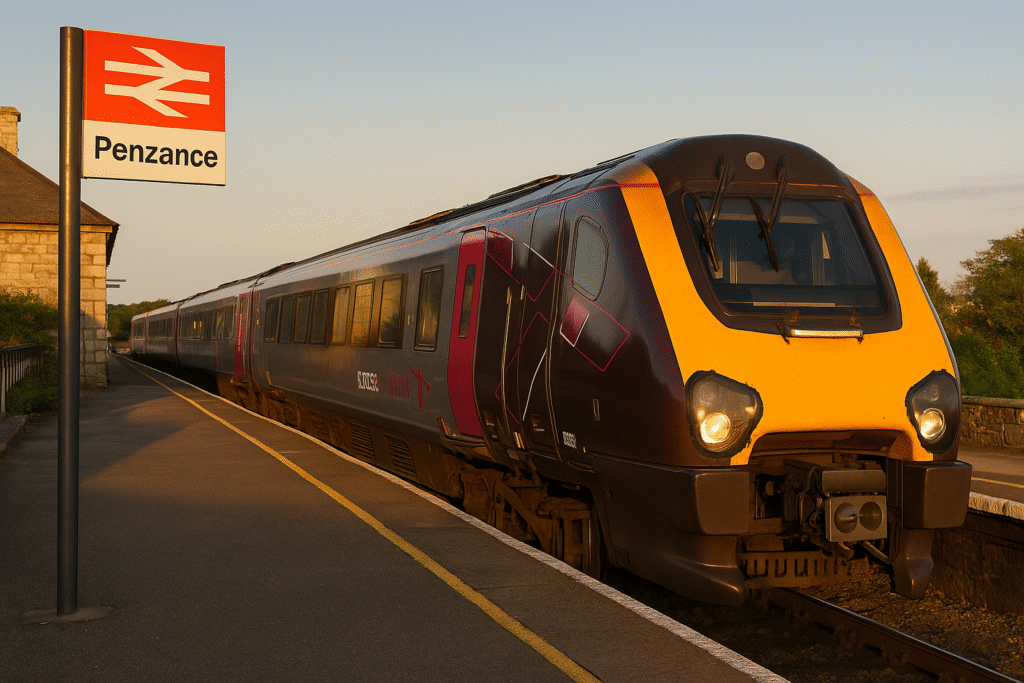
Britain’s most iconic long-haul train journey has made its final journey. The direct service linking Aberdeen in north-east Scotland to Penzance on the Cornish coast has been discontinued, drawing the curtain on more than a hundred years of continuous service and marking a significant moment in UK rail history.
The route, operated by CrossCountry, spanned approximately 774 miles and took around 13 hours and 20 minutes from start to finish. Along the way it made 35 to 36 scheduled stops, passing through major hubs including York, Bristol, and Truro while offering some of Britain’s most memorable scenery—from Scottish moors to Devon cliffs and Cornish coastal vistas.
A storied route built on tradition
Originating in 1921, this direct train service offered a unique way to traverse Britain end-to-end by rail. For many travellers, it was more than just transport—it was an experience of the country’s breadth and diversity: the highlands of Scotland, the Midlands of England, the sea wall at Dawlish, and the Cornish coast near Penzance. Railway enthusiasts documented bucket-list trips on the route precisely because of its continuous nature and length.
Despite its romantic appeal, the journey faced modern challenges. Train operators cited punctuality issues, resource demands, and the fact that only a small fraction of passengers travelled the full distance. Many used only segments of the route rather than committing to the full-length voyage.
The final run and the legacy
The last direct service departed Aberdeen at 8:20 am on 16 May 2025, arriving in Penzance at approximately 9:31 pm that evening. After that date, the route was shortened, with the direct leg ending at Plymouth rather than continuing to Cornwall’s tip. While services still connect northern Scotland to the south-west, the continuous journey from Aberdeen to Penzance is no longer available.
Passengers on the final day included rail-fans and travellers keen to mark the end of an era. Among them the mood was part tribute, part nostalgia. For decades the journey stood as a symbol of Britain by rail—a moving window into almost the entire length of the island nation.
Why was it discontinued?
The decision to end the full route was driven by a mix of operational and economic factors. Reliable performance on a 13-hour journey covering so many miles and stops proved demanding. Service disruptions, crew logistics and lengthy timetable windows made the operation less sustainable in today’s rail-service environment. Additionally, the operator noted that the vast majority of travellers did not ride the full length, but rather boarded or disembarked along the way, reducing the justification for maintaining such a long single-train connection. By truncating the route, CrossCountry claimed it could deliver a more efficient timetable, better crew utilisation and improved service for shorter sector travellers.
What this means for travel in the UK
With the discontinuation of this route, the title of “UK’s longest direct train journey” passes to another service: the overnight Caledonian Sleeper from London Euston to Fort William in Scotland, which covers around 500 miles in roughly 12½ hours. While that journey retains the long-distance feel, it lacks the comparable end-to-end north-to-south sweep of the former Aberdeen-Penzance link.
For tourism and rail-travel enthusiasts, the loss of the full Aberdeen-Penzance route marks a change in how Britain’s long-distance train experiences are framed. The opportunity to take a single train from Scotland’s northeast to Cornwall’s far southwest in one unbroken ride has ended, shifting focus toward changing-train itineraries and segmented adventures.
A scenic journey for the ages
When operating in full, the route offered one of the UK’s most varied rail landscapes. Starting among the granite buildings of Aberdeen, it passed through rural Scotland, crossed the Scottish border, entered the English heartlands, skirted the Severn estuary and the Cotswolds, threaded past historic cities, hugged coastlines in Devon, and finally reached the far tip of Cornwall. Highlights included the exposed sea wall at Dawlish, the dramatic Royal Albert Bridge at Saltash, and the gentle rolling pastures of Somerset and Yorkshire. It held a special place for those who prioritised journey over destination.
The nostalgia factor
For many railway fans this route was a pilgrimage of sorts—a “once in a lifetime” train ride. The length and continuity, combined with changing landscapes and the physical time spent on board, created a narrative that resonated with slow-travel ideals. With its end, there is a sense of loss for what was more than transport: the idea of rail as a journey across a nation.
What lies ahead for travellers and routes
Though the direct service between Aberdeen and Penzance has ended, the story of Britain’s long-distance rail travel is far from over. The future will likely feature targeted long-haul services, enhanced routes, connections with scenic rail experiences, and greater integration of rail within tourism strategies. For travellers still wanting a protracted rail experience, Scotland and Cornwall remain accessible—with connections and breaks built in to piece together multi-day rail adventures.
Conclusion: Reflecting on a rail milestone
The end of the Aberdeen to Penzance direct train marks more than a timetable change—it closes a chapter in British rail romance. The route connected two far ends of the country, wove through nature and history, and offered travellers a genuine deep dive into Britain’s geography from seat to seat. While modern rail operations prioritise efficiency and segment-specific services, the memory of this nearly 13-hour train ride will live on in the hearts of those who rode it, documented it or dreamed about doing so. For UK rail travel, it stands as a reminder of the power of the journey itself—and the collective value of slowing down, signalling “All aboard,” and riding from one coast to the other.
For more travel news like this, keep reading Global Travel Wire