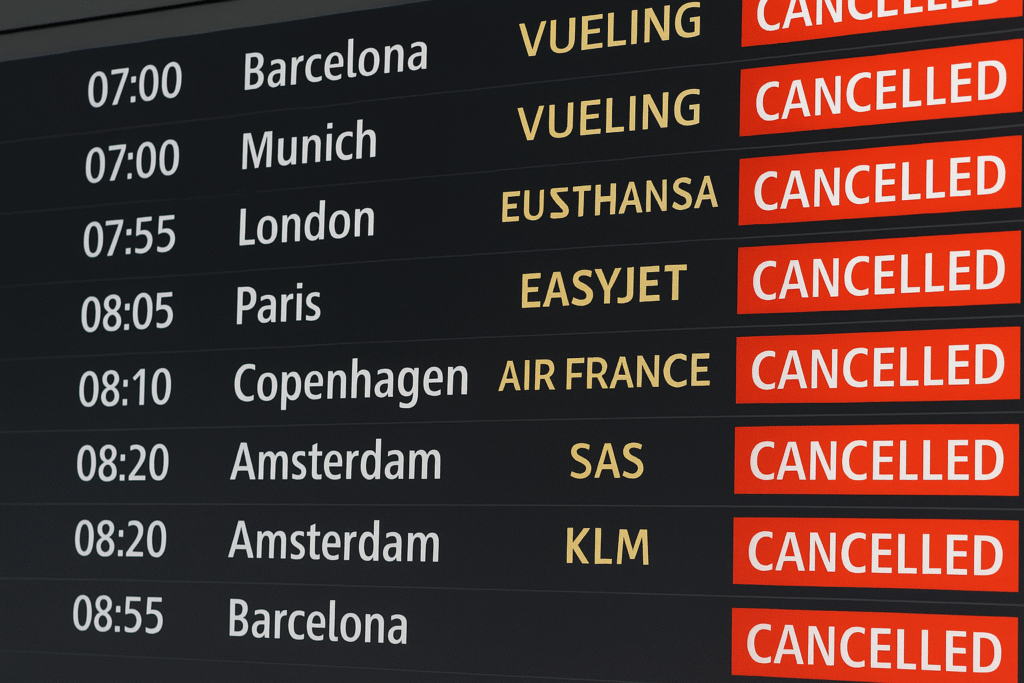
Thousands of passengers across Europe face major travel disruption as airlines cancel and delay hundreds of flights. Carriers including Vueling, Lufthansa, easyJet, Air France, SAS, and KLM have collectively cancelled 56 flights and delayed over 2,000, affecting major airports in Spain, Germany, the UK, France, Denmark, and the Netherlands.
The cancellations and delays have left travelers stranded at some of the continent’s busiest hubs, including Barcelona, London Heathrow, Paris Charles de Gaulle, Copenhagen, and Amsterdam Schiphol. This latest wave of disruption underscores the ongoing strain on Europe’s aviation system, driven by operational challenges and surging passenger demand.
Thousands Stranded Across Europe
Europe’s busiest air corridors are now grappling with long queues, missed connections, and rebookings. easyJet and Vueling account for most of the disruptions, with hundreds of delayed flights across Spain, France, and the UK. At the same time, major carriers such as Lufthansa and Air France are also reporting widespread delays at core airports like Munich and Paris.
In total, 56 flights have been cancelled across all major airlines and 2,092 delayed, affecting an estimated 150,000 travelers. The timing of the disruption—during the busy autumn travel season—adds further pressure to airports already operating near capacity.
Airline Breakdown: Who’s Most Affected
- easyJet: Recorded 706 flight delays and six cancellations. London Gatwick, Amsterdam, and Barcelona saw the heaviest congestion.
- Vueling Airlines: Cancelled ten flights and delayed 168, mostly across Spain and Italy.
- KLM: Delayed 327 flights and cancelled four, with Amsterdam Schiphol among the worst hit.
- Lufthansa: Reported 279 delays and four cancellations across German routes, particularly affecting Munich and Frankfurt.
- Air France: Recorded 250 delays and four cancellations at Paris Charles de Gaulle and Orly.
- SAS and KLM: Experienced additional disruptions at Copenhagen and Amsterdam, extending the impact into Scandinavia.
Operational issues, air traffic congestion, and staffing constraints appear to be the main causes behind the disruptions.
Airports Under Strain
The scale of disruption extends across Europe’s major airports. Barcelona, Amsterdam, Paris, and London continue to face long delays. Amsterdam Schiphol alone recorded over 300 delayed departures and several cancellations, while Barcelona International faced nearly 180 delays.
Frankfurt and Munich also reported heavy backlogs as airlines struggled to realign schedules. At Paris Charles de Gaulle, hundreds of passengers spent hours in queues for rescheduled flights. In Copenhagen, delays rippled across Nordic routes, disrupting connections to Oslo and Stockholm.
These cascading effects are likely to persist into the coming week, as delayed aircraft and crew rotations continue to affect operations.
Regional Highlights
Spain:
Barcelona International remains among the worst affected airports. Vueling’s network saw widespread delays, leaving passengers waiting hours for updates. Malaga and Madrid also experienced minor disruptions as aircraft rotation schedules fell behind.
Germany:
Munich and Frankfurt are struggling to recover from delays tied to Lufthansa and Air France codeshare routes. Many domestic connections to Berlin and Hamburg were rescheduled or merged to ease congestion.
France:
Air France continues to face pressure at both Charles de Gaulle and Orly, with over 300 combined delays. Travelers connecting through Paris reported missed international flights due to late arrivals.
United Kingdom:
easyJet’s delays at London Gatwick and Heathrow caused significant disruption for short-haul routes to Spain and Italy. Many passengers opted for alternative routes via regional airports such as Manchester and Birmingham.
Scandinavia and the Netherlands:
Copenhagen Airport reported almost 50 delays tied to SAS operations, while Amsterdam Schiphol remains one of the most congested in Europe. KLM’s large route network magnified the disruption, impacting travelers across multiple countries.
Traveler Experiences and Airline Responses
Travelers described long waits, lack of communication, and frustration with rebooking options. Many stranded passengers sought overnight accommodations as delays stretched into hours. Airlines have deployed additional staff at ticket counters and call centers to handle the surge in inquiries.
Some airlines, including Lufthansa and Air France, are offering free rebooking or refund options. easyJet and Vueling have issued advisories urging passengers to check flight statuses frequently before heading to the airport.
Airport operators are coordinating with air traffic authorities to improve runway availability and manage passenger flow more efficiently.
Tips for Affected Travelers
- Check flight status frequently: Use airline apps and airport websites for live updates.
- Arrive early: Allow extra time for check-in and security due to longer queues.
- Book flexible tickets: Choose options that allow refunds or changes.
- Stay informed: Follow airline social media accounts for quick alerts.
- Plan alternative routes: Consider nearby airports or train options if flights are disrupted.
Broader Implications for European Travel
The scale of this week’s disruptions highlights deeper challenges in Europe’s aviation sector. Airlines are still managing post-pandemic staffing shortages while handling record passenger numbers. Combined with unpredictable weather and ongoing airspace congestion, even small operational issues can create continent-wide ripple effects.
Industry analysts expect intermittent disruptions to continue through the winter as carriers fine-tune schedules and governments work to ease pressure on air traffic systems.
Conclusion
Europe’s air travel network remains under strain as 56 flights are cancelled and more than 2,000 delayed across key hubs. Passengers traveling through London, Paris, Amsterdam, Barcelona, and Munich should brace for continued delays and stay flexible with travel plans.
Despite the chaos, airlines and airports are working around the clock to restore stability. The coming days will be crucial in determining how quickly Europe’s aviation system can recover and keep millions of travelers moving safely and efficiently.
For more travel news like this, keep reading Global Travel Wire