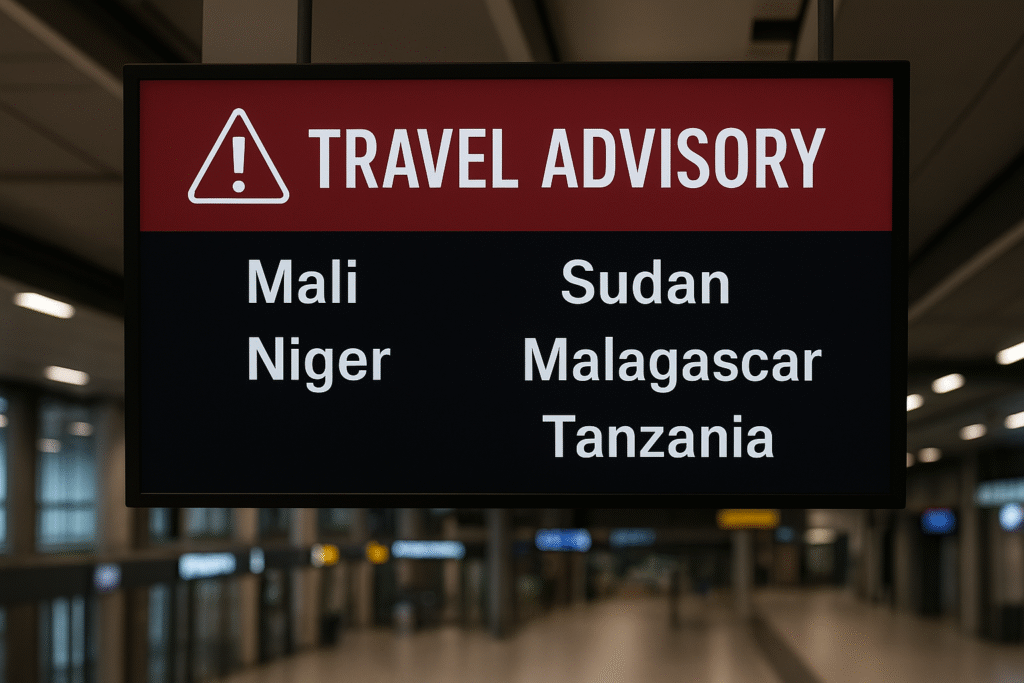
The U.S. Department of State has updated its travel advisory for several African countries, citing worsening security, political unrest and violent crime. The changes reflect heightened concern for tourists and foreign visitors in regions experiencing rapid deterioration.
Officials stress that in destinations flagged as high-risk, travel is more dangerous and governments may have limited capacity to assist.
Sahel Under Pressure: Mali and Niger
Two West African nations, Mali and Niger, are at the centre of the advisory shift. Ongoing insurgencies, militant activity and weak institutional control have severely disrupted stability.
Mali’s long-running conflict and extremist operations have forced diplomatic staff withdrawals and a near-total breakdown of security in large areas. In Niger, remote regions are increasingly lawless, and travellers are warned to avoid non-capital zones.
The advisory places these nations in the highest category for “Do Not Travel” guidance, stressing that staying or entering these countries involves significant risk.
Sudan’s Deepening Crisis
Sudan remains immersed in a severe humanitarian and political emergency. Fighting between military and paramilitary forces has displaced millions, disrupted vital services and made access to safety and aid unpredictable.
The travel update highlights that the U.S. government has limited ability to assist foreign nationals in Sudan, underpinning the “Do Not Travel” classification. Travellers are urged to reconsider any trip amid the volatile environment.
New Concerns for Madagascar and Tanzania
Beyond the Sahel, the advisory shifts also include island and coastal states. In Madagascar, rising civil unrest, crime and protests have tarnished its tourism brand. Incidents of violence, looting and spontaneous demonstrations now pose threats to visitors.
In Tanzania, authorities cite increasing political tension, reports of targeted harassment and isolated violence—especially in border and remote areas. While the country still attracts safari and beach tourism, unchecked risks have prompted a call to exercise greater caution. These two nations are now under the “Reconsider Travel” category.
What the Advisory Levels Mean
Travel warnings follow a four-tier system:
- Level 1: Exercise normal precautions
- Level 2: Exercise increased caution
- Level 3: Reconsider travel
- Level 4: Do Not Travel
These levels reflect assessments of crime, terrorism, civil unrest, kidnapping, health systems and the U.S. government’s capacity to provide support. A Level 4 advisory signals life-threatening risk and limited or no U.S. consular assistance.
Travellers to high-risk destinations are urged to enrol in the Smart Traveller programme, share travel plans, carry emergency funds and prepare evacuation options.
Implications for African Tourism
The enhanced advisories underscore a broader shift in Africa’s security landscape. Regions once considered safe are now challenged by overlapping threats: extremist activity, organised crime, fragile governance and spill-over from neighbouring conflicts.
For tourism-dependent economies, the warnings may lead to cancellations, steep losses and heightened reputational risk. Governments and industry stakeholders must redouble efforts on security, visitor communication and crisis management to rebuild confidence.
Safety Advice for Travelers
Even where travel is not officially banned, visitors should:
- Monitor local news and embassy alerts for security updates
- Avoid demonstrations, remote border zones and sudden gatherings
- Travel during daylight, stay in reputable accommodations, and limit exposure in unstable regions
- Secure comprehensive travel insurance covering medical evacuation and unexpected disruptions
- Maintain communication lines with family, use location sharing and register with your embassy if available
The Road Ahead: Governance & Global Response
The elevated travel warnings serve as a global signal: stability in many parts of Africa is under severe strain. Reversing this trend requires robust governance, regional security cooperation and greater investment in rule-of-law institutions.
Tourism authorities must partner with security agencies to protect visitors, enhance infrastructure and promote destinations carefully. Until these conditions improve, travellers are best advised to scrutinise itineraries and opt for known safe zones.
As the travel advisory takes effect, the delicate balance between tourism opportunity and personal safety remains in flux. For those considering a trip to Africa, diligent research, flexible planning and real-time vigilance are more important than ever.
For more travel news like this, keep reading Global Travel Wire