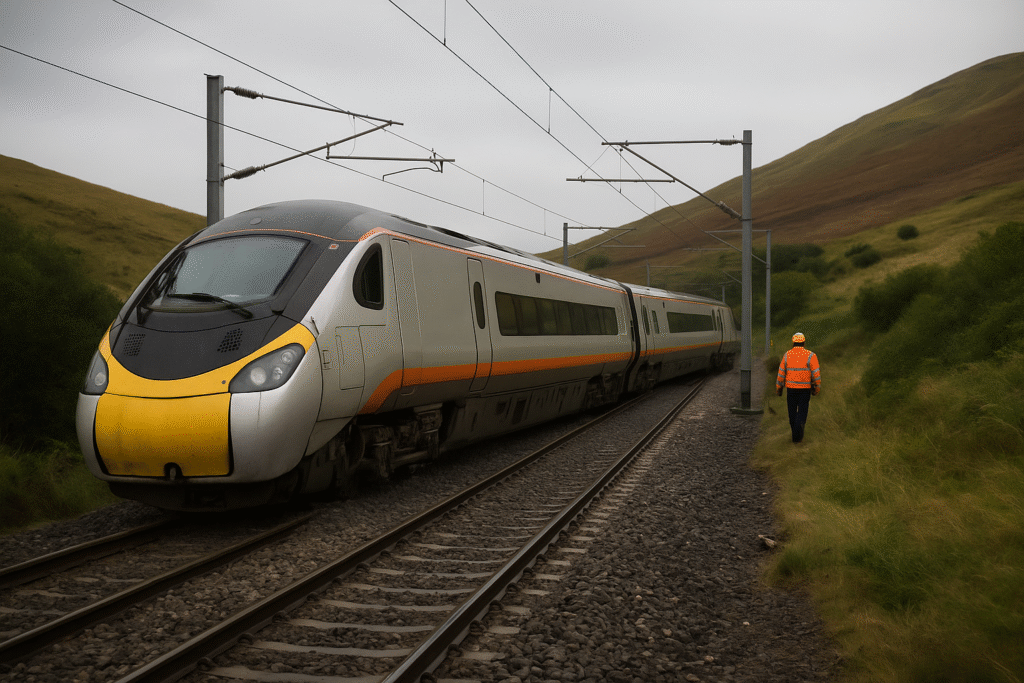
A serious rail incident early Monday morning has thrown the UK’s rail network into turmoil and raised concerns across the tourism sector. At 06:10 am on 3 November 2025, the 04:28 am service operated by a major train company travelling from Glasgow to London derailed near the village of Shap in Cumbria, on the busy West Coast Main Line. All tracks north of Preston are blocked, creating widespread disruption that is affecting commuters, holiday-makers and local tourism businesses alike.
The 11-carriage train struck what is thought to have been a landslide or track obstruction as it ascended the summit near Shap, a notoriously vulnerable part of the route. The lead carriage derailed and came to rest upright, while the remaining vehicles were brought to a safe stop. Emergency services swiftly declared a major incident and began evacuating 86 + passengers and ten crew members. Four people sustained only minor injuries and none required hospital treatment. Within a few hours, all travellers and staff were safely removed and taken to a nearby hotel for care and onward transport.
Rail company statements confirmed that the derailment occurred at around 6.10 am and that the forestalled priority was the safety and wellbeing of all onboard. The operator now warns of “significant disruption” lasting for “a number of days”, and has issued a strong “do not travel” advice for all routes north of Preston. Alternative rail and road services are being arranged where possible, but the closure of one of the UK’s most crucial north–south rail arteries will have an immediate impact.
For the UK tourism industry, the timing couldn’t be worse. The West Coast Main Line carries both domestic travellers and international visitors bound for the scenic landscapes of the north of England and Scotland. Regions such as the Lake District in Cumbria, famed for their natural beauty and widely accessed by train, are now facing a sudden transport bottleneck. Visitors already in the region may face delayed departures and reduced onward travel options, while many potential tourists may postpone or cancel plans altogether. Local hotels, guesthouses, tour operators and hospitality venues are bracing for lower footfall and higher uncertainty.
Commuters and travellers heading to Scotland, northern England, or from the London–Midlands corridor are advised to check their travel plans carefully. Major operators such as the national rail network have alerted passengers that no services will run between Preston and Carlisle until further notice. Replacement buses and alternative routing are being arranged, but passengers should expect vastly increased journey times and possible cancellations. Those with non-essential travel north of Preston are strongly encouraged to postpone their journey.
On the ground, the response has been well-coordinated. The train driver is being credited with swift action under difficult weather and terrain conditions, helping bring the train to a safe halt despite travelling at around 80 mph when the incident occurred. Infrastructure officials have confirmed that the train design held up well, but have also emphasised that investigations into the derailment and the cause of the obstruction are ongoing. A specialist rail-accident investigating body will examine track condition, earthwork stability, weather data and warning systems in the affected zone.
The suspension of the West Coast Main Line has knock-on effects beyond immediate passengers. Rail-based tourism, scenic rail journeys, and connections to remote areas are all disrupted. Visitors travelling to top-tier attractions such as Hadrian’s Wall, the Lake District mountains, and the Scottish Highlands are now facing fewer train options or longer transfers. Tourism operators in Cumbria are already alerting guests about possible delays, offering flexible bookings and advising alternate road travel.
Recovery efforts are underway but remain uncertain. While engineering teams and rail infrastructure experts have mobilised, the severe nature of the terrain and the extent of the landslip-affected zone mean service restoration may take several days or more. Until the line reopens, substitute buses, longer train routes, or even entirely different transport modalities will be the norm. Passengers are advised to remain alert for updates, allow extra time for their journeys, and keep their booking options open.
In the broader context, this derailment raises questions about resilience of key rail corridors in the face of severe weather and ground movement. The Shap summit area is the highest point on the West Coast Main Line and has historically been susceptible to landslips and extreme weather. Infrastructure managers will likely face renewed scrutiny of earth-works, drainage systems, slope monitoring and early-warning protocols. In turn, the tourism sector is learning once again how critical reliable transport links are to visitor flows, revenue and destination reputation.
For tourists who had planned rail-journeys through Cumbria or beyond, the message is clear: re-evaluate travel plans, explore alternative routes (including road or bus services), and keep abreast of transport updates. Those already booked in the Lake District or northern Britain may wish to consult their accommodation providers about flexibility. While the derailment has fortunately produced no serious injuries, the disruption it creates can be just as significant for travel experiences and regional destinations.
In summary, the train derailment near Shap has caused major travel disruption across one of the UK’s most vital rail routes, with immediate consequences for tourism and passenger travel. As emergency teams work around the clock to restore services, both travellers and tourism operators must adapt quickly. The resilience of transport infrastructure and its role in enabling tourism have rarely been more apparent.
For more travel news like this, keep reading Global Travel Wire