The coastal town of Paradip in Odisha is on the verge of a sweeping transformation, setting the stage for its emergence as an integrated hub for tourism, trade and clean energy. In a recent major announcement, the state government revealed plans for a green-field airport, a cruise terminal along the Mangala River and a dedicated green hydrogen hub, all anchored in an ambitious regional development strategy. These infrastructure developments will be supported by the neighbouring cities of Bhubaneswar and Cuttack, turning the region into a unified growth corridor for tourism, industry and sustainable innovation.
Paradip: From Industrial Port Town to Tourism Gateway
Paradip has long been known as a key maritime and trade centre along India’s east coast, with a deep-water port and industrial base. But now the vision extends far beyond trade: the region is being repositioned to welcome travellers too. Paradip’s beach area at the confluence of the Mahanadi River and the Bay of Bengal already draws nature lovers for its wide sandy stretches, rich forest backdrop and marine estuary views. With the latest tourism-infrastructure proposals, the region aims to elevate its appeal and accessibility for domestic and international visitors alike.
Transformative Projects Underway
Chief Minister Mohan Charan Majhi unveiled major investment plans during a marquee maritime-heritage event, setting out three headline projects for Paradip:
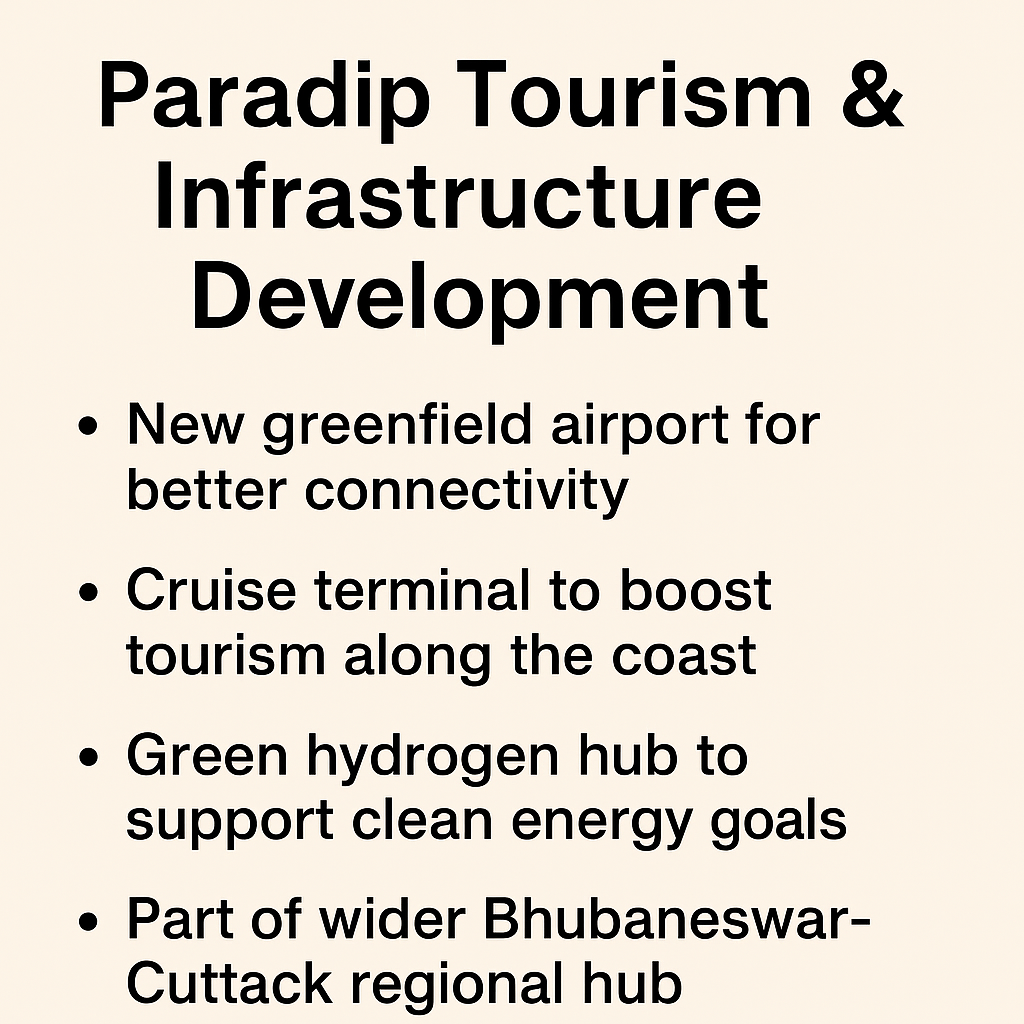
- Green-field airport: This new airport will enhance connectivity for business and leisure travellers, making Paradip far more accessible.
- Cruise terminal on the Mangala River: Positioned to attract cruise ships and recreational vessels, this terminal will open the region’s coastline to immersive visitor experiences and new tourism flows.
- Green hydrogen hub: Under the national push for clean energy, Paradip is designated as a green hydrogen hub, signalling its role in India’s transition toward sustainable industrialisation.
The state government has allocated significant resources toward these developments, including a dedicated funding envelope for the cruise terminal project. The combined effect is a shift in Paradip’s identity—from purely industrial-port town to multi-functional gateway blending tourism, trade and green innovation.
Regional Connectivity: Bhubaneswar, Cuttack & Beyond
The development of Paradip is closely tied to a broader regional plan linking Bhubaneswar, Cuttack, Khurda, Jatni and Paradip itself, effectively creating a megacity-scale growth zone. This integrated approach means tourists arriving for beaches, heritage sites or industry-linked visits will also find enhanced services, better transport links and a richer regional experience. Bhubaneswar and Cuttack bring historical and cultural depth, while Paradip adds coastal and industrial-heritage texture.
Tourism Boost: Beaches, Heritage & Cruise Experiences
As infrastructure improves, tourism stands to benefit significantly. Paradip’s shoreline offers a quieter alternative to busier beach destinations, with scenic drives, forest-lined creeks and less-crowded vistas. The inclusion of a cruise terminal means visitors may soon embark on coastal cruises from Paradip, combining leisure with exploration of less-visited ports and estuarine landscapes. Local festivals tied to the region’s maritime heritage also provide cultural entry points for visitors, deepening the tourism story beyond sand and sea.
Sustainable Growth & Employment Opportunities
These infrastructure and energy projects bring strong economic benefits: construction, hospitality, transport and energy sectors will all see increased activity. Paradip’s designation as a green hydrogen hub positions it at the forefront of India’s clean-energy ambitions. Meanwhile, the airport and cruise terminal open pathways for new jobs in tourism, logistics and services. By combining tourism growth with industry and sustainability, the region is creating a diversified growth model.
Travel Tips for Early Visitors
- Visit the beach at Paradip to enjoy tranquil sands and estuarine views without heavy crowds.
- Explore the port area and marine aquarium, and take in sunset views along the marine drive.
- Pair your visit to Paradip with Bhubaneswar or Cuttack to experience heritage temples, local cuisine and regional culture.
- Keep an eye on evolving connectivity: while the new airport is under development, Bhubaneswar remains the key access point for now.
- For eco-tourism enthusiasts, this region offers potential for river cruises, nature walks and coastal exploration as the infrastructure grows.
Looking Ahead: What This Means for the Region
With these announcements, Paradip is set to occupy an increasingly strategic place in Odisha’s growth story. The convergence of tourism, industry and energy within the same geography creates a dynamic offering: visitors may find themselves on a cruise ship in the morning and visiting a green hydrogen innovation centre in the afternoon. The region’s rise offers a model for how coastal towns can pivot into multifaceted hubs.
For the Indian tourism industry, this moves beyond mere expansion of visitor numbers. It signals a shift toward deeper experiences, where travellers access industrial heritage, clean-energy innovation, port towns and coastal culture in one journey. The combined length of stay, diversity of attractions and connectivity enhancements will make the Paradip–Bhubaneswar–Cuttack axis a noteworthy tourism destination of the coming decade.
In Summary
Paradip’s transformation into a regional hub for tourism, green energy and integrated infrastructure opens a new chapter in eastern India’s development. With a new airport, cruise terminal and green hydrogen hub, supported by the region’s cultural heritage and natural assets, the region is poised to attract a new breed of visitor—those who seek scenic beaches, maritime experience and sustainable innovation in one trip. As Bhubaneswar, Cuttack and Paradip pull together into a cohesive growth zone, visitors and industry alike will find fresh opportunities and experiences unfolding in tandem.
For more travel news like this, keep reading Global Travel Wire