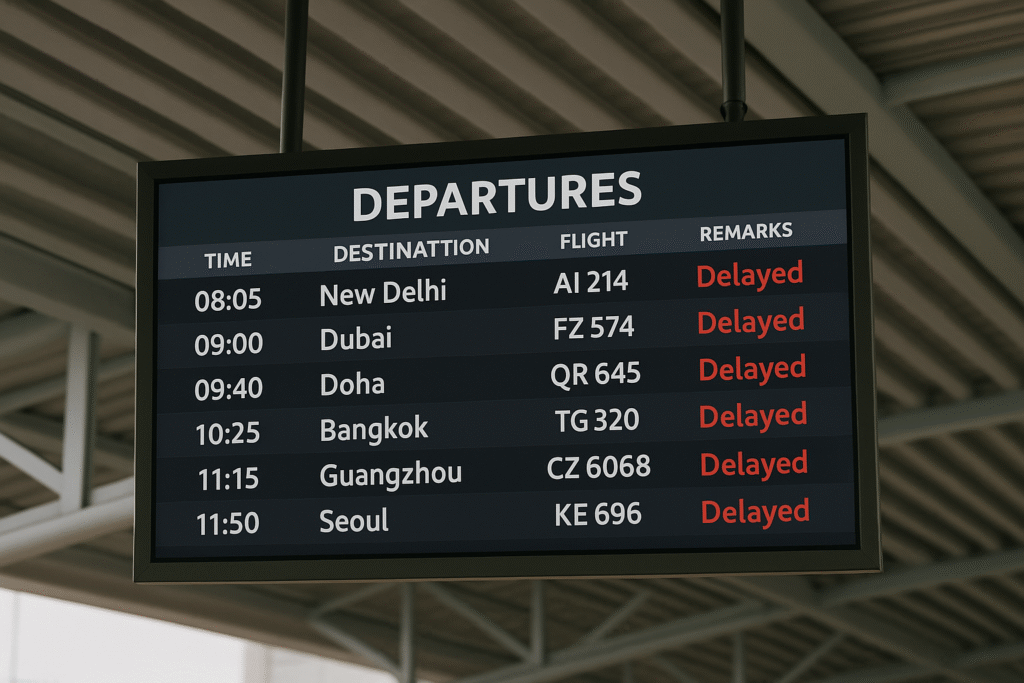
A major IT outage at Tribhuvan International Airport in Kathmandu has caused widespread travel chaos, leading to 134 flight delays across several major airlines. The disruption hit carriers including Qatar Airways, Air India, Air Arabia, Thai Airlines, Korean Air, and multiple China-based airlines. Passengers were left stranded for hours as the airport struggled to restore critical systems that manage flight operations, lighting, and communication.
Tribhuvan Airport is Nepal’s main international gateway and a key hub for South Asian air traffic. The outage exposed vulnerabilities in its air traffic management systems and highlighted the pressing need for modernization in regional aviation infrastructure.
Airlines Face Heavy Disruptions
The technical failure paralyzed flight schedules across both domestic and international routes. Airlines including Qatar Airways, Air India, and Korean Air faced long delays, while regional carriers like Buddha Air and Yeti Airlines experienced major disruptions to domestic schedules.
With the runway lighting system offline, all aircraft movements were temporarily suspended. This led to a backlog of flights waiting to depart or land, creating congestion at nearby airports as inbound planes were diverted.
The affected airlines scrambled to adjust schedules, manage rebookings, and accommodate passengers whose plans were derailed. Many travelers missed connecting flights to destinations such as Doha, Bangkok, Delhi, and Beijing.
Airlines reported that ground-handling teams and customer service counters were overwhelmed as thousands of passengers sought rebooking or overnight accommodations.
Regional and Global Impact
The outage at Kathmandu’s main airport had a cascading effect across South Asia and the Middle East. Flights linking Nepal with major hubs like Dubai, Doha, Bangkok, and Delhi suffered knock-on delays. Aircraft and crew rotations were disrupted, affecting operations in neighboring countries.
Qatar Airways and Air Arabia reported delays on their Middle East-bound routes, while Chinese and Korean carriers faced scheduling setbacks on flights connecting to Beijing, Shanghai, and Seoul.
For international travelers, the incident caused missed connections, lost bookings, and extended layovers. Many tourists visiting Nepal for trekking and mountaineering had to reschedule domestic flights to Pokhara and Lukla. Business travelers also faced major setbacks, as planned meetings and trade-related itineraries were thrown into disarray.
The ripple effects extended beyond Nepal, underlining how interconnected global aviation has become. Even a single failure in one regional hub can disrupt flight networks across continents.
The Root Cause: Technical and Infrastructure Challenges
Airport officials confirmed that a short-circuit in the runway and airfield lighting system triggered the failure. The issue not only shut down aircraft movement but also disabled critical monitoring systems.
Tribhuvan Airport operates with a single runway, making it highly vulnerable to disruptions. Any fault in its lighting or navigation systems can immediately halt operations. The lack of backup systems compounded the crisis, as air traffic controllers and maintenance teams had to revert to manual coordination.
This event revealed how overburdened Nepal’s aviation infrastructure has become. The airport handles millions of passengers annually but still relies on aging systems with limited redundancy. The outage underscores the urgent need for modernization and investment in aviation technology.
Airlines and Authorities Respond
After several hours of delays, technical teams restored partial operations, allowing limited aircraft movements to resume. However, full functionality was only restored later, leading to continued rescheduling and delays.
The Civil Aviation Authority of Nepal has launched an internal review to determine how such a critical system failure occurred. The agency plans to introduce new backup mechanisms and upgrade the airport’s electrical and IT infrastructure.
Airlines have also called for stronger coordination between airport authorities and carriers to improve communication during emergencies. Many travelers reported confusion due to limited announcements and poor information flow during the outage.
Passenger Experience and Travel Chaos
For travelers, the experience was frustrating and exhausting. Many were stranded at the airport overnight without clear updates or accommodations. Check-in counters became overcrowded, and long queues formed at customer service desks.
Tour operators catering to trekking groups and adventure tourists reported significant losses as pre-booked tours and hotel stays had to be rescheduled. Domestic tourism operators also faced cancellations and refund requests from travelers missing their connecting flights.
Despite the chaos, airport staff and airlines worked continuously to manage stranded passengers and restore order. Emergency lighting and manual check-in systems were used to keep limited services running.
The Broader Impact on Nepal’s Tourism Industry
Nepal’s tourism industry, already recovering from recent global travel disruptions, faces renewed challenges from this outage. Tribhuvan Airport serves as the primary entry point for international visitors. Any extended delay can significantly affect the flow of tourists, especially during peak travel seasons.
The country relies heavily on tourism linked to cultural, adventure, and religious travel. Thousands of trekkers, pilgrims, and mountaineers enter Nepal through this airport every month. The recent incident highlights the importance of infrastructure reliability in maintaining Nepal’s reputation as a world-class tourism destination.
Tourism experts stress that ensuring resilient airport operations will be key to sustaining growth. Strengthening systems at Kathmandu’s airport can help prevent similar disruptions in the future and restore confidence among international travelers.
Steps Toward Recovery and Future Preparedness
Authorities are now focusing on strengthening infrastructure and preventing similar failures. Plans include upgrading the airfield lighting network, installing new safety redundancies, and expanding communication systems.
Airlines are also reevaluating contingency plans to improve passenger handling during large-scale disruptions. Ground crews will receive enhanced training for managing unexpected outages.
The government of Nepal has emphasized that long-term investment in airport technology is essential to support growing passenger demand and sustain economic growth through tourism.
Conclusion
The massive IT outage at Tribhuvan International Airport serves as a stark reminder of the fragility of aviation systems in South Asia. With 134 flight delays impacting major airlines like Qatar Airways, Air India, and Air Arabia, the event disrupted travel across the region and inconvenienced thousands of passengers.
For Nepal, this incident underscores the importance of modernizing its aviation infrastructure and improving crisis management capabilities. With timely reforms and investment, the country can strengthen its position as a reliable gateway to the Himalayas and maintain its vital role in regional air connectivity.
For more travel news like this, keep reading Global Travel Wire