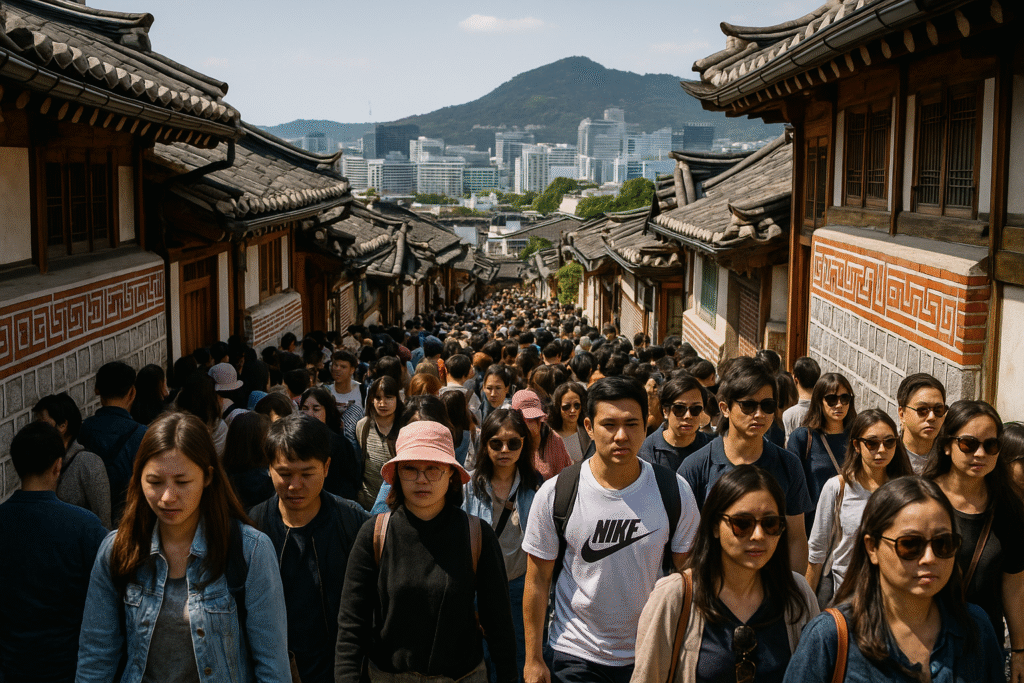
South Korea is facing a surge in foreign visitors in 2025. The country is on track to welcome more than 20 million international tourists this year, fueled by easing travel restrictions and renewed interest. Projections estimate inbound arrivals will hit around 20.09 million and generate roughly US $20.25 billion in tourism revenues.
Tourism hotspots such as Seoul and Jeju Island are now showing signs of strain — longer queues, crowded streets and pressure on local infrastructure.
Overtourism is no longer confined to one region; destinations around the world now share the same headache of balancing economic benefit with community wellbeing.
Understanding the Overtourism Challenge
Overtourism happens when visitor numbers outpace a destination’s capacity to manage them. Impacts include environmental wear, diminished resident quality of life and a drop in visitor experience.
Globally, cities listed as highest risk now track tourist-to-resident ratios and crowd density. The problem hits when the negative side outweighs the benefits.
In South Korea and elsewhere, the question is not just how many visitors, but how and where they travel and stay.
What South Korea Is Doing to Respond
In Seoul, international arrivals have already surpassed pre-pandemic levels — January 2025 welcomed over 900,000 tourists, a 27 % increase from January 2024.
Authorities are taking steps:
- Visitor caps and stricter regulation at key heritage and landmark sites.
- Promoting off-peak travel and redirecting tourists to lesser-visited regions such as Gangwon-do and Gyeongsang-do.
- Using data tools – for example the Korea Tourism Data Lab, which aggregates hundreds of public and private datasets – to monitor and manage tourism flows more intelligently.
These efforts aim to spread the benefits of tourism more evenly and reduce pressure on overvisited spots.
Global Parallels: Japan, Italy and Greece Facing Similar Strains
Japan — key tourism cities like Kyoto, Tokyo and Osaka face intense foot-traffic, especially at heritage sites and public transport hubs. Local authorities are experimenting with higher fees, capped access and sustainable campaigns.
Italy — Venice remains a textbook case of overtourism, with narrow canals and ancient streets feeling the strain. Florence and Rome are likewise working on limiting numbers in major museums, introducing longer opening hours, and shifting visitor loads.
Greece — Popular islands such as Santorini, Mykonos and the larger Crete are seeing rising rents, infrastructure stress and resident push-back. Efforts are underway to spread tourism beyond the hotspots and develop new destination models.
The Stakes: Why Sustainable Travel Matters
Unchecked visitor growth can erode the very charm that attracts travellers in the first place. Heritage may be damaged, communities may fracture, and local businesses may shift away from serving residents to serving tourists only.
Sustainable tourism is about more than caps and visitor taxes. It involves smarter destination planning, diversified tourism products, better transport and lodging infrastructure, and protecting the ties between destination and local life.
As one expert puts it: “the tipping point comes when the negative impacts of tourism outweigh its benefits.”
Looking Ahead: What to Watch For
For South Korea:
- Watch how visitor dispersal to lesser-known areas progresses.
- Check whether peak season visitor caps and new regulation at major sites gain traction.
- See how the shift towards longer stays or off-beat experiences takes hold.
Globally: - More destinations may impose cruise-ship limits, day-visitor taxes or strict entrance quotas.
- Data-driven tourism monitoring is likely to expand — enabling real-time crowd tracking and smarter planning.
- Travel trends may shift: more travellers might choose lesser-visited regions, off-peak seasons, and experiences that emphasise sustainability over mass footprints.
In sum, South Korea’s tourism boom is a double-edged sword. The economic upside is clear, but the social and environmental costs are rising. It joins a growing list of nations now forced to reconcile the appeal of travel with the need for preservation. If destination management does not evolve, many of the world’s beloved corners risk losing the very essence that drew visitors in the first place.
The future of travel may well depend on finding that balance — between hosting the world and protecting home.
For more travel news like this, keep reading Global Travel Wire