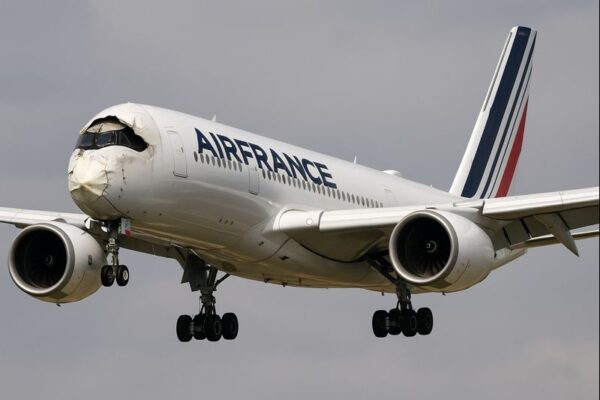
A rare operational incident involving an Air France Airbus A350 on the Osaka–Paris route has drawn strong interest across the global tourism and aviation sectors. The event occurred during a scheduled long-haul service between Japan and France and ended with a safe return to Osaka Kansai Airport.
No passengers or crew were injured. However, the incident highlighted how even advanced aircraft can face unexpected technical challenges. It also showed how airlines, regulators, and manufacturers respond quickly to protect passenger safety and international air connectivity.
For travellers flying between Asia and Europe, the episode offered insight into the complex systems that operate behind every long-haul journey.
Hidden Damage from an Earlier Bird Strike
Investigators later confirmed that the root cause dated back several weeks before the Osaka departure. The aircraft had suffered a bird strike during an earlier operation.
Maintenance teams inspected the radome’s outer surface at the time. No visible damage appeared. However, the inner layer of the radome had developed internal separation. This hidden defect went undetected.
The radome protects the weather radar and allows signals to pass through without interference. Internal damage can restrict radar antenna movement and affect data accuracy.
In the days before the Osaka–Paris flight, the aircraft recorded minor weather radar anomalies. These irregularities did not initially trigger a deeper internal inspection. With no visible cracks or dents, the aircraft remained in service.
Problems Begin After Departure from Osaka
On 28 May 2023, the A350 departed Osaka Kansai Airport for Paris as scheduled. Shortly after climbing through cruise altitude, radar faults appeared again.
These alerts raised concern in the cockpit. The flight crew decided to return to Osaka as a precaution. At that stage, the aircraft remained fully controllable, and conditions inside the cabin were calm.
The decision to turn back reflected standard safety procedures. Long-haul flights rely heavily on accurate weather radar and air-data systems, especially over oceanic routes.
Radome Collapse During Descent
The most serious development occurred during descent. At around 30,000 feet, the radome collapsed inward.
This sudden deformation changed airflow around the aircraft’s nose. It also disrupted pressure near several air-data sensors. As a result, the flight displays began showing conflicting airspeed readings.
The aircraft’s flight-control system reacted by switching between normal and alternate control laws. These transitions are designed to protect the aircraft when data becomes unreliable.
Although alarming, the aircraft remained structurally sound. The crew continued the return to Kansai while managing the evolving situation.
Crew Workload Increases as Data Conflicts Grow
As airspeed differences widened, the crew applied unreliable airspeed procedures. Automated systems remained engaged at first while alerts were reviewed and cross-checked.
Below 15,000 feet, aerodynamic noise and vibration increased. The crew briefly considered diverting to Tokyo. They ultimately chose Osaka due to proximity and runway familiarity.
When slats and flaps were extended for landing, airspeed discrepancies grew further. This confirmed that the issue likely involved the radome rather than a single sensor.
The crew disengaged automation and flew manually. One pilot relied on the head-up display. The other used pitch-and-thrust reference tables to maintain stable flight parameters.
Advanced System Awareness Becomes a Key Lesson
Post-incident analysis revealed that the A350’s NAIADS system could have provided reliable speed and altitude data during the event. This system operates independently of traditional pitot sensors and can retain autopilot support.
However, investigators found gaps in training and documentation. These gaps limited the crew’s awareness of the system’s full capabilities under abnormal conditions.
The finding did not reflect poor crew performance. Instead, it highlighted the need for clearer procedures and stronger system familiarity.
Safe Landing at Kansai Airport
Despite the challenges, the aircraft stabilised on a long downwind leg for runway 24R. The extended approach helped manage the aircraft’s heavier landing weight.
Another brief control-law transition occurred during final setup. The crew maintained control and captured the ILS approach.
The aircraft landed safely. All 309 passengers and 14 crew members disembarked without injury. Airport operations continued with minimal disruption.
Post-landing inspections confirmed severe radome deformation. The rest of the aircraft showed no structural damage, underscoring the A350’s robust design.
Industry Response Strengthens Aviation Safety
Following the incident, Airbus revised radome inspection procedures. Internal structures now receive greater focus after bird strikes, hail, or lightning events.
Updates were also made to the A350 flight manual. These changes address radome-related failures and associated airspeed anomalies.
Air France strengthened its maintenance follow-up processes, especially when radar faults appear. The airline also expanded pilot training to improve understanding of advanced backup systems like NAIADS.
A Reminder of Strong France–Japan Aviation Cooperation
The incident demonstrated effective coordination between French and Japanese aviation authorities. It also showed how airlines and manufacturers work together to improve safety standards.
For the tourism sector, the outcome reinforced confidence in long-haul travel. Even rare technical failures are managed through layered safety systems, skilled crews, and continuous learning.
As travel demand between Japan and Europe grows, this event serves as a reminder that safety improvements often emerge from real-world experience—and benefit passengers worldwide.
For more travel news like this, keep reading Global Travel Wire