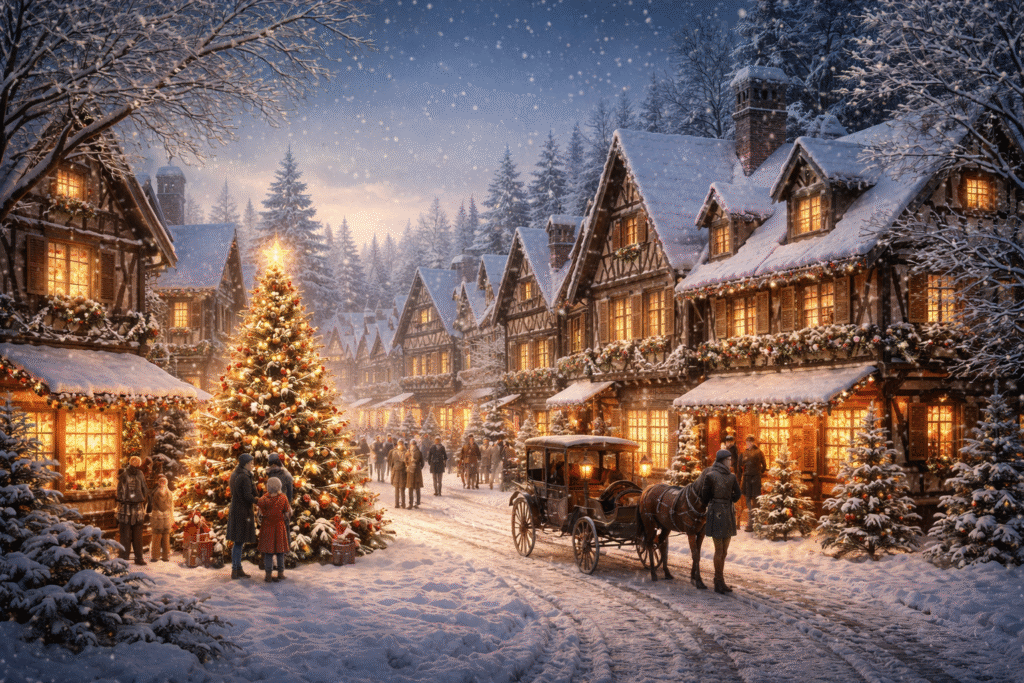
There’s a particular kind of Christmas you can almost hear: boots crunching on fresh snow, warm lights glowing behind frosted windows, and that hush in the air that makes even a busy street feel like a storybook. We call it a “white Christmas”—and while it feels timeless, a big part of the dream was shaped in very specific moments of history.
How the “white Christmas” became the default holiday fantasy
In the UK, the phrase “white Christmas” usually means snow at Christmas—but even the definition can be surprisingly strict. The UK’s Met Office says an “official” white Christmas can be declared if a single snowflake is observed falling during the 24 hours of December 25 (even if it doesn’t settle). In the United States, the benchmark many weather services use is at least 1 inch of snow on the ground on Christmas morning.
That gap between “snowfall observed” and “ground covered in snow” matters, because it explains why so many of us feel like white Christmases “used to be more common.” Sometimes it’s not that snow never happened—it’s that we’re remembering the postcard version of winter.
Victorian winters + the rise of Christmas cards
The Victorian era did a lot of heavy lifting for modern Christmas: the cozy domestic vibe, the sentimental rituals, and (crucially) the imagery. Christmas cards became a real craze in the 19th century, and snow scenes were everywhere—turning winter into an aesthetic, not just weather.
The tradition has a clear starting point: the first commercial Christmas card was commissioned by Henry Cole in 1843. Those early cards helped popularize a shared visual language: holly, candles, carriage rides…and yes, snow.
So even if you live somewhere where December is mostly rain—or even sunshine—the “correct” Christmas can still feel like it’s supposed to be white.
Why American Christmas movies feel so snowy
If you grew up with classic U.S. Christmas films, snowfall can feel non-negotiable: the final kiss happens under streetlamp flurries, the big reunion is framed by perfect drifts, and someone always shakes snow off a scarf at the door. That cinematic snow matches real geography, too: parts of North America have historically had higher odds of snow on the ground at Christmas—especially the Upper Midwest, northern New England, and mountain regions.
And yet, even in the U.S., a white Christmas isn’t guaranteed—many places have always been more “green Christmas” than white, and warming winters are nudging probabilities down in some regions.
Countries that celebrate Christmas—and where to find the snowiest versions
Christmas is celebrated in many countries across Europe, the Americas, Africa, Asia, and Oceania—sometimes as a religious holiday, sometimes as a cultural one, often as both. If your goal is the snowy version, these are the places that most reliably deliver the classic scene.
1) Finland (Lapland) – the fairytale standard
Finland doesn’t just do snow; it does deep winter. Head north to Rovaniemi or beyond for long nights, saunas, and that “is the forest sparkling?” feeling. If you want a white Christmas that looks like a Christmas card learned to breathe, Lapland is it.
2) Norway, Sweden, and Iceland – minimalism + magic
Scandinavia celebrates Christmas with a calm, candlelit coziness that pairs perfectly with winter landscapes. Think: warm pastries, wool blankets, and snow that makes everything quiet. Iceland adds dramatic bonus points: black-sand beaches with snowy peaks in the distance.
3) Switzerland and Austria – alpine Christmas markets
If you want snowy towns, mountain trains, and markets that smell like cinnamon and roasted nuts, the Alps are your playground. Christmas markets are big across German-speaking regions, and higher elevations improve your odds of the full white-Christmas look.
4) Germany, Poland, Czechia – old-town charm in winter coats
These countries celebrate Christmas with a strong market culture, hearty winter food, and historic city centers that look unreal when dusted with snow. Even when snowfall isn’t guaranteed, the atmosphere is—especially in smaller towns.
5) Canada – big winter energy
Canada practically specializes in winter. For reliable snow, aim for interior regions and higher latitudes. Quebec City at Christmas feels like stepping into a snow globe with excellent food.
6) United States – go north, go high, or go Alaska
For the best shot at true “snow on the ground” Christmas mornings, look to Alaska, northern states, and mountain regions—places where historical odds are highest. Ski towns can be a smart choice if you want both snowfall and festive infrastructure.
7) Japan (Hokkaido) and South Korea (Gangwon) – modern winter wonderlands
Christmas is widely enjoyed culturally in Japan and South Korea (even if celebrated differently than in Europe or North America). For snow, Hokkaido and Korea’s mountain areas can deliver serious winter scenery—plus hot springs, great food, and glowing city lights.
A quick reality check (that doesn’t ruin the romance)
The white Christmas is a blend of weather and storytelling: Victorian cards helped paint it, movies reinforced it, and our own nostalgia keeps it glowing. But the best part? You can still find it—and when you do, it feels exactly like you hoped: cold cheeks, warm hands, and that soft snowlight that makes everyone look a little kinder.