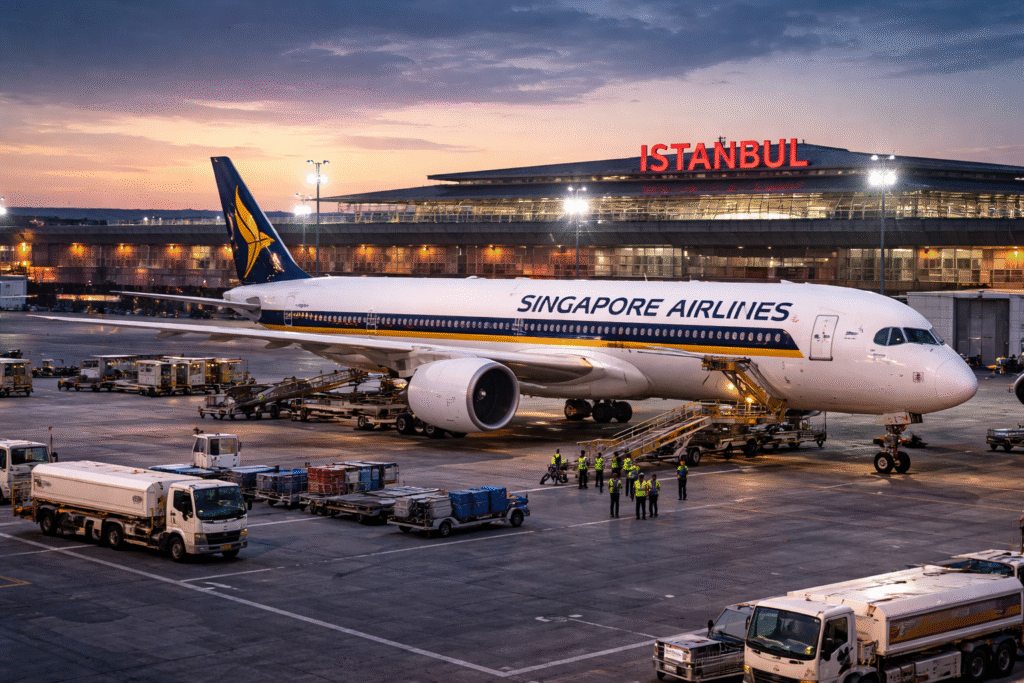
International travel between Turkey and Singapore faced major disruption after a Singapore Airlines Airbus A350-900 failed to depart Istanbul on three consecutive attempts. The incident stretched across nearly three days and affected hundreds of passengers traveling on one of the airline’s key long-haul routes.
The episode brought renewed attention to the operational challenges airlines face when technical issues arise far from their main hubs. It also highlighted how delays on ultra-long-haul routes can quickly escalate into complex logistical situations for both carriers and travelers.
Technical Fault Halts Departure at Istanbul Airport
The disruption began when Singapore Airlines flight SQ391 was scheduled to depart Istanbul Airport for Singapore Changi Airport. Shortly after pushback, the aircraft taxied toward the runway but was forced to return to the gate.
Flight crew identified a technical issue involving the aircraft’s flaps. These components play a vital role during takeoff and landing. Aviation safety procedures require any suspected fault to be resolved before departure, with no exceptions.
Passengers remained onboard for several hours while engineers assessed the problem. Cabin crew distributed meals and drinks as the airline initially expected a swift fix. However, the situation changed once engineers confirmed that a required spare part was not available locally.
Escalating Delays and Passenger Disembarkation
As repair timelines extended, the airline asked passengers to disembark and collect their checked baggage. This marked the start of a prolonged delay rather than a short technical pause.
Singapore Airlines arranged hotel accommodation at two properties near the airport. Meal vouchers were also issued. Despite these measures, some travelers reported out-of-pocket expenses for essentials during their extended stay in Istanbul.
For many passengers, the uncertainty proved challenging. Long-haul travelers often carry tight onward connections, business commitments, or medical needs that become harder to manage during multi-day delays.
Communication Gaps Add to Passenger Frustration
Several travelers raised concerns about communication during the disruption. Passengers reported inconsistent updates and limited visibility of airline representatives in the terminal.
In some cases, travelers relied on third-party tour leaders for information rather than airline staff. From the airline’s standpoint, updates were shared, hotels were secured, and support was offered to those needing rebooking.
The gap between passenger perception and airline processes underscored a key lesson for the tourism sector. Clear, frequent, and visible communication becomes critical during extended delays, especially at major international gateways.
Final Departure After Nearly 38 Hours
After multiple schedule revisions, the aircraft finally departed Istanbul under a revised flight number, SQ9391. The departure occurred in the early hours following extensive engineering checks and part replacement.
The flight arrived in Singapore later that evening, closing a disruption that lasted close to 38 hours. For many travelers, the delay turned a long-haul journey into a multi-day ordeal.
Why Flap Issues Cause Extended Grounding
Aircraft flap systems directly affect lift and takeoff performance. Aviation regulations require engineers to carry out thorough inspections and testing before clearing an aircraft to fly.
At overseas stations, airlines often depend on limited spare part inventories. When a specific component is unavailable, parts must be flown in from other locations. This process can take many hours or even days, depending on distance and customs clearance.
Even well-resourced global airlines face these constraints, particularly on routes served by wide-body aircraft with specialized components.
Similar Disruption Hits US–Singapore Route
A separate Singapore Airlines service later faced comparable challenges on the ultra-long-haul route between the United States and Singapore. Passengers on the Newark to Singapore flight experienced nearly two days of delays.
Severe winter weather initially caused runway closures for de-icing at Newark Airport. Hundreds of delays and cancellations followed, disrupting airport operations and crew schedules.
Compounding Technical and Ground Handling Issues
After weather conditions improved, the flight was rescheduled under a new number. However, further checks revealed a baggage system fault and a nose wheel issue on the aircraft.
Additional inspections uncovered the need for a spare part. Later, engineers also identified damaged tyres, with only one replacement available locally. A second tyre had to be transported from another airport, extending the delay.
Passengers were repeatedly boarded and disembarked as conditions changed, adding to fatigue and frustration.
Passenger Care Under Pressure
During the US disruption, the airline provided hotel rooms, meals, and transport. Some passengers reported delays in hotel availability and transport issues due to vehicle breakdowns.
These challenges reflected the strain placed on airport infrastructure and local service providers during large-scale disruptions, especially when multiple flights are affected at once.
What This Means for Global Tourism
These incidents showed how interconnected modern aviation has become. Long-haul routes depend on smooth coordination between airlines, airports, weather services, and maintenance networks.
For the tourism industry, such events highlight the importance of contingency planning and strong passenger support systems. Travelers increasingly expect timely updates, clear guidance, and practical assistance when disruptions occur.
While safety remains the top priority, the experience in Istanbul and the United States served as a reminder that even premium carriers face complex operational realities in global air travel.
For more travel news like this, keep reading Global Travel Wire