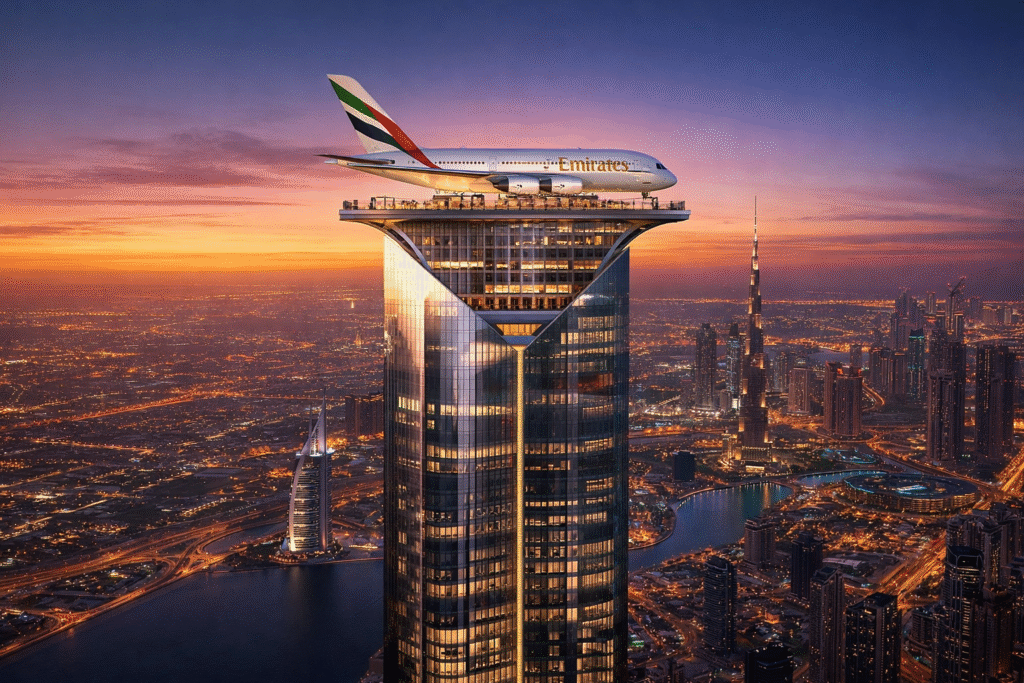
Dubai has built a global reputation for architectural ambition and boundary-pushing luxury, and its latest hospitality vision, the Emirates Air Hotel, pushes that reputation into entirely new territory. Proposed as a $3 billion development, the concept imagines a 580-metre-high skyscraper crowned by a full-scale Emirates Airbus A380, transforming the very definition of what a luxury hotel can be. If realised, the project would not only reshape Dubai’s skyline but also signal a bold new chapter in experiential tourism.
From the Burj Khalifa to the sail-shaped Burj Al Arab, Dubai has consistently embraced record-breaking structures as a key part of its tourism identity. The Emirates Air Hotel concept takes this philosophy further by merging aviation heritage with architectural spectacle, offering guests an experience designed to be as memorable as the destination itself.
Aviation Becomes Architecture
At the heart of the Emirates Air Hotel concept is its most striking feature: a permanently mounted Airbus A380 positioned at the summit of a 125-storey tower. Rather than serving as an aircraft, the A380 would be reimagined as a luxury attraction seamlessly integrated into the building. Guests would access the aircraft directly from the hotel’s upper levels, blurring the line between hotel, museum, and immersive entertainment venue.
The uppermost floor is envisioned as a dramatic sky bar leading into the aircraft’s interior, redesigned as an exclusive lounge space. Glass-bottom walkways extending over the wings would allow guests to step outside and take in uninterrupted views of Dubai from one of the highest vantage points in the city. This fusion of aviation and hospitality represents a new approach to experiential design, where iconic objects become interactive destinations rather than static displays.
Vertical Luxury on an Unprecedented Scale
Beyond its architectural spectacle, the Emirates Air Hotel is designed to showcase luxury in its most exclusive form. The tower would feature an intentionally limited number of accommodations, with just seven royal suites planned, each occupying an entire floor. This scarcity-driven model reflects a growing trend in ultra-luxury travel, where privacy, personalization, and exclusivity outweigh sheer volume.
Each suite is envisioned to offer expansive living spaces, private amenities, and floor-to-ceiling windows framing panoramic views of Dubai’s skyline. By prioritising space and seclusion, the hotel would cater to high-net-worth travelers seeking a rare and highly curated hospitality experience.
One of the most talked-about features is a proposed 360-degree infinity pool suspended high above the city. Designed to create the sensation of floating in the sky, the pool would offer uninterrupted views in every direction, reinforcing Dubai’s reputation for dramatic, headline-making attractions that combine leisure with spectacle.
Dining Takes Flight
Gastronomy plays a central role in the Emirates Air Hotel vision, with dining experiences designed to be as unconventional as the architecture itself. The concept includes three Michelin-starred restaurants, each offering a distinctive culinary identity. The most extraordinary of these would be located inside the A380’s cockpit, transforming the flight deck into an intimate fine-dining venue.
Dining in the cockpit would allow guests to enjoy world-class cuisine surrounded by the controls and design elements of one of the most iconic commercial aircraft ever built. This approach reflects the growing importance of experiential dining in luxury tourism, where the setting is as significant as the menu.
Complementing the restaurants, an Emirates First Class-inspired lounge is also envisioned, offering premium services, refined interiors, and an atmosphere inspired by the airline’s flagship onboard experience. Together, these spaces would reinforce the hotel’s identity as a celebration of aviation excellence and hospitality innovation.
Experiential Tourism Meets Nightlife and Mobility
The Emirates Air Hotel concept goes beyond accommodation and dining by incorporating entertainment and mobility into its design. One of the most unconventional elements is a nightclub planned on the A380’s wing. During daytime hours, this space would function as a helipad, underscoring the hotel’s focus on elite accessibility and seamless travel. By night, it would transform into a high-energy venue suspended above the city.
This multifunctional approach reflects Dubai’s broader tourism strategy, which emphasizes versatility, spectacle, and around-the-clock experiences. By combining nightlife, aviation heritage, and panoramic views, the hotel would appeal to travelers seeking destinations that offer constant engagement and novelty.
Dubai’s Ambition on a Global Stage
If constructed, the Emirates Air Hotel would rank among the tallest hotel structures in the world, reinforcing Dubai’s status as a global hub for ultra-luxury travel and architectural innovation. The project aligns with the city’s long-term tourism vision, which focuses on attracting high-spending visitors through landmark developments and unique experiences.
Large-scale hospitality concepts such as this also support Dubai’s broader economic goals by strengthening its position as a center for global tourism, business travel, and lifestyle investment. The Emirates Air Hotel would likely become an instant landmark, drawing international attention and positioning Dubai at the forefront of future luxury tourism conversations.
A Vision Awaiting Realisation
Despite widespread attention, the Emirates Air Hotel remains a conceptual proposal. No confirmed construction timeline or official approvals have been announced, and the project’s future will depend on market conditions, strategic priorities, and regulatory decisions. Like many visionary concepts unveiled in Dubai, the design may evolve before any physical development begins.
Even as a concept, however, the Emirates Air Hotel serves an important purpose. It illustrates the direction in which luxury hospitality is heading, where hotels are no longer simply places to stay but immersive destinations designed to tell stories, spark curiosity, and deliver once-in-a-lifetime experiences.
Conclusion
The Emirates Air Hotel concept encapsulates Dubai’s relentless drive to redefine what is possible in luxury hospitality and architectural design. By combining a towering skyscraper, a full-scale A380, and a suite of immersive experiences, the project represents a bold vision of the future of tourism. Whether it ultimately rises above Dubai’s skyline or remains an ambitious idea, the Emirates Air Hotel underscores one undeniable truth: in Dubai, no vision is ever too bold, and the boundaries of luxury are constantly being redrawn.
For more travel news like this, keep reading Global Travel Wire