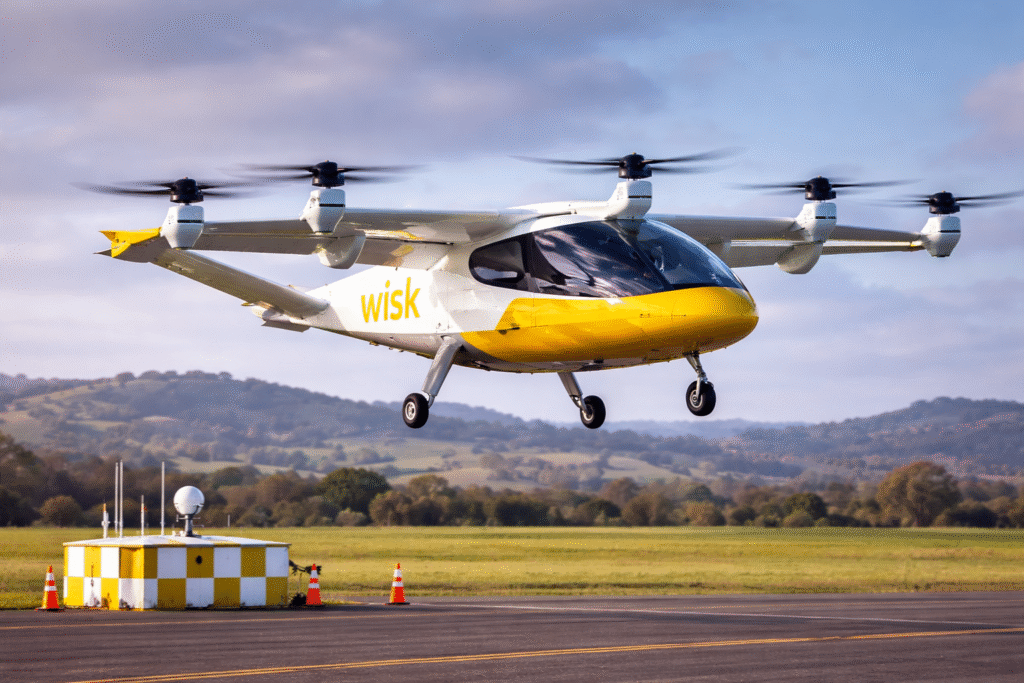
Wisk Aero has reached a major aviation milestone. The company successfully completed the first flight of its full-scale Gen 6 autonomous eVTOL. This event marks a turning point for sustainable and autonomous air travel.
The flight took place at Wisk’s test facility in Hollister, California. It involved a fully autonomous aircraft operating without a pilot onboard. The achievement moves the industry closer to certified passenger-carrying air taxis.
A Short Flight with Long-Term Impact
The initial flight lasted just over 30 seconds. Despite its short duration, the flight delivered critical validation. The aircraft performed a vertical takeoff, hover, slight forward movement, and controlled landing.
The Gen 6 aircraft followed a pre-programmed flight plan. No human pilot or remote controller intervened. The autonomous system managed every phase of the flight.
This success confirms years of design, testing, and system integration.
Why the Gen 6 Flight Matters
The Gen 6 eVTOL represents one of the first uncrewed aircraft designed to carry passengers. Many companies pursue electric vertical flight. Few focus fully on autonomy from the start.
Wisk’s approach removes onboard pilots entirely. This design allows simpler operations and improved safety oversight from the ground. The company believes autonomy offers better long-term scalability.
This flight proves that the concept can work in real conditions.
Built on Years of Rigorous Preparation
Wisk did not rush into free flight. Engineers spent years testing components on the ground. Teams validated propulsion systems, software, and control laws.
The company also relied heavily on simulation. Engineers tested thousands of virtual scenarios before approving flight readiness. This preparation reduced risk and increased confidence.
The first hover flight confirmed that simulations matched real-world behavior.
Autonomous Control Sets This Aircraft Apart
The Gen 6 eVTOL does not rely on remote piloting. Its onboard systems receive and execute digital flight plans.
Once uploaded, the aircraft flies exactly as commanded. It adjusts thrust, balance, and stability independently. This autonomy defines the Gen 6 design philosophy.
The system continuously monitors performance and safety margins. If conditions change, it reacts faster than human input.
Expanding the Flight Test Program
After the first hover, Wisk has entered a structured test phase. Engineers will now perform short control tests known as chirps.
These tests introduce small inputs to observe aircraft response. Teams compare real behavior against simulation predictions. This process refines control laws and flight dynamics.
Once validation is complete, Wisk will advance to low-speed directional flight.
Preparing for Critical Transition Tests
One of the most challenging phases lies ahead. The aircraft must transition from vertical lift to forward wingborne flight.
These transition tests require precise control and stability. Wisk plans to perform them within the next six months.
Engineers will also simulate system failures during transitions. These scenarios help prove resilience and safety margins.
Successful transitions will signal readiness for advanced flight testing.
Certification Remains a Central Focus
Wisk has already entered formal certification discussions with aviation authorities. The company is pursuing type certification for the Gen 6 aircraft.
Certification requires more than flight hours. Regulators demand proof across countless scenarios. Wisk combines real flight data with extensive simulation.
This blended approach mirrors methods used in modern commercial aviation. It ensures robust validation of autonomous behavior.
Simulation Plays a Critical Safety Role
Autonomous systems must handle rare and extreme events. Flight testing alone cannot cover every possibility.
Wisk runs tens of thousands of simulated flights. These include weather changes, mechanical faults, and airspace constraints.
Simulation allows safe testing of edge cases. It also supports regulatory confidence in system reliability.
Scaling Up Testing in the Coming Years
Wisk plans to increase its testing pace in 2026. The goal includes multiple flights per day, several days each week.
A second Gen 6 aircraft is nearing completion. It will soon begin ground testing and then join flight operations.
Adding aircraft will speed up data collection and validation. It will also support parallel testing scenarios.
A Vision for Urban Air Mobility
Wisk aims to reshape how people move within cities. Autonomous air taxis could reduce congestion and travel times.
Electric propulsion also lowers emissions compared to helicopters. Quiet operations suit dense urban environments.
The company envisions structured air routes managed through digital systems. Ground-based supervisors will monitor multiple aircraft simultaneously.
Sustainability Drives the Long-Term Strategy
Electric vertical flight supports climate goals. It reduces reliance on fossil fuels and limits local pollution.
Governments increasingly support sustainable transport solutions. Urban air mobility aligns with broader infrastructure planning.
Wisk positions its Gen 6 aircraft as part of this future ecosystem.
A Defining Moment for Autonomous Aviation
The first flight of the Gen 6 eVTOL marks more than a technical success. It signals maturity in autonomous aviation design.
Many challenges remain before commercial service begins. Certification, infrastructure, and public acceptance still require work.
However, this flight proves that autonomous passenger flight is achievable.
Looking Ahead to the End of the Decade
Wisk targets certification before the decade ends. The company continues to refine systems through testing and simulation.
Each successful flight builds confidence among regulators and industry partners. Momentum now favors progress rather than speculation.
The Gen 6 flight represents a leap toward a new travel era. Autonomous, electric air taxis now move from concept toward reality.
For more travel news like this, keep reading Global Travel Wire