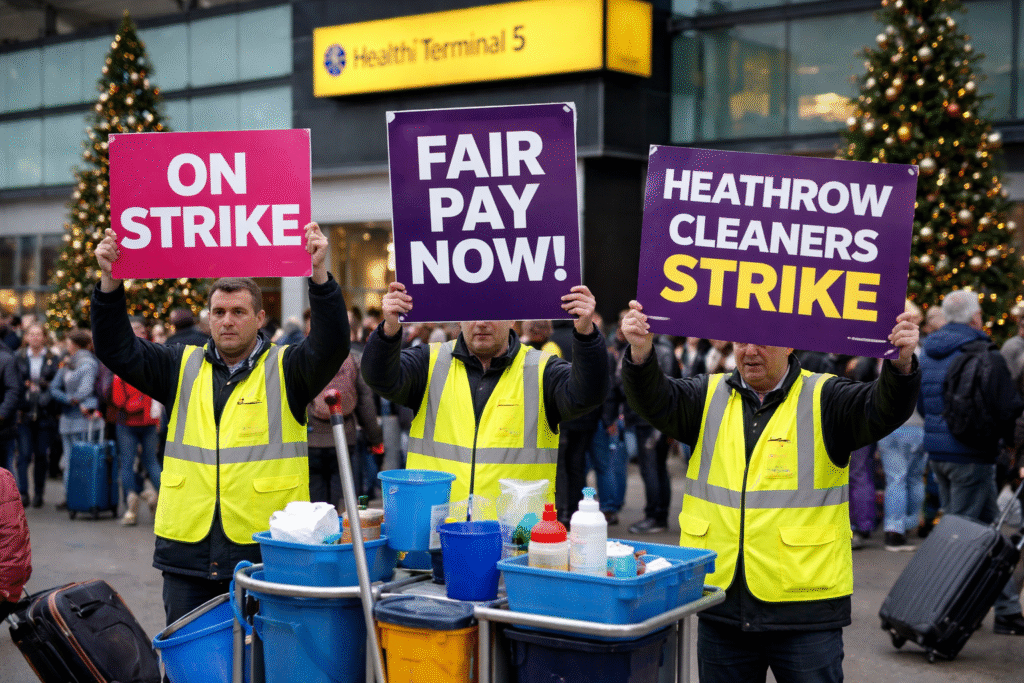
The United Kingdom’s peak holiday travel season now faces fresh disruption. More than 80 cleaners serving British Airways at Heathrow Airport will launch a prolonged Christmas strike after a long-running pay dispute. The action is set for 18 to 29 December, directly overlapping one of the busiest travel weeks of the year.
The cleaners are employed by OCS, an outsourcing company responsible for soft services across several British Airways facilities. Their demand is simple: raising the current £12.21 hourly rate to the London living wage of £13.85. For workers in one of the world’s most expensive cities, the gap has become impossible to absorb, especially as inflation and housing costs continue to rise.
A Pay Dispute That Has Escalated for More Than a Year
The disagreement has simmered for over 12 months. Workers argue that their rate no longer reflects London’s real cost of living. Other contracted cleaners at Heathrow already receive the higher living wage, creating what the workforce describes as a “two-tier system” within the same airport.
Cleaners under OCS say they have requested fair pay through multiple rounds of negotiation. Yet talks have delivered little progress. With frustration building, the union representing the group has backed more assertive action during the Christmas rush.
Why Cleaners Are Essential to Heathrow’s Operations
These workers maintain British Airways offices, engineering hangars, cargo sites, and operational buildings across four busy terminals. Their tasks support flight planning, aircraft maintenance, luggage operations, and day-to-day airline administration.
Although the strike does not target pilots, cabin crew, or check-in teams, any pressure on support facilities can slow wider airport processes. Heathrow is one of Europe’s largest gateways, with more than a million passengers expected during the Christmas period. Even minor delays often ripple through the entire travel chain.
Airport specialists note that cleaning teams are central to safety, sanitation, and smooth operations. During high-volume travel windows, their work becomes even more critical.
London’s High Living Costs Driving Wage Demands
London continues to rank among the world’s priciest cities. Housing, transport, childcare, and utilities absorb a large share of income for low-paid workers. The London living wage is set to offer a more realistic threshold for basic living needs.
Many cleaners report financial pressure that extends beyond normal budget challenges. Some rely on food support services. Others share rooms or overcrowded accommodation to manage rent. These realities have made the wage dispute more urgent and have placed workers under significant stress.
Concerns Over Sick Pay and Working Conditions
Pay is only one part of the dispute. Workers say sick pay remains insufficient. Some report returning to work shortly after surgery or illness to avoid losing income. In an airport environment where hygiene and safety matter, this raises concerns for both staff and passengers.
Several cleaners have worked in outsourced roles for decades with limited scope for advancement. A few have delayed retirement because they cannot afford it. These stories have strengthened calls for better long-term conditions rather than temporary improvements.
Strike Action During Peak Travel Week
The planned strike from 18 to 29 December will overlap with the Christmas getaway. Heathrow typically sees heavy congestion during this period as families travel for holidays, and international tourists arrive for winter breaks.
Public demonstrations will also occur on 18 and 19 December near Hatton Cross station. These events aim to highlight the pay gap and build momentum for negotiations.
While flight cancellations are not expected, travellers may experience slower services in affected areas. Airport users have been advised to allow extra time during the busiest days.
A Repeat of Earlier Walkouts
This is not the first time OCS cleaners have taken action. Earlier in the year, workers at Terminal 5 staged walkouts over similar issues. At the time, the situation drew attention to widespread dissatisfaction with outsourced labour models.
Although OCS has accreditation for paying the living wage to directly employed staff, most outsourced workers fall outside this framework. This difference remains a major sticking point in negotiations.
Impact on the UK’s Travel and Tourism Sector
This dispute arrives as the UK tourism sector continues to rebuild momentum. Heathrow plays a major role in welcoming international visitors, with winter often bringing increased arrivals for holiday events, shopping, and New Year celebrations.
Any operational tension during this period can affect passenger experiences. Delays or reduced services may cause frustration, which could influence travel perceptions. Consistency and reliability are essential at global hubs, especially during festive peak seasons.
What This Means for Aviation Employers
The strike highlights deeper challenges within the aviation labour structure. Many essential roles, including cleaning, security, and ground services, rely on outsourced workforces. Pay differences across contractors can create inequality within the same operational environment.
Airlines and service providers now face growing pressure to standardise pay rates and improve conditions. Such measures may reduce the risk of future strikes and support overall travel stability.
Looking Ahead
With the strike set to begin, both British Airways and OCS face a critical moment. Travellers will closely monitor the situation as Christmas approaches. Industry observers expect renewed talks, as the holiday travel window leaves little room for further disruption.
The outcome of this dispute may shape future employment standards across UK airports. What happens next will influence workers, airlines, and millions of passengers who depend on Heathrow during peak travel seasons.
For more travel news like this, keep reading Global Travel Wire