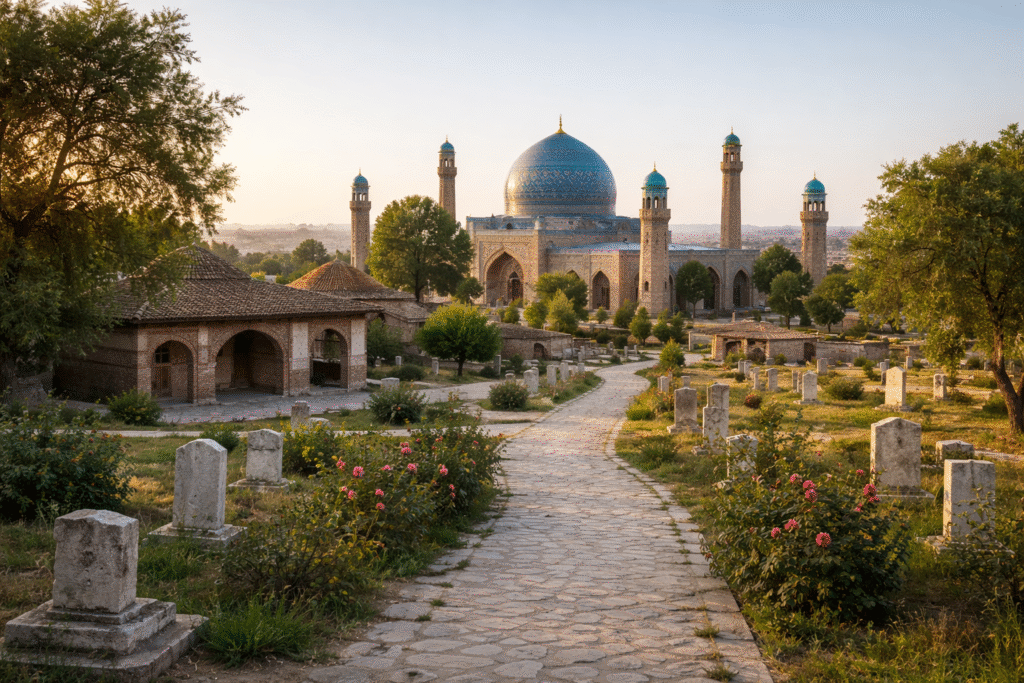
Just beyond the urban edges of Ganja, Azerbaijan’s second-largest city, lies a landscape where movement slows and meaning deepens. The outskirts surrounding the Ganja Imamzadeh complex offer travelers an experience shaped not by crowds or spectacle, but by faith, memory, and quiet continuity. This area presents a softer, more reflective side of travel in western Azerbaijan—one that rewards patience and observation.
For culturally curious visitors and travel storytellers, the Imamzadeh outskirts represent an overlooked dimension of the region. Here, spirituality is not curated for tourism; it is lived daily, woven into routines, gestures, and shared spaces.
Understanding the Ganja Imamzadeh Complex
At the heart of the area stands the Imamzadeh mausoleum, a revered religious site believed to be the resting place of a descendant of the Prophet Muhammad. Over centuries, the shrine has expanded into a broader religious ensemble, incorporating prayer halls, courtyards, and burial grounds that continue to serve the local community.
While the central complex draws pilgrims from across the country, the surrounding outskirts tell a quieter story. These peripheral spaces show how sacred centers influence settlement patterns, social life, and cultural behavior far beyond their architectural boundaries.
The Spiritual Role of the Outskirts
The neighborhoods and open spaces around Imamzadeh function as an extension of the sacred environment. Families gather not only for formal prayer, but for remembrance, contemplation, and shared silence. Elderly visitors linger in shaded areas, children move respectfully through courtyards, and caretakers maintain the grounds with understated devotion.
Small vendors and local residents support the site in ways that feel organic rather than commercial. This delicate balance preserves the area’s authenticity and makes it especially appealing to travelers interested in spiritual landscapes rather than traditional sightseeing.
Architecture That Encourages Reflection
Moving away from the shrine’s central dome, architecture becomes modest and human-scaled. Low-rise buildings, simple homes, and open land create a visual and emotional transition from the city’s density to contemplative space.
This gradual shift mirrors the experience of visitors themselves. As noise fades and horizons open, attention turns inward. The absence of grand design emphasizes presence over performance, allowing travelers to engage with the space on their own terms.
Experiencing the Area as a Cultural Observer
There are no guided routes or scripted narratives in the Imamzadeh outskirts. Instead, meaning emerges through observation. How people walk slowly toward the shrine. How conversations soften near sacred areas. How pauses replace urgency.
For visitors, this unscripted environment offers insight into Azerbaijan’s traditions of religious tolerance and everyday spirituality. Faith here is visible but never imposed, expressed through behavior rather than display.
Seasonal Rhythms and Changing Atmosphere
Each season reshapes the character of the Imamzadeh outskirts. In spring, greenery and flowering trees enhance the sense of renewal associated with pilgrimage and reflection. Summer brings steady local visitation, often in the cooler hours of early morning and evening.
Autumn introduces stillness, as warmer tones settle over the landscape. Winter, by contrast, reduces the environment to essentials—stone pathways, open sky, and quiet presence—revealing the enduring strength of the site without ornament.
Accessibility Without Disruption
One of the area’s most appealing qualities is its proximity to central Ganja. Easily reached yet emotionally distant from urban pace, the Imamzadeh outskirts are ideal for half-day exploration. Visitors can move between city life and sacred space without abrupt transition.
Walking remains the most meaningful way to experience the area, allowing travelers to sense gradual changes in sound, space, and social behavior rather than rushing from point to point.
Respectful Travel in Living Sacred Space
As an active religious environment, respectful conduct is essential. Modest dress, subdued voices, and sensitivity during prayer times are expected. Photography, while permitted in some areas, should always be discreet and non-intrusive.
Such awareness does more than preserve dignity—it deepens understanding. Travelers who approach the site with humility often leave with a stronger sense of connection and insight.
A Window Into Local Values and Identity
What distinguishes the Ganja Imamzadeh outskirts is continuity. Life here flows around the sacred rather than separating from it. Faith exists alongside daily routine, without ceremony or spectacle.
For travel writers and cultural explorers, this coexistence offers a powerful narrative—one grounded in lived tradition rather than dramatic contrast.
Where Meaning Lives Between Places
The true value of the Imamzadeh outskirts lies not in any single structure, but in the space between arrival and departure. In the walk from city edge to shrine, in shared silence beneath open sky, travelers encounter a deeper form of understanding.
Here, travel becomes less about seeing and more about sensing—an experience that lingers quietly, much like the landscape itself.
For more travel news like this, keep reading Global Travel Wire