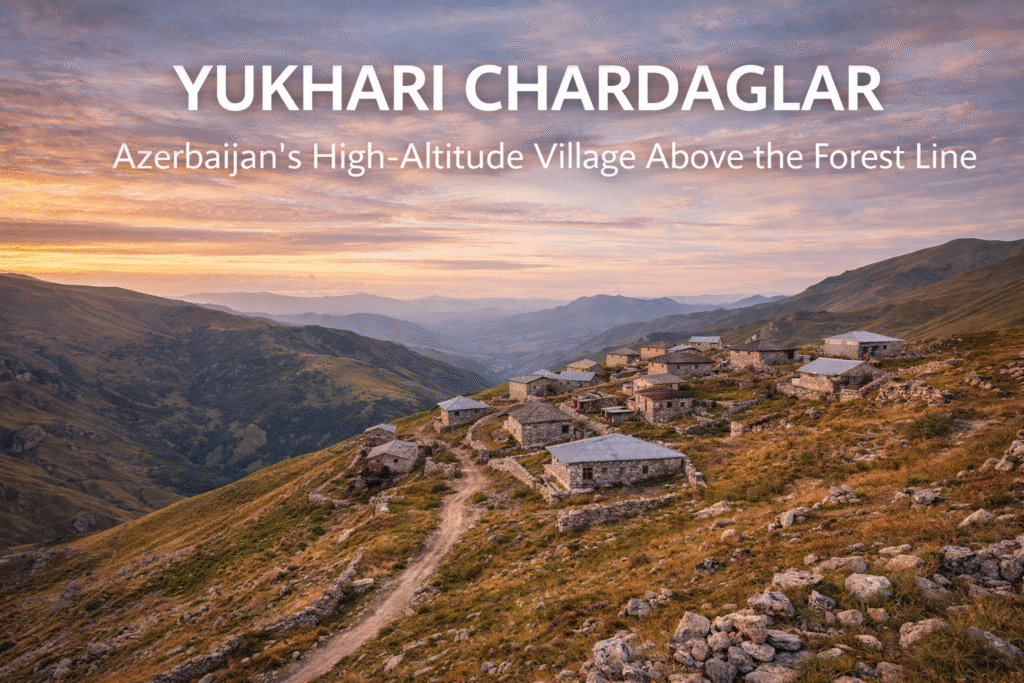
High in the interior landscapes of Azerbaijan, far from major transport routes and urban influence, the village of Yukhari Chardaglar exists as a direct outcome of elevation, climate, and necessity. Situated in the uplands of the Ismayilli District, this small settlement lies near and, in parts, above the forest line, where exposure replaces shelter and endurance defines daily rhythm.
Yukhari Chardaglar is not a destination built for visitors. There are no landmarks curated for photographs, no viewpoints promoted for social media, and no facilities designed for convenience. Instead, the village offers something increasingly rare in modern travel: a clear, unfiltered look at how rural life continues in highland environments where geography remains the dominant force.
A Highland Setting Shaped by Exposure
The village occupies open highland terrain where forests thin out and rolling slopes give way to expansive skies. From many points, the horizon remains visible, uninterrupted by dense vegetation or built structures. This openness creates a strong sense of scale and distance, reinforcing how small human settlement appears within the broader landscape.
Elevation brings cooler temperatures year-round, frequent winds, and seasonal isolation. Weather conditions influence agriculture, movement, and even social interaction. In Yukhari Chardaglar, climate is not a background feature—it is an active participant in daily life.
Architecture Built for Survival, Not Display
Homes in Yukhari Chardaglar reflect generations of environmental knowledge. Buildings are compact, constructed primarily from stone and locally sourced materials. Thick walls provide insulation against cold winters, while heavy roofs withstand strong winds and snowfall.
There is little emphasis on decoration. Every architectural decision serves a purpose, shaped by durability, insulation, and longevity. The village’s built environment stands as quiet evidence of adaptation rather than aesthetic ambition.
Rural Life Governed by Necessity
Daily life in Yukhari Chardaglar follows agricultural and pastoral rhythms that have remained largely unchanged for decades. Livestock care, fodder preparation, seasonal planting, and winter readiness structure the year. These tasks are not optional or symbolic—they are essential for survival.
Visitors encounter life as it is lived, not as it is presented. Work continues regardless of observation, reinforcing the authenticity of the village. This reality demands respectful behavior from travelers, where presence is unobtrusive and observation replaces interaction.
Sound, Wind, and Highland Silence
At altitude, sound carries differently. Wind becomes a constant presence, shaping the acoustic environment as much as the physical one. Animal calls, footsteps, and distant voices travel across open space, while moments of quiet feel expansive rather than empty.
Silence here is layered, shaped by movement and weather rather than absence. It reinforces both isolation and connection—to land, climate, and routine.
Walking Through a Village Shaped by Terrain
Movement within Yukhari Chardaglar follows the contours of the land. Paths curve with slopes, adjusting to drainage patterns and exposure. Walking requires attention, as footing, wind, and weather can shift quickly.
For travelers, this naturally slows pace. Exploration is guided by terrain rather than signage, encouraging patience and observation over destination-focused movement.
Seasonal Extremes and Long-Term Adaptation
Seasonal change defines life in Yukhari Chardaglar more than any calendar. Summer brings longer days and improved access, allowing agricultural tasks and movement between settlements. Winter introduces snow, restricted mobility, and periods of isolation.
Spring and autumn are transitional, marked by preparation rather than celebration. The village’s resilience is most visible in how it anticipates these shifts—storing resources, adjusting routines, and planning months in advance.
A Natural Fit for Slow Travel
Yukhari Chardaglar does not support checklist tourism. There are no attractions to “complete” and no experiences packaged for quick consumption. Instead, the village aligns naturally with slow travel principles, where understanding develops through time spent rather than activities undertaken.
Travelers who remain longer begin to notice subtle patterns: how weather shapes daily decisions, how land use dictates movement, and how community life adapts quietly to environmental pressure.
Cultural Continuity Without Performance
Traditions in Yukhari Chardaglar persist because they remain necessary. There are no staged demonstrations or formal heritage displays. Cultural practices continue through repetition and relevance, not preservation efforts.
This quiet continuity gives the village cultural significance beyond its size. It represents a living thread within Azerbaijan’s mountain heritage, sustained through daily necessity rather than institutional protection.
The Village’s Place in Azerbaijan’s Mountain Story
Yukhari Chardaglar is representative of many highland communities across Azerbaijan—villages rarely featured in tourism campaigns yet essential to the country’s cultural continuity. Their importance lies not in visibility but in endurance.
Together, these settlements form the backbone of Azerbaijan’s mountain identity, preserving ways of life shaped by elevation, distance, and adaptation.
Responsible Travel in Sensitive Environments
From a tourism perspective, Yukhari Chardaglar supports only minimal, low-impact visitation. Its environment is fragile, and its social fabric depends on stability rather than volume. Responsible access requires restraint, respect, and awareness.
Such an approach aligns with sustainable rural tourism goals, where exposure does not come at the cost of disruption.
Where Understanding Replaces Attraction
Yukhari Chardaglar offers no dramatic highlights or iconic scenes. Its value emerges slowly, through observation of routine, weather, and landscape interaction.
For travelers willing to slow down, the village provides insight into endurance rather than spectacle. It demonstrates that significance can exist quietly—shaped by altitude, routine, and patience—and that sometimes the most meaningful journeys are those that ask us to observe rather than arrive.
For more travel news like this, keep reading Global Travel Wire