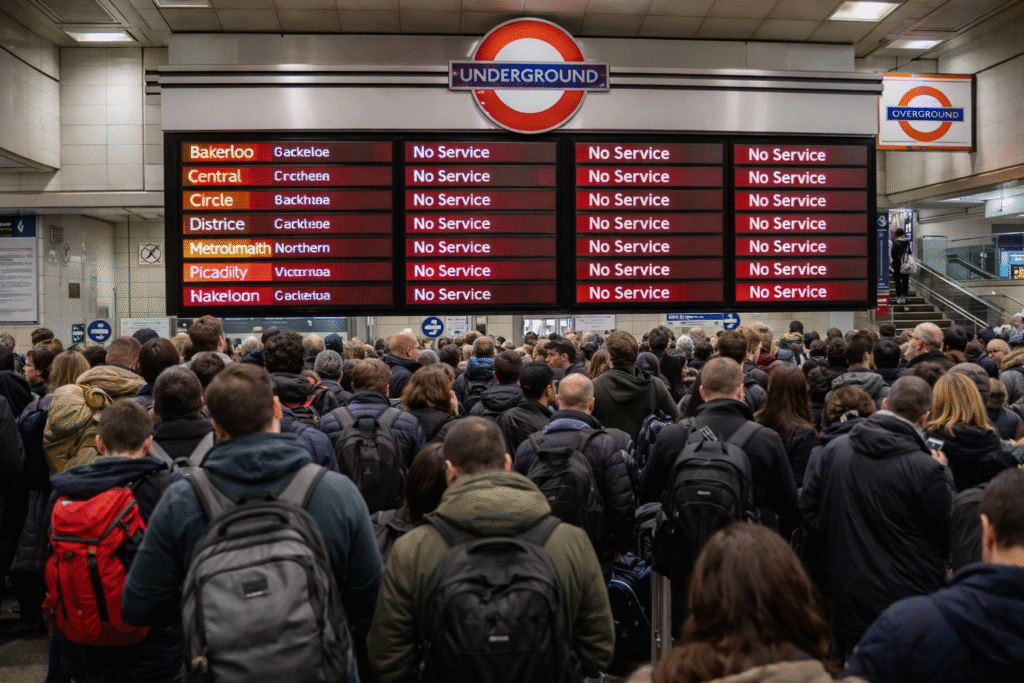
London entered transport chaos on New Year’s Eve after a critical infrastructure failure shut down large parts of the rail network. Transport for London suspended multiple services following a points failure at Lambeth North Underground station. The incident affected millions of residents, workers, and visitors during one of the busiest travel days of the year.
The disruption forced a complete suspension of the Bakerloo line and triggered knock-on effects across the wider network. London Overground and the Elizabeth line also faced partial closures and delays. Passengers scrambled for alternatives as New Year celebrations approached.
Major Network Shutdown: What’s Affected Across London’s Rail Services
The failure at Lambeth North quickly spread disruption across central and outer London. TfL halted Bakerloo line services due to unsafe track conditions. Other Underground lines reported reduced frequency and partial suspensions.
The District line and Piccadilly line experienced service gaps across several sections. London Overground routes faced part closures, limiting orbital travel around the capital. The Elizabeth line also saw restricted operations, affecting east-west connections.
This level of disruption created severe congestion across remaining services. Bus routes filled rapidly as passengers searched for alternatives.
Points Failures Explained: The Technical Fault Triggering Chaos
A points system controls how trains move between tracks at junctions. This equipment allows safe routing across busy sections of rail networks. When points fail, trains cannot switch tracks safely.
At Lambeth North, the failure disabled track switching entirely. Engineers could not guarantee safe train movement through the junction. TfL responded by suspending services to protect passenger safety.
Such failures require manual inspection and repair before trains can resume. This process often takes several hours due to safety requirements.
Impact on Other TfL Services: Overground and Elizabeth Line Disruptions
Although Overground and Elizabeth line systems operate separately, they remain operationally connected. Disruption in one area can reduce capacity across the entire network.
Overground services experienced part closures at key interchange stations. This limited access between outer London zones and central hubs. The Elizabeth line faced delays and partial suspensions due to congestion and signaling constraints.
Passengers relying on cross-London travel experienced longer journeys and overcrowding. Many missed planned connections as schedules changed throughout the evening.
Holiday Travel Complications Increase Pressure
London transport already operates under modified schedules during the holiday season. Planned engineering works typically reduce services between Christmas and New Year.
This year, major station works and timetable changes were already in place. The unexpected system failure added further pressure to an already strained network.
Passengers who planned journeys around holiday schedules now faced complete route changes. New Year’s Eve events across London intensified demand at the worst possible time.
Alternative Travel Advice and Passenger Options
TfL urged passengers to avoid non-essential travel during the disruption. Officials encouraged use of London buses, river services, taxis, and ride-share options.
Bus routes experienced heavy congestion as displaced Tube passengers switched modes. River services offered limited relief along central routes.
National Rail services remained operational but faced increased demand. Holiday engineering work continued to affect several mainline routes.
Passengers using contactless or Oyster cards could switch modes without penalty for disrupted journeys.
Safety and Service Recovery Efforts Underway
TfL deployed engineering teams immediately after the failure. Crews began inspecting track equipment and signaling systems at Lambeth North.
Safety protocols require full testing before reopening affected sections. Engineers must confirm mechanical stability and signal integrity.
TfL plans a phased service restoration once repairs conclude. Priority routes in central London will reopen first.
Passengers can expect rolling updates as recovery progresses into New Year’s Day.
Economic and Commuter Impact Intensifies
The shutdown created significant economic disruption across London. Hospitality and retail sectors faced staffing shortages due to travel issues.
Tourists attending New Year’s Eve celebrations encountered unexpected delays. Many adjusted plans or canceled reservations due to transport uncertainty.
Late-night workers faced difficulty reaching jobs as taxi demand surged. Ride-share prices increased across central zones.
The disruption placed additional strain on emergency and public services operating overnight.
Looking Ahead: Lessons for Transport Resilience
This incident highlights the challenges of maintaining aging transport infrastructure. London’s rail network remains one of the oldest and most complex worldwide.
Transport planners continue reviewing long-term investment strategies. Reliability and system resilience remain key priorities moving into 2026.
TfL aims to restore full service as quickly as possible. Passengers should monitor official updates before traveling.
For more travel news like this, keep reading Global Travel Wire