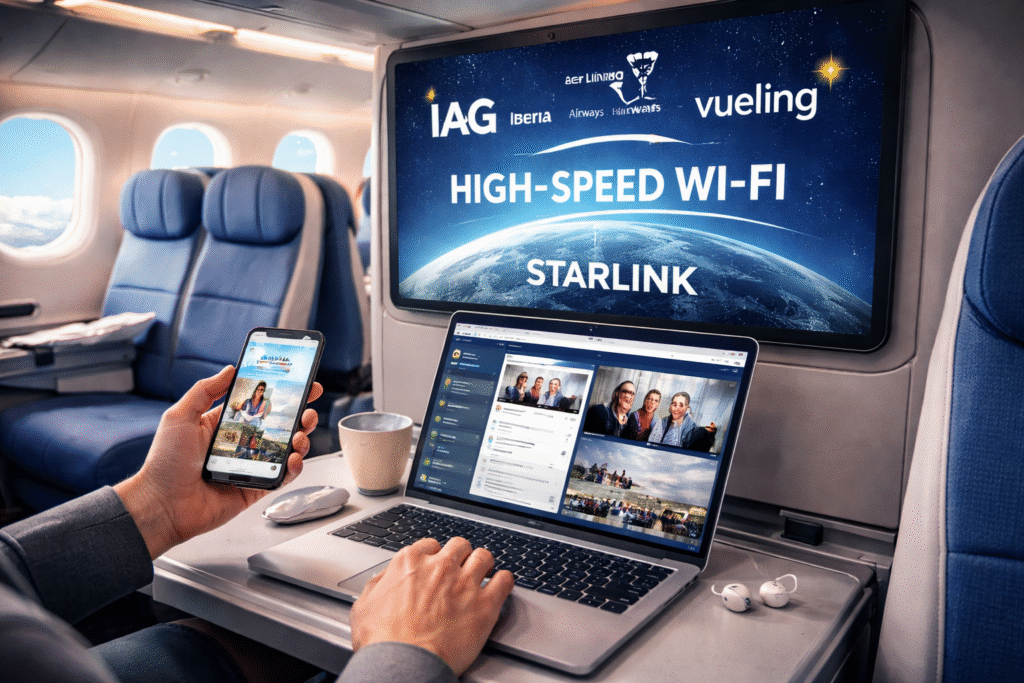
International Airlines Group has announced a major transformation of the in-flight experience with plans to equip more than 500 aircraft across its airline portfolio with next-generation high-speed Wi-Fi. Through a strategic partnership with Starlink, the airline group aims to deliver lightning-fast, reliable internet connectivity to passengers by 2026, positioning itself as one of the most digitally advanced airline groups in Europe.
The ambitious rollout will span IAG’s major carriers, including British Airways, Aer Lingus, Iberia, LEVEL, and Vueling. Once completed, the initiative will significantly reshape how passengers stay connected in the air, whether flying short-haul routes within Europe or long-haul services across continents.
A Step Change in Passenger Connectivity
As passenger expectations continue to evolve, in-flight connectivity has shifted from a luxury to a necessity. IAG’s decision reflects the reality that modern travelers increasingly expect the same digital access in the air as they enjoy on the ground. With Starlink’s low-Earth orbit satellite technology, passengers will be able to browse the internet, stream high-definition content, join video calls, and work online without the interruptions traditionally associated with airborne Wi-Fi.
Unlike older satellite systems that rely on geostationary satellites far from Earth, Starlink operates thousands of satellites in low Earth orbit. This dramatically reduces latency and increases speed, enabling a smoother, more consistent connection even over oceans and remote regions. For passengers, this means fewer dropouts, faster load times, and a far more dependable digital experience from gate to gate.
Transforming Short-Haul and Long-Haul Travel
The scale of the project is notable. More than 500 aircraft, representing the majority of IAG’s fleet, will be fitted with Starlink equipment. This ensures that connectivity improvements will not be limited to premium long-haul routes alone. Short-haul European flights, often used by business travelers and frequent flyers, will also benefit from the same high-speed access.
On long-haul services, enhanced connectivity is expected to transform productivity and comfort. Business travelers will be able to remain connected to teams and clients throughout their journey, while leisure passengers can enjoy uninterrupted entertainment, social media, and messaging. For many, this will fundamentally change perceptions of long-distance flying, making extended journeys feel shorter and more engaging.
A Competitive Advantage in a Digital Aviation Era
In an increasingly competitive global aviation market, technology has become a key differentiator. IAG’s fleet-wide adoption of Starlink places it ahead of many rival airline groups that still rely on older connectivity solutions or limited coverage. While several international airlines have begun experimenting with next-generation satellite Wi-Fi, the scale and speed of IAG’s rollout make it one of the most ambitious connectivity upgrades undertaken by a European airline group.
The move also strengthens IAG’s premium positioning, particularly for its flagship carriers. Enhanced connectivity complements existing investments in cabin design, onboard service, and digital platforms, reinforcing the group’s focus on delivering a seamless end-to-end travel experience.
What Passengers Can Expect Onboard
Although detailed pricing and access models may vary by airline and cabin class, the overarching goal is to make high-quality connectivity widely accessible. Full-service carriers within the group are expected to integrate Wi-Fi into their broader customer experience, while low-cost brands may offer flexible access options tailored to different traveler needs.
Importantly, the technology is designed to support multiple devices simultaneously, allowing passengers to connect smartphones, tablets, and laptops without significant performance loss. This aligns with the realities of modern travel, where passengers often rely on several connected devices throughout a journey.
Supporting a Broader Digital Strategy
The Starlink partnership forms part of IAG’s wider digital transformation agenda. Beyond passenger convenience, enhanced connectivity opens new opportunities for operational efficiency and innovation. Faster, more reliable onboard internet enables improved real-time data sharing between aircraft and ground teams, supporting smarter maintenance planning, enhanced safety monitoring, and more responsive customer service.
In the longer term, robust connectivity also lays the foundation for future advancements such as personalized onboard services, real-time content updates, and greater integration between airline apps and onboard systems. These developments reflect a broader industry shift toward data-driven, connected aviation.
Setting New Standards for In-Flight Experience
As remote work, digital entertainment, and constant connectivity become embedded in everyday life, airlines that fail to adapt risk falling behind. IAG’s decision to invest at scale sends a clear signal about its long-term vision for air travel. By treating connectivity as a core part of the passenger experience rather than an optional add-on, the group is helping to redefine what travelers can expect when they step onboard.
Looking Ahead
With installations expected to begin ahead of full deployment by 2026, passengers flying with IAG’s airlines can look forward to a future where being offline at 35,000 feet is no longer the norm. The partnership with Starlink not only enhances comfort and convenience but also positions IAG as a leader in the next phase of aviation innovation.
As the industry continues to evolve, this move may well set a new benchmark for in-flight connectivity, influencing airline strategies far beyond Europe. For travelers, it marks the arrival of a new era where the sky is no longer a barrier to staying connected.
For more travel news like this, keep reading Global Travel Wire