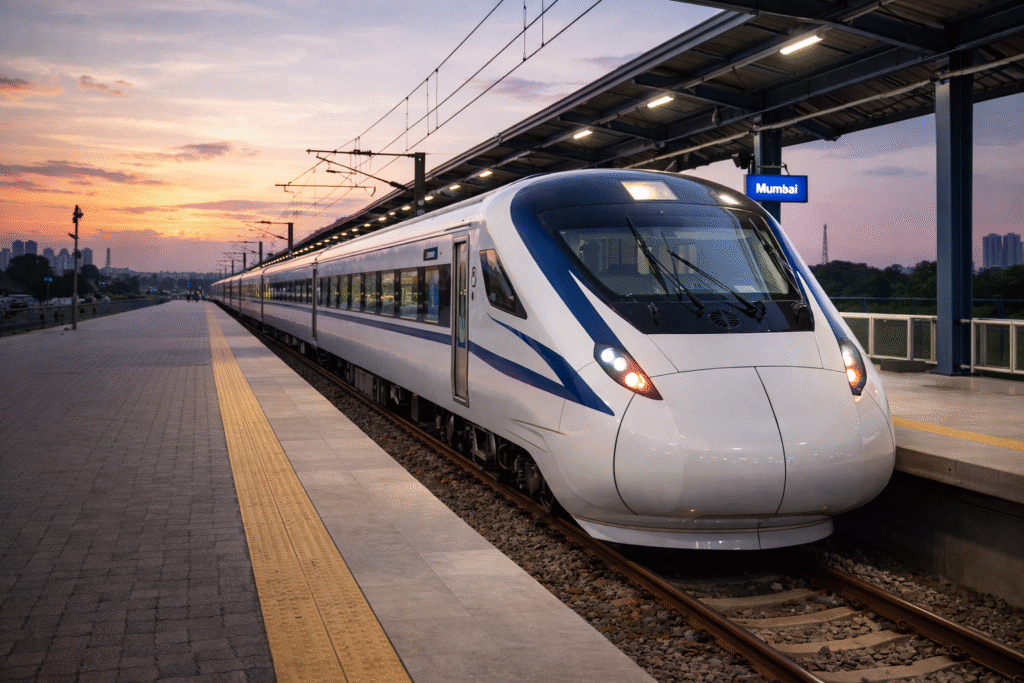
India is on the brink of a historic transformation in rail travel with the Mumbai–Ahmedabad High-Speed Rail corridor scheduled to begin operations by August 15, 2027. This landmark project, being implemented by Indian Railways, is poised to redefine intercity travel, tourism mobility, and economic connectivity across western India. Once operational, the bullet train will introduce a new era of speed, comfort, and efficiency, placing India firmly on the global high-speed rail map.
The ambitious corridor connects Mumbai and Ahmedabad, two of the country’s most influential economic and cultural hubs. The project has been envisioned as more than just a transport upgrade; it represents a structural shift in how people travel for business, leisure, and tourism across one of India’s busiest corridors.
A Dramatic Reduction in Travel Time
One of the most transformative aspects of the bullet train is its impact on journey duration. The current rail and road travel time between Mumbai and Ahmedabad ranges from seven to eight hours. The new high-speed service will reduce this to approximately two hours, enabling same-day travel for work, leisure, and tourism.
This drastic reduction in travel time is expected to change travel behaviour across the region.Extraction of time from travel allows tourists to explore more destinations in shorter trips, encourages weekend tourism, and supports spontaneous travel decisions. For business travellers, it means greater productivity and easier access to multiple cities in a single day.
Phased Launch for Early Benefits
The Mumbai–Ahmedabad bullet train corridor, stretching over 500 kilometres, will be commissioned in phases. Initial operations are planned on shorter stretches such as Surat–Bilimora, followed by expansions covering Vapi–Surat and Vapi–Ahmedabad. The final phase will complete the connection from Thane to Ahmedabad, establishing seamless end-to-end connectivity.
This phased rollout ensures that passengers begin experiencing the benefits of high-speed rail even before the full corridor is completed. It also allows for gradual integration of technology, operations, and passenger services, ensuring safety and reliability from the outset.
World-Class Technology Meets Indian Rail
The project is being developed using Japanese Shinkansen technology, globally recognised for its safety record, precision, and operational excellence. This technology brings international standards of high-speed rail to India, including advanced signalling systems, earthquake detection mechanisms, and aerodynamic train design.
More than 85 percent of the corridor is elevated, minimising land disruption and ensuring smoother, faster travel. The rapid progress of viaduct construction and river bridges highlights the scale and engineering sophistication of the project. Modern stations, designed as integrated transport and commercial hubs, are being developed along the route, setting new benchmarks in rail infrastructure.
Connecting Cities, Cultures, and Tourism
The bullet train will serve several key cities across Maharashtra and Gujarat, including Thane, Vapi, Surat, Bharuch, Vadodara, and Ahmedabad. These cities are not only major business and industrial centres but also gateways to rich cultural heritage, cuisine, and tourism experiences.
For rail tourism, the impact is expected to be substantial. Faster and more comfortable travel will make destinations along the corridor more accessible to domestic and international tourists. Cities such as Surat and Vadodara, known for their historic sites, festivals, and local markets, are likely to see increased visitor footfall. Ahmedabad, with its UNESCO-recognised heritage, riverfront developments, and cultural institutions, stands to gain significantly from enhanced connectivity.
The bullet train also encourages multi-destination travel, allowing tourists to explore several cities within a short time frame. This aligns with evolving travel trends that favour experiential tourism and efficient mobility.
Enhancing Passenger Experience
Beyond speed, the Mumbai–Ahmedabad bullet train promises a superior passenger experience. Modern interiors, comfortable seating, smooth rides, and advanced safety features will elevate rail travel to a level previously unseen in India. The convenience of city-centre stations, reduced security formalities compared to air travel, and predictable travel times further strengthen its appeal.
For tourists, this means less time spent in transit and more time exploring destinations. For families and leisure travellers, the train offers a stress-free alternative to congested highways and airports.
Economic and Tourism Ripple Effects
The high-speed rail corridor is expected to generate wide-ranging economic benefits. Improved connectivity encourages investment, supports regional development, and boosts hospitality and service industries along the route. Tourism, in particular, stands to benefit from increased accessibility and higher travel volumes.
The project also strengthens India’s position as a destination capable of hosting international conferences, exhibitions, and large-scale events, supported by fast and reliable intercity travel. This integration of transport and tourism infrastructure enhances the country’s global competitiveness.
A Blueprint for India’s Rail Future
The Mumbai–Ahmedabad bullet train is widely seen as a pilot for future high-speed rail corridors across India. Its successful implementation will pave the way for similar projects connecting other major regions, further transforming the nation’s travel landscape.
As the 2027 launch approaches, anticipation continues to build among travellers, industry stakeholders, and tourism operators. The project symbolises India’s commitment to modern infrastructure, sustainable mobility, and world-class travel experiences.
When the first bullet train departs, it will not only mark the beginning of a faster journey between Mumbai and Ahmedabad but also signal a bold new chapter in India’s rail tourism story—one defined by speed, comfort, connectivity, and opportunity.
For more travel news like this, keep reading Global Travel Wire