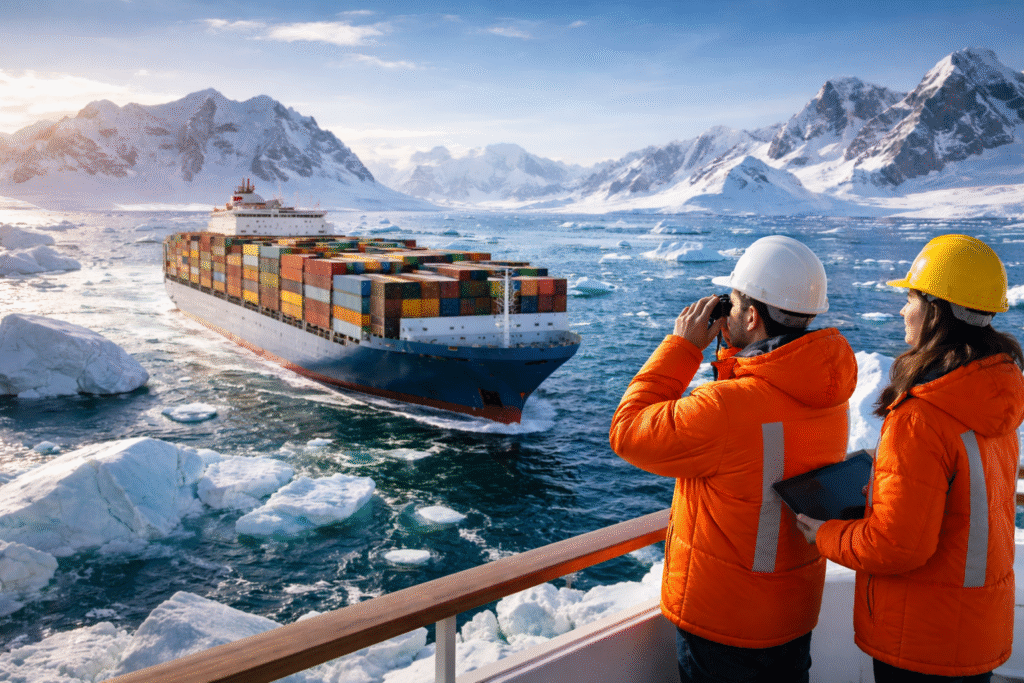
South Korea is preparing to redefine global travel and trade through a bold Arctic shipping initiative. The Ministry of Oceans and Fisheries plans a trial voyage in September. A 3,000 TEU-class container ship will sail from Busan to Rotterdam.
This ambitious project supports South Korea’s goal to strengthen its position in global logistics. Officials see the Arctic route as a strategic breakthrough. The initiative also aligns with national policies to expand maritime leadership.
A Shorter and Faster Link Between Asia and Europe
The Arctic route offers a dramatic reduction in distance and time. Traditional routes through the Suez Canal cover about 20,000 kilometers. Ships often spend close to 30 days at sea.
The Arctic corridor shortens the journey to around 13,000 kilometers. Travel time could drop to nearly 20 days. This efficiency promises faster cargo movement and improved supply chain reliability.
For global industries, these gains could translate into lower costs and quicker market access. The implications extend beyond shipping into tourism, business travel, and international commerce.
Why the Arctic Route Matters for Global Travel
Shipping routes shape global travel patterns and economic flows. Faster shipping supports smoother logistics for airlines, cruise operators, and tourism suppliers. Reduced transit times improve access to goods and services worldwide.
South Korea’s Arctic initiative could also influence future passenger travel. Infrastructure developed for shipping often supports research, tourism, and polar exploration. This route could open new opportunities for Arctic-related travel industries.
Congestion and Risk Push Change
The Suez Canal remains vital but faces growing pressure. Increased traffic has led to congestion and delays. Political instability and security risks add uncertainty.
The Arctic route offers a compelling alternative. By avoiding crowded waterways, ships gain predictability and efficiency. South Korea aims to provide a stable option for long-term trade planning.
Diplomatic Challenges Remain Central
The Arctic corridor relies heavily on the Northern Sea Route. This passage crosses waters controlled by Russia. South Korea must secure Russian cooperation for navigation approval.
Diplomatic engagement will play a decisive role. Officials plan talks with Russian authorities to ensure safe passage. These discussions carry added complexity due to international sanctions.
South Korea must balance global alliances with strategic interests. Successful diplomacy will determine whether the Arctic route becomes commercially viable.
Insurance and Cost Pressures Test Viability
Financial factors present another major challenge. Arctic operations carry higher risks due to ice, weather, and remoteness. Insurance premiums rise sharply above 60 degrees north latitude.
Studies show significant cost increases for vessels on this route. A 5,000 TEU ship could face insurance hikes exceeding hundreds of thousands of dollars. These costs may discourage early adoption.
The government recognizes this barrier. Officials are exploring incentives to offset initial expenses. These measures aim to attract shipping companies during the early phase.
Government Incentives to Drive Adoption
South Korea plans to support early participants financially. Incentives may include subsidies, fee reductions, or operational guarantees. These steps could reduce risk for shipping firms.
Authorities expect economies of scale over time. As more ships use the route, costs should stabilize. Long-term adoption could make the Arctic corridor competitive with traditional routes.
The September trial voyage will test these assumptions. Its success will influence future investment and participation.
Attracting Industry Confidence
Shipping companies remain cautious. Harsh Arctic conditions and limited infrastructure raise concerns. Cargo networks along the route remain underdeveloped.
The trial voyage aims to address these doubts. A successful journey would prove operational feasibility. It would also demonstrate safety and efficiency under real conditions.
Industry confidence will depend on results. Reliable data from the trial will shape future commitments.
Environmental Benefits Strengthen the Case
The Arctic route offers environmental advantages. Shorter distances reduce fuel consumption. Lower emissions support global sustainability goals.
Many companies now face pressure to cut carbon footprints. The Arctic corridor could help meet these targets. This appeal may attract environmentally focused businesses.
South Korea views sustainability as a strategic advantage. The route could support greener global trade practices.
Long-Term Impact on Travel and Trade
If proven viable, the Arctic route could reshape global logistics. Faster shipping would reduce inventory delays and costs. Businesses could respond more quickly to demand shifts.
Tourism and travel sectors would also benefit indirectly. Efficient supply chains support smoother operations across hospitality and transport industries.
Over time, the Arctic route could encourage new forms of Arctic travel. Research expeditions and niche tourism may expand alongside shipping activity.
A Defining Moment for Global Connectivity
South Korea’s Arctic initiative marks a turning point in global trade thinking. The project challenges long-established routes and assumptions. Success would place South Korea at the forefront of maritime innovation.
The September trial voyage stands as a critical milestone. It will test diplomacy, economics, and operational readiness. The outcome will shape future global shipping patterns.
If successful, the Arctic route could usher in a new era of faster, greener, and more resilient global connectivity.
For more travel news like this, keep reading Global Travel Wire