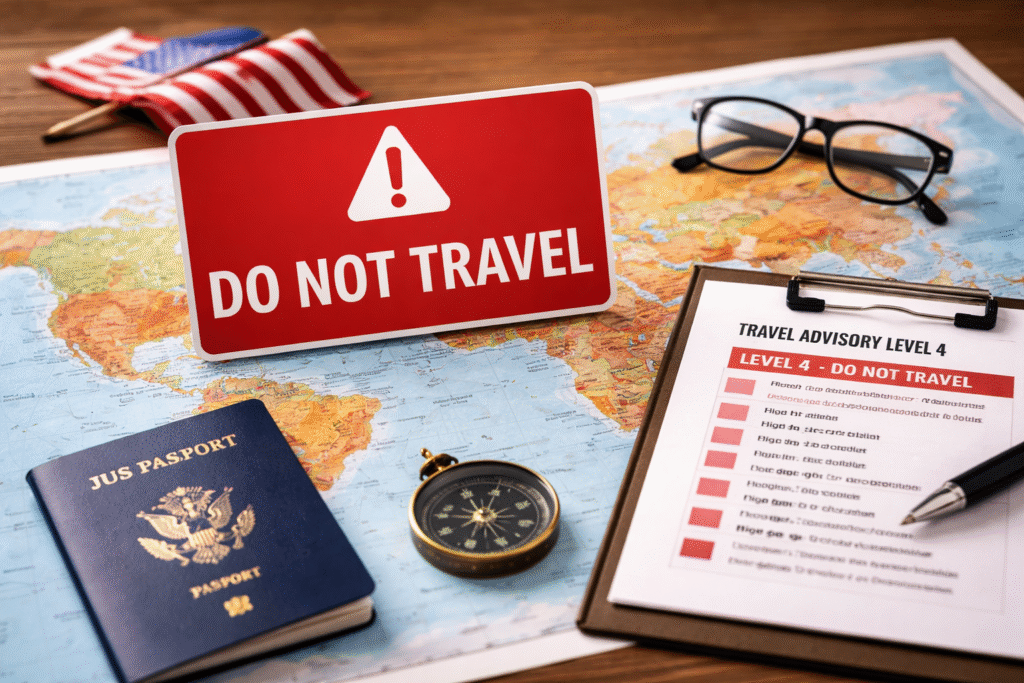
The United States has issued one of its most extensive travel advisories in recent years, designating more than 20 countries as Level 4 “Do Not Travel” destinations. The alert highlights growing security challenges across several regions, from conflict zones to areas impacted by political collapse and severe crime.
The advisory does not legally prohibit travel by Americans. Instead, it serves as a high-priority warning that conditions in these nations pose life-threatening risks. Other governments, including Canada, the United Kingdom and Australia, maintain parallel advisory systems and continue to monitor similar threat indicators.
What Level 4 Means
The U.S. travel advisory system uses four tiers:
- Level 1 – Normal precautions
- Level 2 – Increased caution
- Level 3 – Reconsider travel
- Level 4 – Do not travel
Level 4 is reserved for extreme environments. It signals that the government may have limited or no capacity to provide emergency support, including evacuation or consular assistance.
Countries on the Level 4 List
The current Level 4 advisory covers the following countries:
Afghanistan, Belarus, Burkina Faso, Burma (Myanmar), Central African Republic, Haiti, Iran, Iraq, Lebanon, Libya, Mali, Niger, North Korea, Russia, Somalia, South Sudan, Sudan, Syria, Ukraine, Venezuela and Yemen.
These countries span multiple continents and represent a broad spectrum of geopolitical and humanitarian crises. For many, travel disruptions are not only likely but expected.
Why These Destinations Are Considered High-Risk
Several core factors underpin the designation:
1. Active Armed Conflicts
Countries such as Ukraine, Syria and Afghanistan continue to experience ongoing military conflicts. Frontlines can shift quickly, civilian infrastructure may be targeted and unexploded ordnance remains a hazard.
2. Terrorism and Extremist Violence
Parts of the Sahel region, including Mali, Niger and Burkina Faso, face frequent attacks by extremist groups. Somalia and Libya also struggle to contain militant networks and armed factions.
3. Political Instability and Civil Unrest
Venezuela and Haiti illustrate how internal crises can escalate into high-risk environments. Economic collapse, weak policing and gang control have reduced state capacity to protect citizens and visitors.
4. Crime and Kidnapping Threats
In several Level 4 nations, kidnapping for ransom and organised criminal activity are persistent risks. Foreign nationals are sometimes targeted due to perceived wealth or diplomatic value.
5. Limited Diplomatic Assistance
Some Level 4 countries have restricted U.S. diplomatic presence. North Korea, for example, offers almost no access for American consular officials. In conflict zones, embassy operations may be suspended entirely.
Impact on Travellers and Tourism
The advisory carries wide-ranging effects for travellers, airlines and global tourism industries.
Travel Itinerary Changes
Americans are urged to cancel or postpone travel to these destinations. Students, humanitarian workers and business travellers may need revised plans or alternative routes.
Insurance Restrictions
Many travel insurance providers exclude coverage for war zones, terrorism and civil disorder. Claims arising from trips to Level 4 nations may be denied, leaving travellers financially vulnerable during emergencies.
Reduced Tourism Revenue
Countries on the advisory list already face steep declines in international tourism due to instability. For many, tourism once served as a key source of jobs and revenue. Recovery timelines now depend on security improvements and diplomatic negotiations.
Global Advisory Coordination
International travel advisories often align indirectly. When the U.S. escalates a destination to Level 4, other countries may update their own guidance. Airlines and tour operators also review risk exposure and adjust schedules.
Advice for Americans Traveling Abroad
The U.S. government urges travellers to take proactive safety steps before any overseas trip, especially to volatile regions. Recommended preparations include:
- Checking the latest travel advisory status
- Reviewing emergency contact procedures
- Learning local laws and security conditions
- Enrolling in travel alert programs for real-time updates
- Preparing evacuation or shelter-in-place plans
These steps aim to reduce risk during crises such as protests, power outages or border closures.
Human Side of the Advisory
The warning resonates with families, students and professionals who view travel as part of education and cultural exchange. Yet global conditions show that tourism depends on stability. When conflict and governance break down, entire regions become inaccessible, and the freedom to explore is replaced by concern for personal safety.
Conclusion
The expanded Level 4 “Do Not Travel” list underscores how rapidly global security landscapes can shift. From wars to political upheaval, multiple crises now overlap in ways that disrupt travel and weaken safety nets for foreign visitors. For U.S. citizens and the global tourism sector, these advisories highlight the importance of informed planning and situational awareness in an unpredictable world.
For more travel news like this, keep reading Global Travel Wire