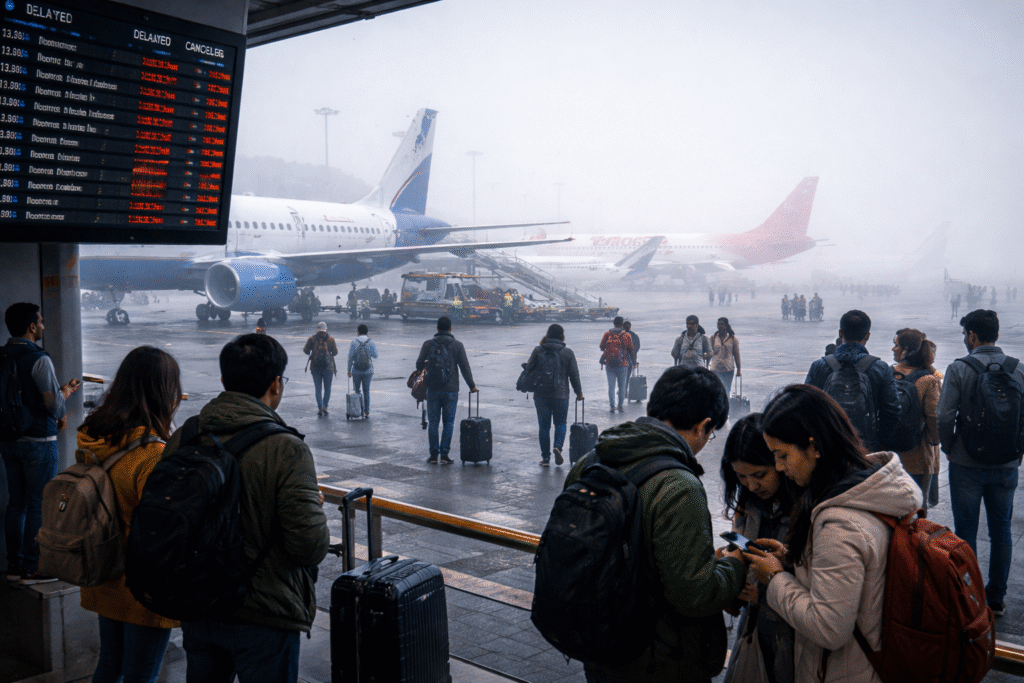
Northern India faced dense winter fog that caused serious travel disruptions across major airports. Airlines issued advisories as visibility dropped across key aviation routes. Travelers experienced delays, diversions, and cancellations as flight schedules shifted throughout the morning rush. The dense fog affected both domestic and international operations, which increased delays at major travel hubs.
Major Airlines Issue Passenger Advisories
IndiGo, Air India, and SpiceJet released public alerts that warned of weather-related disruptions. These advisories urged passengers to monitor flight status updates and allow extra time for transit. Fog-related operational challenges peak during winter in Northern India, and these airlines prepared for higher passenger volumes during the season.
Flight schedules faced disruption across Delhi, Varanasi, Jammu, and Chandigarh. Several secondary airports also experienced delays due to low visibility and runway slowdowns. Travel demand remained high due to seasonal movement and winter tourism. This increased pressure on airlines that attempted to maintain planned schedules.
Air India Warns Travelers About Visibility Reductions
Air India reported reduced visibility at several airports, which created challenges for landing and takeoff operations. The airline highlighted visibility issues in Delhi, Udaipur, Varanasi, Amritsar, Jammu, and Chandigarh. Morning departures and arrivals faced the most disruption due to the fog layer that forms during dawn hours.
Air India deployed additional ground staff to support travelers who needed rebooking or routing adjustments. Travelers flying to or from Northern India received guidance to check flight statuses before traveling to airports. Air India also reminded travelers that safety remained the highest operational priority during winter weather events.
IndiGo Reports Sudden Visibility Drops at Major Airports
IndiGo issued alerts for several Northern Indian cities, including Delhi, Lucknow, Patna, Jaipur, Kanpur, Chandigarh, and Dehradun. The airline explained that visibility levels can drop suddenly in winter due to regional temperature inversions that form overnight. These conditions limit air traffic movements during peak travel windows.
Passengers flying with IndiGo faced delays due to reduced runway capacity. Many flights required longer separation intervals during approach and departure. IndiGo encouraged travelers to remain flexible and adjust travel plans to accommodate weather-related changes.
SpiceJet Notes Disruptions Across the Morning Rush
SpiceJet issued a broad advisory that included routes through Delhi, Jammu, Gorakhpur, Varanasi, Patna, Guwahati, and Srinagar. The airline warned of cascading delays due to flight rotations. Operators attempted to manage congestion by rescheduling flights and changing runway assignments during peak fog hours.
SpiceJet activated assistance teams to manage queries at major airports and support travelers seeking revised timings. Ground crews also prepared for extended connection delays across the network. Many travelers experienced longer airport wait times as operational adjustments continued through the morning period.
Winter Fog Challenges India’s Aviation Sector Each Season
Dense winter fog disrupts aviation across Northern India each year. Fog reduces visibility, which complicates runway movements, approach patterns, and gate scheduling. Many airports use instrument landing systems that support limited visibility operations. However, dense fog can still restrict movements for safety reasons.
Delhi’s major airport handles a large share of winter traffic. The airport uses advanced landing systems to support operations in low visibility. However, heavy fog events still slow traffic during landing peaks and create delays that spread to later flights. The cascading effect increases disruption at airports across the region.
Tourism Impact as Seasonal Travel Demand Rises
The fog arrived during a busy period for outbound and domestic tourism in India. Winter tourism attracts travelers to destinations such as Jaipur, Varanasi, and Srinagar. Pilgrimage tourism also increases activity through airports in Ayodhya, Varanasi, and Jammu. These travel trends increase passenger volume during winter fog events.
International travelers experienced delays at major hubs as flight operations slowed during morning schedules. Rebooking delays affected transit passengers traveling through Delhi. Tourism analysts noted that winter fog events generate seasonal travel stress across the aviation network each year.
Passengers Encouraged to Monitor Weather and Status Updates
Airlines encouraged passengers to check real-time flight updates before departure. Road visibility also decreased during heavy fog events, so travelers faced slower airport travel as well. Airlines reminded passengers to allocate extra time for airport security and check-in procedures during winter conditions.
Passengers with flexible schedules opted to travel later in the day to reduce disruption risk. Afternoon departures face fewer fog issues because the fog layer lifts as temperatures rise. Travel experts recommend this strategy for winter travelers who want to reduce flight uncertainty.
Northern India Braces for Continued Fog Activity
Meteorological forecasts suggested that fog conditions will persist throughout the month. Airlines prepared for continued operational adjustments to protect safety and manage scheduling. Authorities advised passengers to remain informed and plan ahead as winter travel continues.
Seasonal fog remains a recurring challenge for Northern India’s aviation network. However, airline advisories, proactive planning, and traveler awareness can mitigate disruption during peak fog periods.
For more travel news like this, keep reading Global Travel Wire