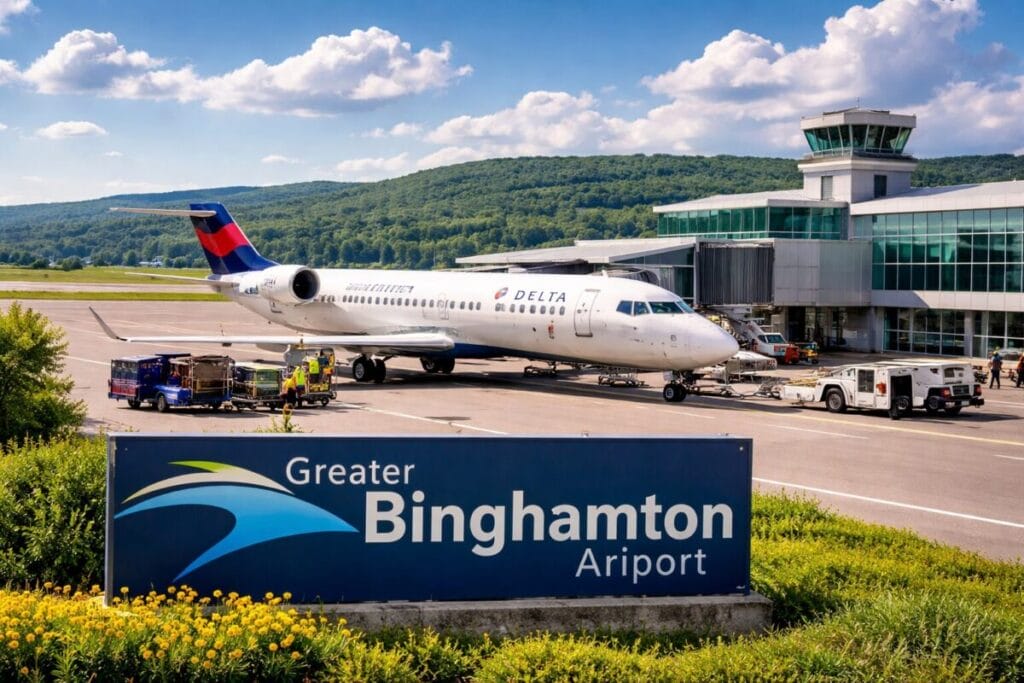
Delta Air Lines will continue operating from Greater Binghamton Airport after reversing a plan to end service in early 2026. The decision followed strong advocacy from state leaders who emphasized the vital role of regional air access for tourism, economic mobility, and local communities. The outcome has been celebrated across New York, especially in the Southern Tier, where Binghamton serves as the only commercial airport.
Earlier Withdrawal Would Have Cut All Commercial Flights
Delta had previously announced the suspension of its Binghamton–Detroit route, which would have left the airport without any scheduled airline. The cancellation threatened to isolate the region from national travel networks and disrupt tourism flows. It also would have forced travelers to rely on distant airports in Syracuse, Elmira, or Scranton.
The Detroit route is modest in mileage, yet it is strategically important. Detroit Metropolitan Airport functions as a major national hub, allowing smooth onward connections to dozens of U.S. and international destinations. For tourists, students, and business travelers, the route serves as a bridge between the Southern Tier and the wider travel ecosystem.
State Advocacy Secures Air Connectivity
New York officials quickly engaged with Delta after the withdrawal plan surfaced. Concerns centered on tourism access, workforce mobility, and the long-term economic impact on an already service-dependent region. While the route does not benefit from federal Essential Air Service subsidies, its value for the local economy is well recognized.
Through coordinated dialogue, state leaders underscored why air connectivity remains fundamental for communities that rely heavily on travel-based industries and regional commerce. Delta reversed course, confirming that daily service will continue and gradually scale back to pre-suspension levels.
Binghamton Airport’s Role in Regional Travel and Tourism
Greater Binghamton Airport plays a unique role in the Southern Tier. It supports business travel for major employers, attracts visitors to local tourism assets, and enables students to access top regional universities. Healthcare providers and medical tourism also depend on quick travel connections to larger metropolitan areas.
Tourism officials have long argued that access matters as much as destination appeal. Without flights, the region would become harder to reach and less competitive when compared to other leisure markets. The Detroit link keeps Binghamton visible within the national tourism network and sustains consistent visitor inflows.
Aviation Decisions Influenced by More Than Profit
Airline network planning remains driven by efficiency, aircraft availability, and market performance. Yet the Binghamton case shows how route decisions can intersect with government policy and community interests. Airlines often take into account the broader implications of withdrawing from small markets, especially in regions where state partnerships support tourism growth.
New York has increased investments in aviation infrastructure and tourism promotion in recent years. Airport modernization programs aim to strengthen passenger experience, enhance security processing, and support future route development. These initiatives created a policy environment in which cutting air service carries reputational stakes for airlines with large footprints in the state.
Delta Air Lines’ Strategic Position in New York
Delta remains one of New York’s most prominent carriers, operating major facilities at John F. Kennedy International Airport and LaGuardia Airport. The airline employs thousands across the state and contributes significantly to tourism and trade. Maintaining Binghamton service helps protect that relationship and demonstrates continued commitment to statewide connectivity.
By staying in the Southern Tier, Delta preserves its role as the region’s sole commercial carrier while sustaining feeder traffic into its Detroit hub. That hub connection benefits Delta as well, as it channels higher-yield traffic from smaller communities into larger domestic and international markets.
Economic and Tourism Benefits for the Southern Tier
Tourism stakeholders in the region have welcomed the decision. Local hotels, restaurants, cultural institutions, and event venues depend on reliable air access. Colleges and universities attract out-of-state students and visiting families, while medical centers draw patients seeking specialized treatment. All of these sectors face reduced demand when air access declines.
Regional planners have noted that visitation trends in smaller U.S. cities often correlate with the availability of direct air routes. Removing service can create a cascading effect, lowering visitor spending and weakening brand visibility for the destination. Maintaining the Detroit flight prevents these negative travel impacts.
Broader Lessons for U.S. Regional Airports
The episode highlights the fragile position of regional airports that rely on a single airline. Without multiple carriers or subsidy protections, these markets remain vulnerable to network changes driven by aircraft supply and labor constraints. Many regional airports across the country face similar pressures as airlines retire smaller jets and consolidate routes toward larger hubs.
Policy experts have suggested that continued state-level involvement may become more common as air access grows increasingly linked to tourism and economic development goals.
Bottom Line
Delta’s decision to retain service at Greater Binghamton Airport has protected an essential travel connection for the Southern Tier. The move supports tourism, strengthens local business travel, and keeps the region plugged into national and international air networks. It also reinforces the idea that aviation strategy and public policy can align when regional vitality is on the line.
For more travel news like this, keep reading Global Travel Wire