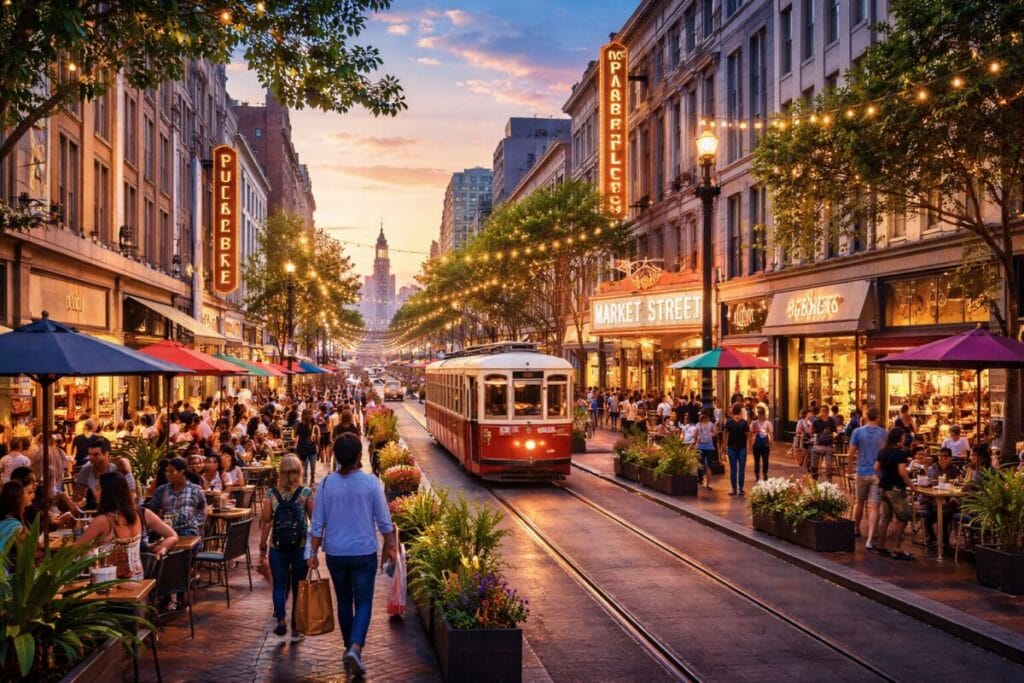
San Francisco’s Mid-Market district, once known for its theaters, nightlife, and bustling retail corridors, is preparing for a pivotal year in 2026 as city leaders pursue an ambitious revitalization strategy aimed at restoring confidence among businesses, travelers, and residents. After years of economic strain, business closures, and persistent social challenges, the district is now backed by new development funds, cultural initiatives, and a vision for transforming Market Street into a modern urban destination.
Located between Civic Center and SoMa, Mid-Market has historically served as a gateway to San Francisco’s urban identity. Yet the area’s recovery from the pandemic has been uneven, with small businesses facing reduced foot traffic and hotels experiencing weakened visitor demand. For tourism officials and city planners, Mid-Market represents both the challenge and the opportunity of San Francisco’s broader economic restoration.
Confronting the Area’s Most Pressing Challenges
One of the district’s most visible hurdles has been the ongoing presence of nighttime drug activity and related street behavior, which has impacted visitor perceptions and discouraged investment in the area. While daytime enforcement has reduced some illegal activity, the lingering issues after dark continue to hinder local commerce, limiting the area’s competitiveness against other entertainment districts in the city.
City leadership has responded with targeted policy proposals focused on enforcement, health interventions, and street-level improvements. Mayor Lurie has emphasized a multi-agency approach that prioritizes public safety alongside support systems designed to address addiction and homelessness. For tourism and hospitality leaders, public safety improvements will be essential to restoring the district’s reputation and attracting event organizers, tourists, and convention attendees.
New Funding and Development Drive Revitalization in 2026
After years of stalled redevelopment efforts, 2026 marks the beginning of a coordinated public-private strategy led by the San Francisco Downtown Development Corporation, which has launched with an initial $60 million allocation. The fund is designed to support small business activation, revive vacant storefronts, and attract investors willing to test new concepts in the neighborhood.
One of the signature efforts is a retail activation program encouraging pop-up stores, culinary concepts, and creative businesses to take temporary or subsidized retail space along Market Street. These shorter-term leases offer entrepreneurs a runway to test demand while filling empty storefronts that once contributed to the district’s visual blight. City officials hope that successful tenants will transition into permanent leases and help rebuild the district’s commercial identity.
Mixed-Use Redevelopment and Housing Innovation
The city’s long-term vision for Mid-Market also involves reimagining existing building stock. Underutilized office buildings, affected by San Francisco’s shift to remote and hybrid work patterns, are now candidates for residential conversion. Initiatives converting older office towers into compact housing units and housing pods are generating momentum in 2026, reflecting broader national discussions about the future of downtowns.
Increasing residential density is expected to support retail recovery by providing a local customer base for restaurants, cafés, markets, and entertainment venues. Tourism analysts note that mixed-use neighborhoods with residents, office workers, and tourists typically show stronger long-term resilience.
Tourism, Events and Hotel Sector Eye Gradual Comeback
San Francisco’s hotel sector experienced notable strain in the years following the pandemic, and Mid-Market properties were no exception. Newly opened hotels struggled to attract steady business, with some food and beverage outlets shutting down shortly after launch due to low occupancy and reduced convention traffic. However, 2026 is expected to deliver new opportunities as the city prepares to host major events, sports tourism, and international conferences.
Large-scale sporting events, including the Super Bowl and FIFA-related programming, are projected to boost regional hotel bookings, creating spillover demand into Mid-Market hotels. Convention planners are also returning to San Francisco’s Moscone Center, bringing renewed visitor spending into retail and dining corridors.
Cultural Revival and the Potential Theater District
Perhaps the most culturally ambitious component of the revitalization effort is the proposal to formalize a Mid-Market Theater District. Historically, the neighborhood was home to some of the Bay Area’s most important movie and live theater venues. Landmark institutions such as the Orpheum and Golden Gate theaters anchor the corridor and offer a foundation for a structured entertainment district that could support tourism and local arts.
The creation of a designated theater district could drive evening foot traffic, reinvigorate pre-show dining culture, and establish Mid-Market as a cohesive cultural brand rather than a transitional urban zone. Similar strategies have proven successful in cities such as Chicago and New York, where theater districts play central roles in their tourism ecosystem.
Can Mid-Market Stage a Full Comeback?
The road to recovery will require sustained cooperation among city stakeholders, developers, small business owners, artists, and tourism advocates. While early revitalization efforts are promising, success will depend on the district’s ability to address safety, stimulate investment, attract cultural audiences, and rebuild a sense of place.
If these elements align, Mid-Market could once again emerge as one of San Francisco’s most vibrant districts — a place where residents mingle with theater-goers, tourists explore historic landmarks, and small businesses thrive alongside new development.
For now, 2026 represents both the challenge and the opportunity: a test of whether coordinated public-private action can restore Mid-Market as a cultural, commercial, and tourism hub at the heart of San Francisco.
For more travel news like this, keep reading Global Travel Wire