Singapore’s cultural tourism scene is poised for a vibrant season as the Asian Civilisations Museum (ACM) prepares to open Garden of Senses: A Tea Reverie, a landmark exhibition that merges heritage storytelling, sensory immersion, and contemporary design. Presented in partnership with international tea brand CHAGEE and supported by the Singapore Tourism Board (STB), the exhibition will run daily from 28 January to 7 June 2026, signaling a growing appetite for experiential travel experiences that engage visitors beyond traditional museum viewing.
At a time when global travelers are increasingly motivated by culture-led itineraries, the exhibition positions tea as a bridge between history, craftsmanship, and social connection. Instead of treating tea solely as a beverage, Garden of Senses reframes it as a cultural language shared across regions and generations. Through curated thematic spaces, guests are invited to experience tea through sight, sound, texture, fragrance, and reflection, transforming a familiar ritual into a journey of heritage and emotion.
Heritage Meets Contemporary Lifestyle Culture
The exhibition represents ACM’s first collaboration with an international lifestyle brand—an example of how cultural institutions are expanding beyond traditional curatorial models. The partnership aligns with Singapore’s broader tourism strategy, which promotes the city as a hub where global heritage, design innovation, and modern consumer culture intersect. By integrating historical artifacts alongside contemporary artistic responses, Garden of Senses presents tea culture as a living tradition that continues to evolve.
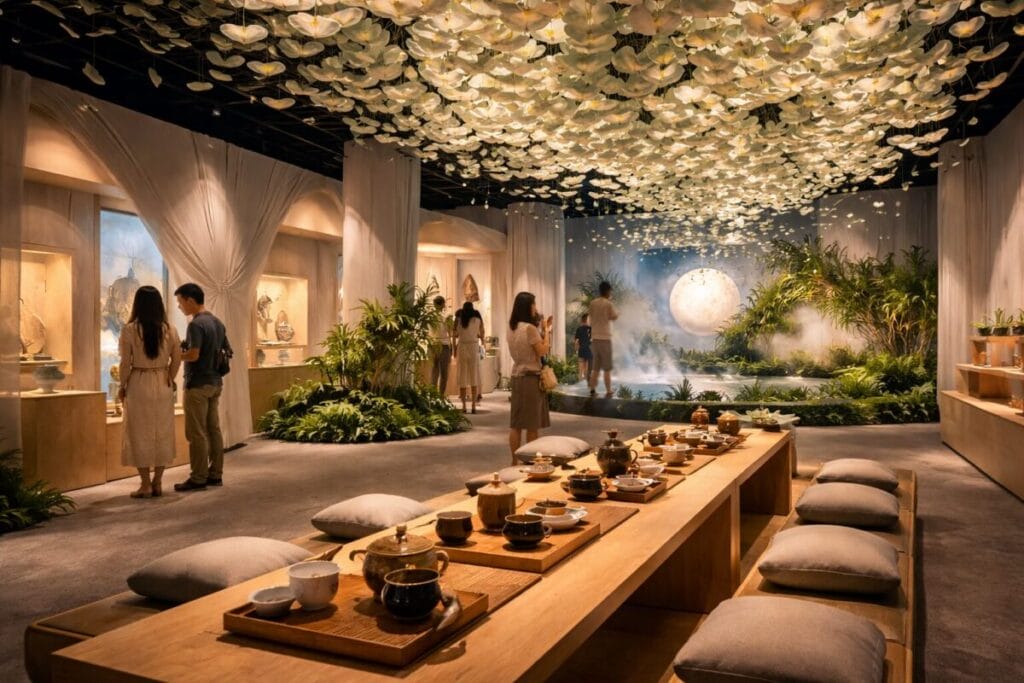
Visitors can view 3D-printed interpretations of historic tea utensils, contemporary brewing vessels, and sculptural works that mimic the organic shapes of leaves and petals. These objects are accompanied by digital animations, ambient soundscapes, and scent-infused rooms that mimic the calming rhythms of tea preparation. The layering of media and senses encourages participants to slow down, observe, and engage with the exhibition as an embodied cultural practice.
Tea as Ritual, Connection, and Social Expression
CHAGEE’s contribution highlights tea’s modern relevance. While tea has historically served as a symbol of hospitality, diplomacy, and ceremony across Asia, the exhibition emphasizes its role in contemporary life as a medium of social connection. In an age of digital acceleration, tea rituals offer rare moments of pause—spaces where attention is focused, conversation deepens, and sensory awareness heightens. The exhibition invites visitors to rediscover those moments within communal tasting zones and reflective pockets designed to encourage stillness.
According to tourism analysts, exhibitions that frame cultural heritage through intimate everyday practices are becoming increasingly appealing for international travelers, especially those seeking meaningful encounters with local traditions. The rise of “experience-led travel” places museums, tea houses, culinary venues, and boutique cultural programs at the forefront of itinerary planning.
Multi-Sensory Design Attracts Experience-Seeking Tourists
One of the most distinctive characteristics of Garden of Senses is its focus on sensory immersion. Spatial designers have integrated sound, scent, and material textures into the exhibition, acknowledging how multi-sensory environments help visitors form emotional connections with cultural content. Teaware replicas invite tactile engagement, sound installations evoke the rhythmic tempo of pouring and steeping, and botanical fragrance zones introduce visitors to the diverse aromatics found across tea-producing regions.
These components align with tourism trends in which travelers increasingly seek experiential, hands-on, and multisensory content over passive observation. For destination cities, such exhibitions help energize museum visits and diversify cultural offerings for both tourists and domestic audiences.
Singapore Positions Itself as a Cultural Gateway
The exhibition also plays a role in Singapore’s tourism development. As regional travel rebounds and interest in Asian cultural experiences accelerates, the city is investing in collaborations that amplify heritage narratives while maintaining contemporary relevance. Tea culture, which spans China, Japan, Southeast Asia, and beyond, offers a natural platform for Singapore to showcase its identity as a historic crossroads of trade, migration, and cultural exchange.
Hospitality operators have noted increasing demand for thematic tourism surrounding gastronomy, design, and cultural experiences—segments that complement traditional sightseeing. Museums, galleries, and cultural districts are benefiting from this shift as travelers spend more time engaging with exhibitions, guided tastings, workshops, and artisanal retail.
Extending the Experience Beyond the Museum
To extend the exhibition into public space, a CHAGEE pop-up will operate along the Singapore River for the duration of the showcase. The pop-up will offer tea beverages and limited merchandise collections, including exhibition-inspired plush charms featuring motifs that reference both ancient tea trade networks and facets of Singaporean identity. By blending museum storytelling with consumer culture, the pop-up reinforces tea as both a heritage object and a modern lifestyle symbol.
For tourism strategists, the activation represents a strong example of how cultural experiences can extend beyond institutional walls to influence the broader visitor economy—supporting cafés, retail partners, hospitality venues, and waterfront districts.
Cultural Travel and the Future of Immersive Exhibitions
Garden of Senses: A Tea Reverie is part of a broader global shift toward immersive cultural programming that emphasizes participation, sensory engagement, and emotional resonance. As travelers seek destinations that offer intellectual depth alongside experiential richness, cultural institutions are evolving their curatorial approaches to accommodate new expectations.
For Singapore, the exhibition contributes to its positioning as a cultural gateway where history, creativity, and contemporary lifestyle converge. For visitors, it offers a journey into one of Asia’s most enduring heritage traditions—reimagined for modern audiences with the sensory detail and design sophistication that define today’s cultural travel experiences.
For more travel news like this, keep reading Global Travel Wire