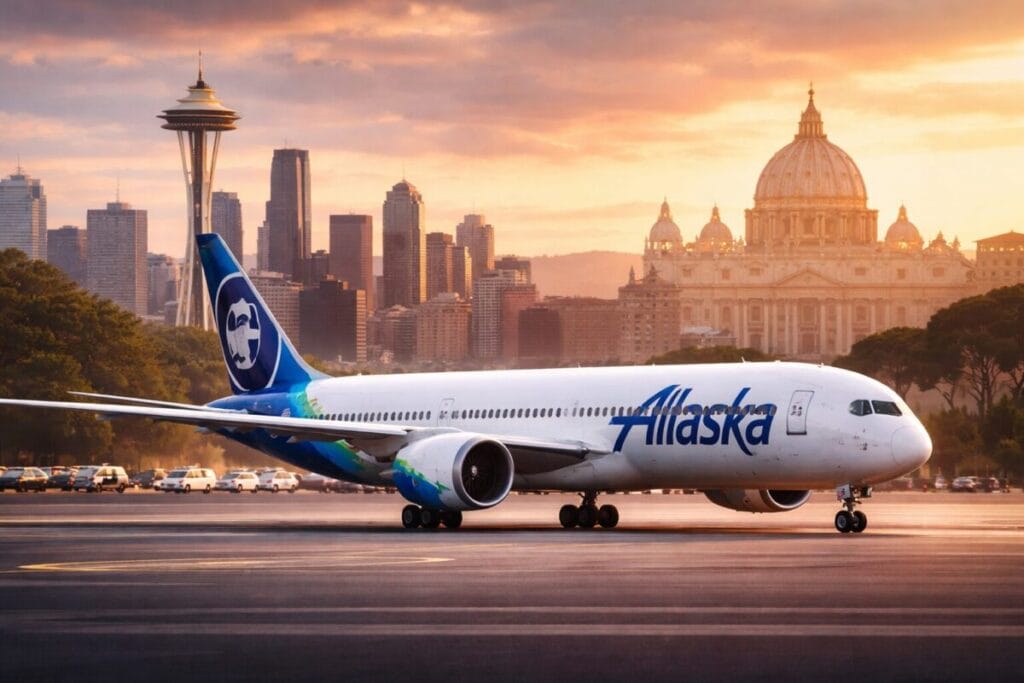
Alaska Airlines is preparing to enter Europe’s long-haul market with its first nonstop flight between Seattle and Rome in April 2026. The milestone is more than a network announcement. It signals a bold shift from a North American carrier into a global competitor with ambitions across Europe and Asia. The upcoming Seattle–Rome link has sparked strong demand from travelers while also capturing the imagination of the airline’s own workforce.
A Route With High Symbolic Value
The inaugural flight between the United States and Italy represents years of planning tied to long-term international growth. For Alaska Airlines employees, the new service has taken on historic meaning. More than 500 staff members have already placed themselves on standby for the inaugural flight, surpassing the total number of seats on the aircraft. Many employees see this journey as a once-in-a-career moment that marks the airline’s entry into Europe.
The United States and Italy share strong travel ties driven by tourism, business travel, heritage routes, and seasonal cultural events. Italy welcomed tens of millions of international visitors in recent years, with Rome remaining one of the most visited capitals in Europe. The Alaska Airlines route taps into steady demand from U.S. travelers seeking direct access to major European heritage destinations.
Tourism Opportunities Between Seattle and Rome
Seattle has seen consistent tourism growth supported by cruise traffic, outdoor recreation, cultural attractions, and a strong tech industry presence. Rome, meanwhile, remains a global tourism powerhouse. Travelers often combine Rome with other destinations across Italy such as Florence, Naples, Capri, Venice, and Sicily.
The new route opens the door for multi-city itineraries and tour packages marketed toward U.S. visitors. Italian tourism agencies have reported rising interest from North America as travelers seek culinary experiences, historical exploration, and cultural immersion. The Rome service provides Alaska Airlines with an anchor route in a tourism sector that remains resilient and globally competitive.
Aircraft Choice and Limited Capacity
Alaska Airlines plans to operate the route using the Boeing 787-9 Dreamliner, a fuel-efficient widebody built for long-haul travel. The aircraft offers premium cabins, improved cabin air quality systems, and quieter interiors that appeal to both leisure and business travelers. While comfortable for long flights, the Dreamliner still carries a limited number of seats. Employee travel on the inaugural flight is restricted to space-available standby rules, and paying passengers retain priority access.
With more than 500 employees competing for limited standby seats, only a fraction will secure a place on the historic Rome flight. Many staff members have already prepared backup plans should they not clear the standby list.
Employee Pride Reflects Corporate Transformation
Alaska Airlines once operated largely within the continental United States along with select flights to Mexico, Canada, and Hawaii. Its expansion into Asia and now Europe marks a significant evolution. Employees who witnessed decades of growth view the Rome launch as validation of long-term strategy and operational maturity.
To many within the company, this flight symbolizes new global connectivity and a competitive future in long-haul aviation. It also highlights a cultural shift: employees are not only working for the airline but actively celebrating its transformation.
European Expansion Beyond Italy
The Rome service forms part of a broader push across Europe. Alaska Airlines has already confirmed flights to London Heathrow and Reykjavik in 2026. London will operate year-round using Dreamliner aircraft, while Reykjavik will run seasonally using single-aisle jets. This flexibility allows the airline to match aircraft type with route demand and seasonality.
The airline has also expanded in Asia with flights to Seoul and Tokyo, positioning Seattle as a strategic transpacific and transatlantic gateway. These moves support a long-term goal of connecting major cultural, economic, and tourism hubs.
Fleet Growth Enabling International Network
To support international operations, Alaska Airlines ordered additional Boeing 787 Dreamliners. The aircraft will anchor long-haul strategy through the end of the decade. The company intends to serve at least a dozen global destinations by 2030, extending its reach far beyond its historical North American footprint.
International expansion also supports tourism flows in both directions. European and Asian travelers gain new access to the U.S. Pacific Northwest, a region known for national parks, indigenous heritage tourism, scenic coastlines, and year-round outdoor activities.
A Defining Moment for a Rising Global Carrier
The level of internal enthusiasm for the Seattle–Rome flight has set a record for Alaska Airlines. While not every employee will board the inaugural service, the excitement alone reflects confidence in the airline’s global vision. The route connects two iconic cities, stimulates international tourism demand, and announces the carrier’s serious entry into European aviation markets.
For Alaska Airlines, the Seattle–Rome service is more than a flight. It is a statement of identity, ambition, and the next chapter in its history as it positions itself on the world stage.
For more travel news like this, keep reading Global Travel Wire