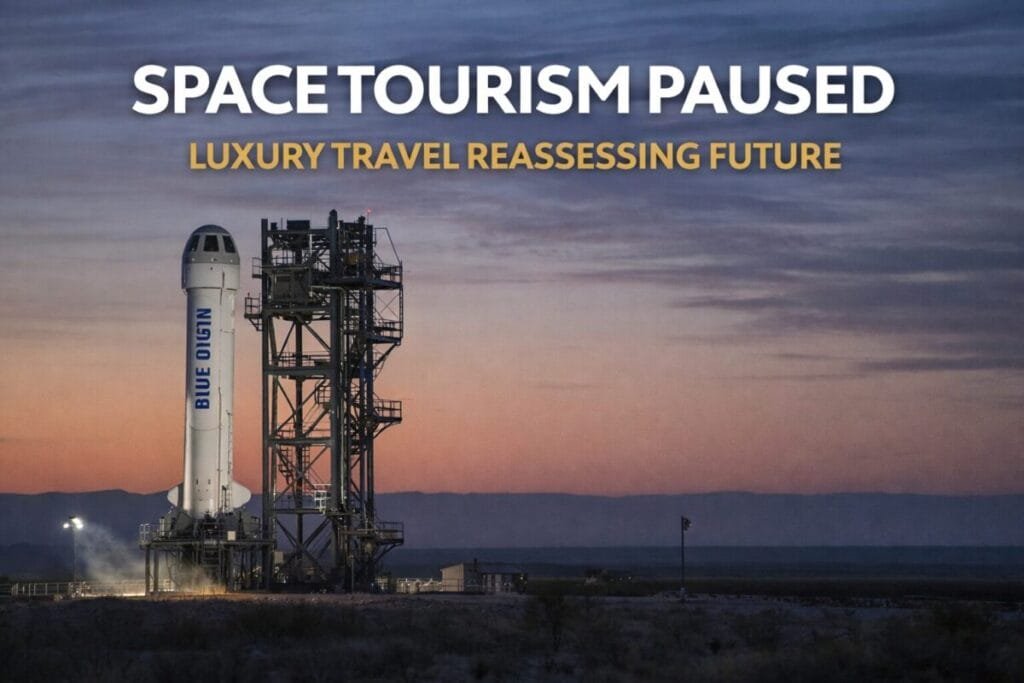
The global luxury travel industry has been jolted by a major announcement from Blue Origin, the private space company founded by Jeff Bezos. The company has confirmed it will suspend its commercial space tourism flights aboard the New Shepard rocket for at least the next two years, a decision that has surprised travelers, investors, and tourism leaders across the United States, China, United Kingdom, Japan, and India.
For the ultra-wealthy who once viewed a suborbital flight as the ultimate travel milestone, the announcement signals a temporary end to one of the most exclusive experiences ever offered to civilians. More broadly, it raises questions about how luxury airlines, five-star hotels, and destination planners will adapt now that space tourism—once considered the next frontier of elite travel—is on hold.
Why Blue Origin Pressed Pause
Blue Origin’s decision is not rooted in declining demand, but in a strategic shift. The company is redirecting engineering talent, funding, and infrastructure toward its role in the Artemis lunar program, which aims to return humans to the Moon and establish a long-term presence there. In doing so, the company is prioritizing deep-space exploration over short-duration suborbital tourism.
While the move underscores long-term ambition, it has left the luxury tourism sector grappling with immediate consequences. New Shepard flights were not just a technological marvel; they were a symbol of a new category of travel designed exclusively for the world’s wealthiest individuals.
Shockwaves Across Luxury Travel Markets
Space tourism may have served a niche audience, but its influence extended far beyond the launchpad. High-net-worth travelers booking spaceflights often combined the experience with premium long-haul air travel, private aviation services, and extended stays at elite resorts near launch sites.
Airlines offering top-tier cabins benefited from this trend, as space tourists routinely booked first-class or private jet travel en route to spaceports. The suspension of flights now forces premium carriers to rethink how they attract and retain the same clientele without the once-in-a-lifetime appeal of space travel.
Luxury hospitality is also feeling the ripple effects. High-end resorts and boutique hotels near launch regions had positioned themselves as integral parts of the space tourism journey, offering pre-flight wellness programs, post-flight celebrations, and bespoke concierge services tailored to future astronauts. With launches paused, these properties must now pivot toward alternative ultra-luxury experiences.
What It Means for the Ultra-Wealthy Traveler
For affluent travelers from the United States, Europe, and Asia who had spaceflight on their bucket lists, the pause is a disappointment—but not the end of experiential travel. Demand for exclusivity remains strong, and the ultra-wealthy are already shifting attention toward other rare and immersive experiences.
Private island buyouts, expedition cruises, polar travel, and ultra-remote eco-luxury lodges are absorbing interest once directed at space tourism. At the same time, private aviation and personalized travel itineraries are becoming even more central to how elite travelers define luxury.
In Asia, particularly in China, Japan, and India, interest in futuristic travel experiences continues to grow. The pause by Blue Origin may slow momentum, but it is unlikely to dampen long-term fascination with space as a travel destination.
Is Space Tourism Really Over?
Despite the pause, space tourism itself is not disappearing—it is evolving. Other players in the sector continue to develop their own visions of civilian space travel. Orbital missions, lunar flybys, and extended space stays remain part of the long-term roadmap for the private space industry.
Blue Origin’s focus on lunar exploration could ultimately lead to a new tier of luxury space travel far beyond suborbital hops. While such experiences may be even more exclusive and expensive, they point to a future where space travel becomes deeper, longer, and more transformative.
A Turning Point for Luxury Hospitality Strategy
The temporary halt is also prompting luxury hotels and resorts to reassess how they define “once-in-a-lifetime” travel. Rather than relying on proximity to spaceports, many are doubling down on regenerative tourism, hyper-personalized service, and experiences rooted in nature, culture, and science.
Wellness tourism, conservation-led travel, and adventure luxury are emerging as dominant themes. These offerings appeal to the same clientele drawn to space tourism—travelers seeking rarity, meaning, and bragging rights—while remaining grounded on Earth.
The Bigger Picture for Global Tourism
From a broader tourism perspective, Blue Origin’s announcement highlights how closely innovation, ambition, and travel have become intertwined. Space tourism captured global imagination, but it also exposed the fragility of emerging luxury niches that depend on complex technology and long-term investment cycles.
Governments and tourism boards watching the space sector are now recalibrating expectations. While space travel remains a symbol of progress, destinations are increasingly focused on sustainable growth, resilience, and diversification rather than relying on headline-grabbing novelties.
Looking Ahead: Pause, Not an Ending
The pause in New Shepard flights represents a moment of reflection rather than retreat. For airlines, hotels, and luxury travel planners, it is an opportunity to innovate beyond space and redefine aspiration in new ways. For travelers, it reinforces a familiar truth: luxury travel is not defined by one experience, but by constant evolution.
When space tourism returns—and most experts believe it will—it is likely to be more advanced, more regulated, and even more exclusive. Until then, the ultra-wealthy will continue to explore the limits of Earth-bound luxury, while the space industry prepares for its next giant leap.
In the end, Blue Origin’s decision may reshape luxury travel narratives, but it does not diminish the enduring human desire to explore beyond known horizons. Space tourism is paused, not forgotten—and when it reemerges, it may redefine luxury travel all over again.
For more travel news like this, keep reading Global Travel Wire