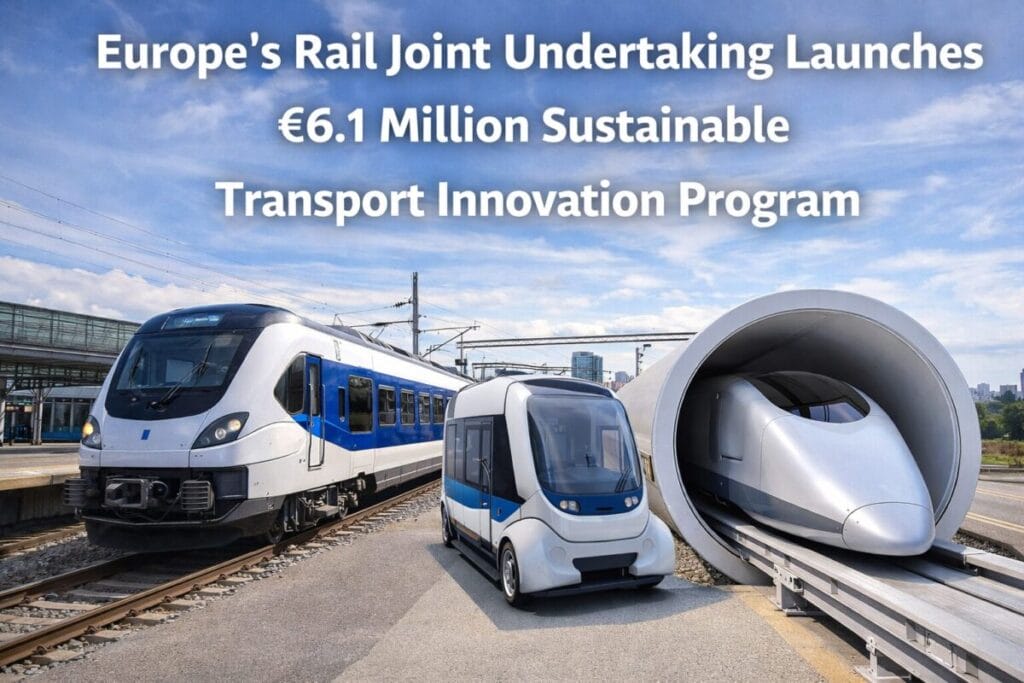
Europe is taking a bold step toward transforming the future of transportation with a new innovation program aimed at accelerating sustainable mobility solutions. The Europe’s Rail Joint Undertaking has announced a €6.1 million initiative designed to support groundbreaking research and development in lightweight rail vehicles, automated multimodal systems, and emerging hyperloop technologies. The program reflects Europe’s commitment to modernizing transport infrastructure while reducing environmental impact and improving travel efficiency.
As climate change targets and urban mobility challenges continue to shape transportation policy, the initiative highlights the European Union’s strategic investment in next-generation solutions that could redefine how people travel across cities and regions.
Driving Innovation in Sustainable Rail Technology
The new funding call represents one of the first major steps in Europe’s rail innovation agenda for 2026. Designed to encourage collaboration between industry leaders, research institutions, and technology innovators, the program focuses on developing transport solutions that are both cost-efficient and environmentally sustainable.
A key component of the initiative is the design of lightweight regional rail vehicles. These trains will be engineered to operate more efficiently on branch lines and secondary routes, many of which feature challenging infrastructure such as tight curves, aging track systems, or lower passenger volumes.
By reducing weight and optimizing energy consumption, these new rolling stock concepts aim to lower operational costs while maintaining high safety standards and passenger comfort. Lighter trains also have the potential to extend the life of existing rail infrastructure, making regional networks more sustainable without requiring extensive reconstruction.
Revitalizing Regional Connectivity
Regional rail services are often the backbone of local mobility, connecting rural communities to major urban centers and supporting tourism in lesser-known destinations. However, maintaining these lines can be costly, particularly in areas with lower passenger demand.
The development of lightweight rolling stock offers a practical solution by creating trains specifically tailored to regional needs. Improved efficiency could help preserve vital routes that might otherwise face closure, ensuring continued access for residents and visitors alike.
For tourism, enhanced regional connectivity opens new opportunities for exploring remote landscapes, heritage towns, and natural attractions that are less accessible by air or road. Sustainable rail systems can therefore play a critical role in promoting responsible travel while dispersing visitor traffic beyond major cities.
Advancing Automated Multimodal Mobility
Another major focus of the initiative is the advancement of automated multimodal transport systems. Building on previous research projects exploring integrated mobility solutions, the program aims to develop transport pods capable of seamlessly transitioning between rail, road, and cable-based networks.
These automated systems are envisioned as flexible mobility units that adapt to different transportation environments, enabling smoother transfers and reducing travel disruptions. By integrating multiple modes into a single system, passengers could enjoy more streamlined journeys, minimizing waiting times and simplifying trip planning.
Central to this vision is the development of an advanced Mobility Management System, which will oversee autonomous operations and coordinate interactions between various transport networks. Such technology could revolutionize passenger mobility by creating highly efficient, interconnected transport ecosystems.
Exploring the Potential of Hyperloop Technology
The initiative also looks toward the future with support for hyperloop development. Hyperloop systems aim to transport passengers at extremely high speeds within low-pressure tubes, offering the potential for rapid, energy-efficient long-distance travel.
While the concept has generated significant interest globally, safety standards and certification frameworks remain key challenges. The European program seeks to address these issues by supporting research into safety guidelines, performance requirements, and regulatory frameworks.
Establishing clear certification processes is essential for gaining public trust and ensuring interoperability between countries. By investing in foundational standards, Europe aims to position itself as a leader in the development and potential deployment of hyperloop technology.
Aligning with Europe’s Climate Goals
The €6.1 million initiative is closely aligned with the European Union’s broader objective of achieving net-zero emissions by 2050. Transportation remains one of the largest contributors to greenhouse gas emissions, making innovation in sustainable mobility a critical priority.
Energy-efficient trains, integrated multimodal systems, and advanced transport technologies can collectively reduce carbon footprints while improving travel experiences. By encouraging collaboration across sectors, the program seeks to accelerate innovation timelines and bring practical solutions to market more quickly.
Opportunities for Industry and Research
Organizations across Europe—including universities, technology firms, engineering companies, and transport operators—are invited to submit proposals under the funding program. The initiative aims to foster partnerships that combine technical expertise with real-world operational insights.
This collaborative approach ensures that solutions are not only technologically advanced but also commercially viable and scalable across diverse European transport networks.
Transforming the Future of Travel
The launch of this initiative signals a significant milestone in Europe’s journey toward smarter, greener mobility. By investing in lightweight trains, automated multimodal transport, and hyperloop innovation, Europe’s Rail Joint Undertaking is laying the groundwork for a future where travel is faster, more efficient, and environmentally responsible.
For travelers, these developments promise improved connectivity, reduced travel times, and more sustainable options across the continent. For the tourism sector, enhanced transport infrastructure could unlock new destinations and support balanced growth by connecting regions in innovative ways.
As research progresses and pilot projects emerge, the initiative represents a forward-looking vision of transportation—one that blends technological innovation with environmental stewardship to shape the future of mobility in Europe.
For more travel news like this, keep reading Global Travel Wire