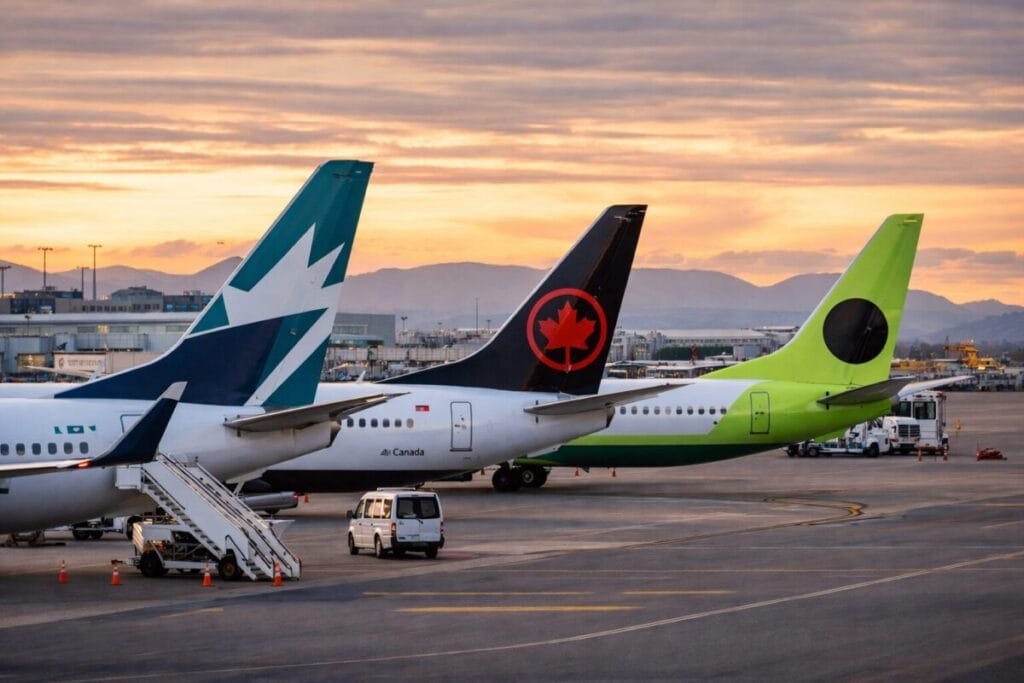
Canada’s long-standing air travel connection with the United States is undergoing a notable contraction as WestJet, Air Canada, and Flair Airlines collectively remove fifteen routes linking major Canadian cities to key US destinations. Cities such as Boston, Los Angeles, San Francisco, and Atlanta are among those affected, signaling a significant shift in airline strategy driven by declining cross-border demand and evolving travel preferences.
For decades, transborder travel between Canada and the US has been one of the busiest aviation corridors in the world, supporting tourism, business travel, education, and family connections. However, for the Summer 2026 season, Canadian carriers are making decisive network changes that reflect a broader reassessment of profitability, capacity deployment, and passenger behavior in the post-pandemic era.
Changing Dynamics of Cross-Border Travel
The reduction in routes highlights a slowdown in demand for Canada–US travel compared to pre-pandemic levels. While leisure travel has rebounded strongly in many international markets, cross-border business travel has been slower to recover. Remote work, virtual meetings, inflationary pressures, and shifting consumer priorities have all contributed to softer demand on certain transborder routes.
At the same time, competition on popular US corridors has intensified, with major American airlines maintaining strong positions on key city pairs. This has placed pressure on Canadian carriers to reevaluate routes that no longer deliver sustainable yields, particularly where operational costs continue to rise.
WestJet Leads the Pullback
WestJet has made the most extensive adjustments, confirming the removal of a large number of US routes from its Summer 2026 schedule. The airline’s major hubs, including Calgary, Vancouver, Toronto, and Edmonton, will see reduced connectivity to several US cities that previously supported both leisure and business travelers.
The airline’s revised network reflects a sharp reduction in transborder capacity as it reallocates aircraft to markets showing stronger demand and better financial performance. WestJet is increasingly prioritizing domestic routes, sun destinations, and long-haul international services, where passenger interest and revenue potential are proving more resilient.
By trimming underperforming US routes, WestJet aims to stabilize margins and maintain flexibility in an environment marked by high fuel prices, labor costs, and competitive pressures.
Air Canada Adopts a Cautious Approach
Air Canada is also scaling back select US services, suspending several routes that historically catered to business and leisure travelers. While the airline continues to operate a broad transborder network, these targeted reductions reflect a more cautious outlook on certain regional US markets.
Air Canada’s strategy centers on optimizing capacity and focusing on routes that align with long-term demand trends. The carrier has increasingly emphasized international growth, particularly in Europe and Asia, alongside strengthening its domestic network. With strong competition from US airlines on many transborder routes, Air Canada is choosing to deploy resources where it can achieve stronger returns.
Flair Airlines Refocuses Its Network
Low-cost carrier Flair Airlines is following a similar path by scaling back its US presence. Known for offering budget-friendly fares, Flair has suspended select routes to major US cities as part of a broader fleet and network optimization effort.
For Flair, the decision reflects the challenges of sustaining low-cost operations on routes where demand volatility and competitive pricing limit profitability. By narrowing its focus, the airline aims to strengthen its core markets and improve operational efficiency.
Broader Industry Trends Behind the Cuts
The collective removal of fifteen routes underscores a wider trend affecting North American aviation. Travelers are increasingly favoring domestic trips and leisure-focused international destinations, such as beach resorts and cultural hubs, over short-haul cross-border travel. Economic uncertainty, higher travel costs, and changing work patterns have all influenced these choices.
Airlines are also grappling with elevated operating expenses, including fuel, airport fees, and staffing. In this context, routes that once thrived on frequent business travel are now being reassessed, particularly where demand has not returned at expected levels.
What This Means for Travelers
For passengers, the immediate impact will be fewer nonstop options between Canada and the United States. Travelers heading to cities like Los Angeles, San Francisco, or Boston from certain Canadian hubs may now need to connect through larger airports, potentially increasing travel time and costs.
Reduced competition on some routes could also lead to higher fares, especially during peak travel periods. While alternative options will remain available through other airlines, schedules may be less convenient for travelers accustomed to direct flights.
On the other hand, airlines argue that these changes will help stabilize networks and ensure more reliable service on remaining routes, benefiting travelers in the long term.
A Strategic Shift for Canadian Airlines
Looking ahead, Canadian carriers are signaling a clear pivot toward markets with stronger growth potential. Domestic travel within Canada continues to show steady demand, while international leisure destinations in Europe, the Caribbean, and Mexico are seeing sustained interest.
This strategic realignment reflects a broader transformation in the aviation sector, where flexibility and profitability take precedence over maintaining extensive networks for legacy reasons. Airlines are increasingly focused on matching capacity to demand rather than preserving routes that no longer align with traveler behavior.
A New Phase for Canada–US Air Travel
The scaling back of Canada–US routes by WestJet, Air Canada, and Flair Airlines marks a turning point in transborder aviation. While disruptive for some travelers, the changes reflect a pragmatic response to shifting demand patterns and economic realities.
As airlines continue to adapt to the evolving travel landscape, Canada–US air connectivity is likely to remain more selective and demand-driven. For travelers, this means adjusting expectations, planning ahead, and watching closely as airlines refine their networks in response to a new era of post-pandemic travel.
For more travel news like this, keep reading Global Travel Wire