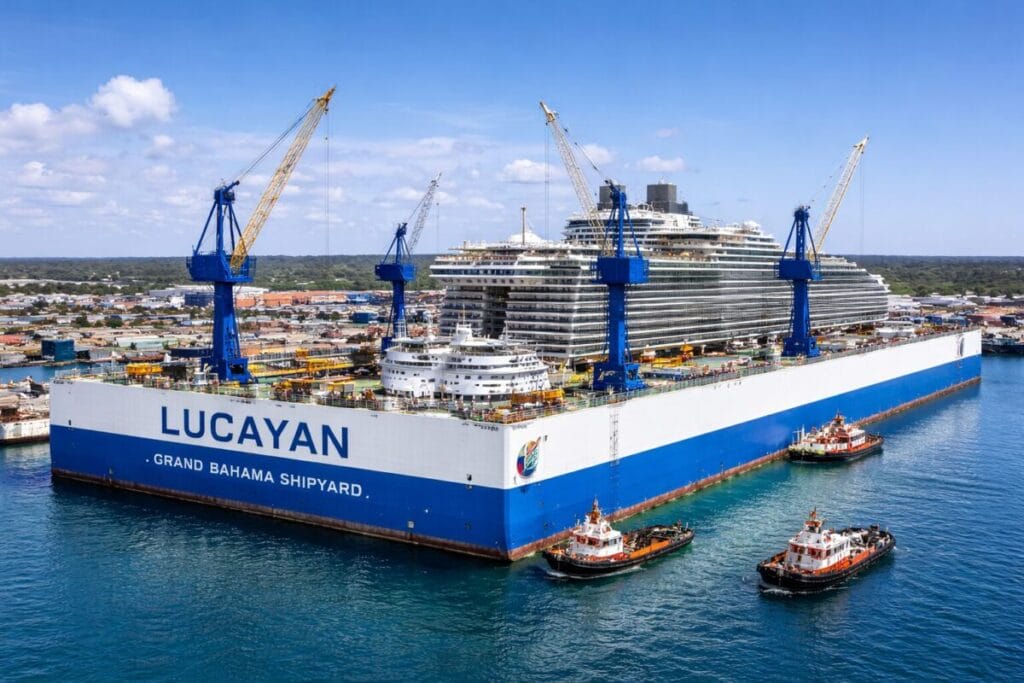
The delivery of the Lucayan floating drydock to Grand Bahama Shipyard marks a significant milestone in maritime infrastructure, positioning the Bahamas as a leading hub for servicing ultra-large cruise ships. Built with advanced engineering and cutting-edge digital systems, the new drydock is expected to reshape maintenance operations for modern mega-cruise vessels while strengthening the Caribbean’s role in global cruise logistics.
As cruise ships continue to grow in size and complexity, facilities capable of handling these massive vessels have become increasingly essential. The arrival of Lucayan reflects the industry’s evolving needs and the growing importance of specialized infrastructure that supports efficient fleet operations.
Engineering Innovation Meets Maritime Scale
Constructed by Beihai Shipbuilding in China, the Lucayan stands among the largest floating drydocks ever created. Measuring nearly 414 meters in length and 85 meters in width, the structure is designed to accommodate ships exceeding 200,000 gross tons — including some of the newest generation cruise liners currently operating worldwide.
Its immense lifting capacity allows operators to perform complex repairs, structural modifications, and routine inspections without requiring vessels to travel long distances to traditional shipyards. For cruise companies, this translates into reduced downtime and improved scheduling flexibility, ensuring ships remain operational during busy travel seasons.
The delivery of the drydock represents years of planning, engineering precision, and collaboration between international maritime organizations.
Advanced Technology Enhancing Safety and Efficiency
What distinguishes Lucayan from earlier drydock designs is its integration of advanced automation and digital technologies. Certified to international safety standards, the facility incorporates automated control systems and intelligent ballast management, enabling precise submersion and lifting procedures.
One of its most innovative features is digital twin technology — a virtual replica of the drydock that allows operators to monitor performance in real time, simulate operational scenarios, and anticipate maintenance needs before problems arise. This predictive approach enhances safety while minimizing unexpected delays during servicing operations.
By leveraging these technologies, Grand Bahama Shipyard aims to streamline maintenance processes, improve accuracy, and reduce operational risks associated with handling large vessels.
Expanding Capacity at Grand Bahama Shipyard
The addition of Lucayan is part of a broader expansion strategy at Grand Bahama Shipyard, one of the Caribbean’s most important maritime service centers. The new drydock complements the recently introduced East End dock, creating a dual-dock system capable of servicing multiple large cruise ships simultaneously.
This expanded capacity allows the shipyard to handle increased demand from cruise operators seeking convenient maintenance locations along major Caribbean routes. The ability to accommodate several vessels at once also improves turnaround times, helping cruise lines maintain tight schedules and meet passenger expectations.
Industry stakeholders view the expansion as a strategic investment designed to support the long-term growth of the cruise sector.
Supporting the Evolution of Mega-Cruise Ships
The modern cruise industry has seen rapid growth in ship size and onboard technology, with new vessels incorporating advanced propulsion systems, environmental upgrades, and complex entertainment facilities. These innovations require specialized infrastructure capable of performing detailed technical work.
Facilities like Lucayan enable a wide range of services, including hull inspections, propulsion system maintenance, environmental retrofits, and interior refurbishments. Having such capabilities in the Caribbean reduces the need for ships to travel to distant shipyards, saving time and fuel while supporting more sustainable operations.
As cruise lines continue to invest in next-generation ships, high-capacity drydocks are becoming essential assets within global maritime networks.
Strengthening the Bahamas as a Maritime Hub
The arrival of Lucayan reinforces the Bahamas’ strategic role within the cruise industry. Located along some of the busiest cruise routes in the world, the region offers convenient access for vessels operating in the Caribbean and the Americas.
Beyond operational benefits for cruise companies, the expansion is expected to generate economic opportunities for local communities. Technical jobs in engineering, logistics, and ship repair services are likely to increase, while supporting industries such as hospitality and transportation may also see growth.
The investment aligns with broader national efforts to develop maritime infrastructure and attract international business partnerships.
International Collaboration and Technological Progress
The construction of Lucayan also highlights advancements in global shipbuilding capabilities. The project demonstrates how modern engineering can combine massive structural design with sophisticated digital monitoring systems.
From fabrication of large steel components to integration of intelligent automation technologies, the drydock represents a new standard in maritime infrastructure. Collaboration between shipbuilders, classification societies, and cruise industry stakeholders ensured the facility meets rigorous operational and safety requirements.
Such international partnerships are becoming increasingly common as the maritime sector adapts to technological innovation and evolving industry demands.
A Transformational Step for Caribbean Cruise Infrastructure
The introduction of Lucayan comes at a time when cruise tourism is rebounding and expanding, driving demand for reliable maintenance facilities close to popular destinations. As ships grow larger and itineraries become more complex, efficient servicing infrastructure is crucial for maintaining operational readiness.
By enhancing capacity, improving safety standards, and incorporating advanced digital tools, Lucayan is expected to play a pivotal role in supporting cruise fleet modernization.
For travelers, these behind-the-scenes developments may not be immediately visible, but they contribute to smoother voyages, safer ships, and more reliable cruise schedules.
Looking Ahead
With Lucayan set to become fully operational, Grand Bahama Shipyard is poised to emerge as one of the most capable cruise maintenance hubs in the region. The combination of scale, technology, and strategic location positions the facility to serve the evolving needs of the global cruise industry.
As maritime infrastructure continues to evolve alongside growing tourism demand, investments like Lucayan demonstrate how innovation and strategic planning can shape the future of ocean travel — ensuring that the world’s largest cruise ships remain ready to explore new destinations and deliver exceptional experiences for passengers worldwide.
For more travel news like this, keep reading Global Travel Wire