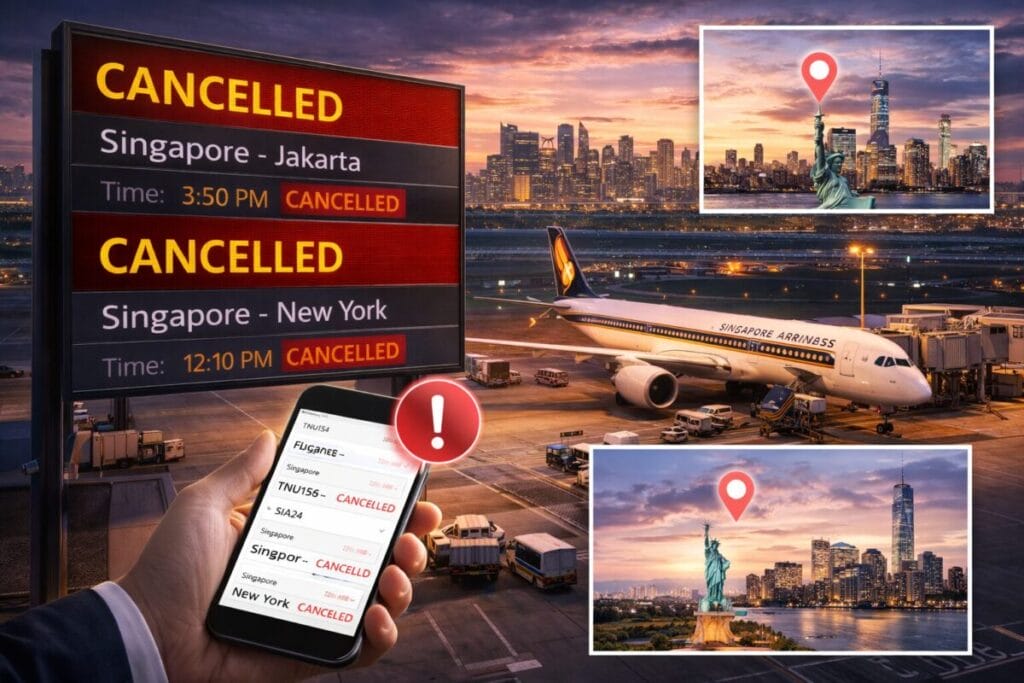
Singapore Changi Airport experienced significant travel disruption after four outbound flights were cancelled across multiple days. The affected routes included key regional services to Jakarta and a long-haul intercontinental service to New York. These cancellations created ripple effects for passengers and airlines operating from one of Asia’s busiest aviation hubs.
The disruption involved both short-haul and long-haul operations, highlighting operational challenges within high-density route networks. Travelers heading to Southeast Asia and North America faced schedule changes and rebooking procedures.
Singapore plays a central role in global aviation connectivity. Therefore, disruptions at this hub often influence broader regional and international travel flows.
Jakarta Routes Experience Multiple Cancellations
Three of the cancelled services operated between Singapore and Soekarno-Hatta International Airport in Jakarta. This route ranks among the most heavily traveled corridors in Southeast Asia due to strong business, trade, and tourism ties between the two cities.
Flight TNU154, operated with an Airbus A320, was cancelled on two separate days. In addition, Flight TNU152, operated with an Airbus A321, was withdrawn from the departure schedule on another date. All affected services were outbound departures from Singapore.
The repeated cancellation of the same flight number suggests ongoing operational constraints rather than a single isolated incident. High-frequency regional routes typically rely on tight aircraft rotation schedules. Therefore, even minor disruptions can cascade into repeated adjustments.
Jakarta remains a critical destination for both business and leisure travelers. Consequently, these cancellations affected a large number of passengers traveling within Southeast Asia.
Long-Haul Service to New York Also Affected
The disruption extended beyond regional travel when Singapore Airlines cancelled Flight SIA24 to John F. Kennedy International Airport in New York. This long-haul service operates with an Airbus A350-900 and connects Singapore directly to the United States.
The cancellation of a transcontinental flight has broader implications compared with short-haul routes. Long-haul services often carry connecting passengers from multiple Asian destinations. Therefore, the impact extended beyond point-to-point travelers.
Passengers scheduled to travel to New York likely required rebooking onto alternative flights, which may have involved extended transit times or changes in routing. Intercontinental cancellations also affect aircraft utilization and crew scheduling across multiple time zones.
Summary of Cancelled Services
A total of four outbound flights were cancelled from Singapore:
- Two separate cancellations of Flight TNU154 to Jakarta
- One cancellation of Flight TNU152 to Jakarta
- One cancellation of Flight SIA24 to New York
These cancellations occurred on different days and involved three aircraft types: Airbus A320, Airbus A321, and Airbus A350-900. The variety of aircraft suggests that the disruption did not stem from a single fleet issue.
Passenger Impact and Operational Pressure
For travelers, flight cancellations often result in immediate logistical challenges. Passengers may face delayed departures, limited seat availability on alternative flights, and missed onward connections.
Airlines must respond quickly by activating contingency plans. Customer service teams handle rebooking requests, while operations managers coordinate aircraft repositioning and crew adjustments. Ground staff must also adapt to schedule changes and manage passenger flows efficiently.
Repeated cancellations on a high-traffic route such as Singapore to Jakarta add complexity. Airlines must maintain schedule integrity while accommodating affected passengers. Recovery efforts become more demanding when disruptions occur over several consecutive days.
What the Operational Patterns Indicate
The cancellations spanned multiple aircraft models and different route categories. This pattern indicates broader scheduling or resource constraints rather than a mechanical issue tied to one specific aircraft type.
Airlines operating major hubs depend on precise timing and aircraft rotation. A delay in one segment can affect multiple subsequent flights. When disruptions persist, network planners may cancel services proactively to restore operational balance.
Such decisions aim to minimize cascading delays across the broader network. However, passengers experience immediate inconvenience as a result.
Broader Context in Asia-Pacific Aviation
The Asia-Pacific aviation market continues to experience operational adjustments as airlines balance rising demand with available resources. Major hubs such as Singapore play a pivotal role in linking regional and long-haul networks.
Any instability at a central hub influences connectivity across Southeast Asia, Europe, and North America. Singapore Airlines, known for its extensive global network, manages complex scheduling across multiple continents.
Operational challenges can arise from crew availability, aircraft rotations, weather patterns, or network congestion. Airlines often adjust schedules temporarily to stabilize services and protect overall reliability.
Travel Advisory for Passengers
Travelers departing from Singapore during periods of operational adjustment should monitor flight status updates closely. Airlines typically notify passengers through mobile applications, email, or text messages regarding schedule changes.
Passengers with tight connections or time-sensitive travel plans may consider arriving at the airport earlier and confirming updated departure information in advance.
Airlines generally provide rebooking options or alternative routing for cancelled services. However, seat availability on high-demand routes can remain limited during peak travel periods.
Maintaining Stability in a High-Volume Hub
Singapore Changi Airport consistently ranks among the world’s leading aviation hubs in terms of passenger traffic and connectivity. Managing operations at this scale requires coordination among airlines, airport authorities, and ground services.
While occasional disruptions occur in any global network, repeated cancellations draw attention due to Singapore’s strategic role in international aviation.
Airlines continue working to stabilize schedules and maintain passenger confidence. As recovery measures take effect, travelers can expect gradual normalization of affected routes.
The recent cancellations highlight the delicate balance between demand, operational capacity, and network reliability in modern aviation. As airlines refine schedules and resource allocation, maintaining transparency and passenger communication remains essential for restoring stability across key routes.
For more travel news like this, keep reading Global Travel Wire