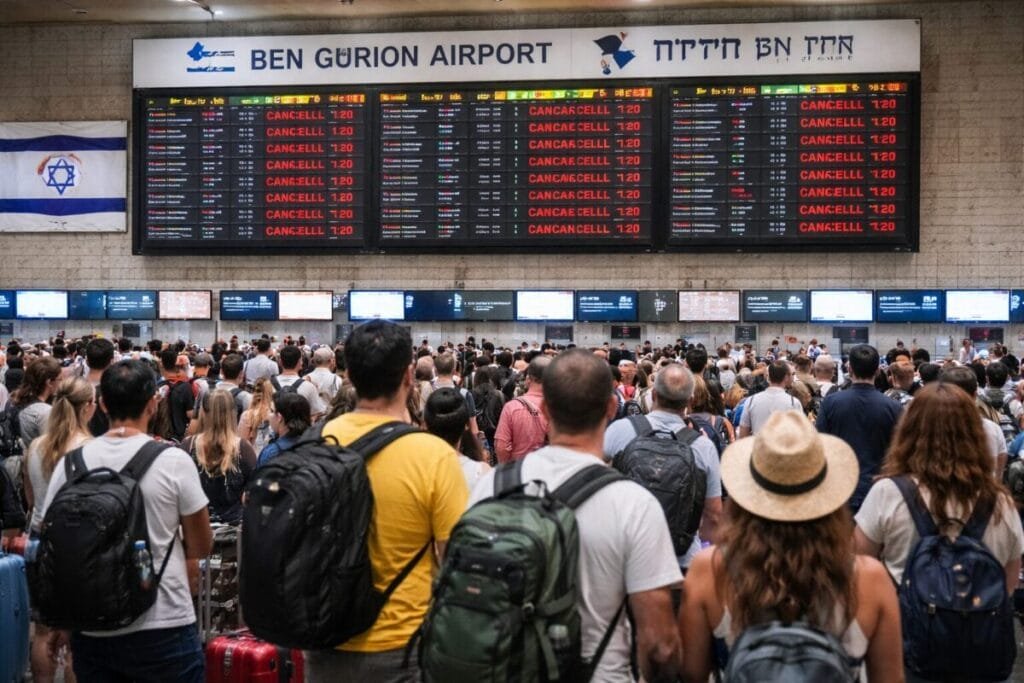
Israel’s aviation sector has been thrown into severe turmoil after 211 flights were cancelled at Ben Gurion Airport, disrupting global travel and stranding thousands of passengers across Europe, North America, and the Middle East. The unprecedented wave of cancellations follows escalating military tensions linked to the ongoing US-Israel conflict, triggering airspace restrictions and emergency security measures that have rippled through international airline networks.
Ben Gurion Airport, Israel’s primary international gateway, is one of the busiest hubs in the region, handling millions of passengers annually. The sudden suspension of services by major global carriers has created widespread operational challenges and left travelers stranded in cities including Dubai, Prague, Rome, New York, Los Angeles, Miami, Toronto, and Zurich.
Escalating Conflict Sparks Aviation Shutdown
The disruption began after military tensions intensified in early 2026, prompting Israel to raise its national security alert level. In response to regional instability and missile threats, aviation authorities implemented precautionary airspace restrictions to safeguard civilian aircraft.
These restrictions forced airlines to reassess the safety of operating routes into and out of Tel Aviv. Notices issued to global carriers advised caution in specific air corridors, particularly those crossing volatile areas of the Middle East. As a result, many airlines opted to suspend operations rather than risk exposure to unpredictable security conditions.
Airspace limitations and rerouting challenges significantly impacted transatlantic and European services, especially those linking Tel Aviv with major hubs in the United States and Europe.
Airlines Ground Services to Tel Aviv
Among the carriers affected were FlyDubai, Wizz Air, United Airlines, Swiss International Air Lines, Delta Air Lines, and Air Canada. These airlines collectively operate dozens of weekly connections between Israel and key global destinations.
FlyDubai suspended multiple daily services between Dubai and Tel Aviv, a route popular with both business and leisure travelers. Wizz Air, known for its extensive European network, halted flights connecting Tel Aviv with Prague, Rome, London, and other cities.
Transatlantic services also faced significant disruptions. United Airlines paused its New York–Tel Aviv route, while Delta suspended flights from New York and Miami. Air Canada halted its Toronto service, and Swiss temporarily stopped operations between Zurich and Tel Aviv.
The cancellations have had a cascading effect, impacting not only direct passengers but also those relying on connecting itineraries through major hubs.
Global Airports Grapple with Stranded Travelers
The immediate consequence of the cancellations has been the stranding of passengers at airports worldwide. At Ben Gurion Airport, terminal areas experienced overcrowding as travelers sought rebooking assistance and updated information.
Similar scenes unfolded at Dubai International Airport, where FlyDubai passengers were left awaiting alternatives. In Europe, airports in Prague, Rome, and Vienna reported congestion as travelers with onward connections to Tel Aviv faced delays and uncertainty.
In the United States, New York’s JFK, Los Angeles International Airport, and Miami International Airport saw passengers scrambling for rebooking options after cancellations were announced with limited notice.
Airport authorities and airline customer service teams worked to manage the surge in inquiries, though long queues and extended wait times were widely reported.
Airspace Rerouting Compounds Delays
Beyond outright cancellations, many flights were forced to adopt longer routes to avoid restricted airspace. Detours around specific Middle Eastern corridors added significant flight time to services that continued operating.
Flights departing Tel Aviv toward North America and Europe were rerouted via alternative pathways, increasing fuel consumption and extending travel durations. These changes placed additional strain on airline schedules, aircraft rotations, and crew duty limits.
European connections between Tel Aviv and cities such as Paris, Rome, and Prague were similarly affected, with some flights diverted through alternative hubs like Vienna and Zurich.
The congestion in available air routes created bottlenecks, further complicating airline recovery efforts.
Tourism and Economic Impact
The travel crisis arrives at a sensitive time for Israel’s tourism industry. Tel Aviv and Jerusalem typically attract millions of international visitors each year for religious, cultural, and business travel.
Cancellations have disrupted pilgrimage tours, corporate travel plans, and vacation itineraries. Hotels and tour operators have reported last-minute cancellations and booking uncertainty.
International tourism to Israel plays a significant role in the country’s economy. A prolonged aviation disruption could impact hospitality, retail, and local service sectors.
Travel agencies worldwide are advising clients to postpone non-essential trips until stability returns to the region’s airspace.
Government and Airline Response
Israeli aviation authorities are working closely with global regulators to monitor the evolving security landscape. The Ministry of Transport and Road Safety has emphasized that all measures are designed to protect passengers and crew.
Airlines are actively rebooking customers on future flights or offering refunds where services remain suspended. However, limited seat availability on alternate routes has made swift recovery challenging.
Consular services in affected countries have also been alerted to assist citizens facing extended delays.
Travel Advisory and Outlook
With tensions ongoing, airlines continue to evaluate operational risks daily. While some carriers may resume limited services once airspace stability improves, uncertainty remains high.
Travelers planning to fly to or from Tel Aviv are urged to monitor flight status updates closely and remain flexible with travel arrangements. Industry experts recommend considering comprehensive travel insurance and maintaining direct communication with airlines.
The cancellation of 211 flights at Ben Gurion Airport serves as a stark reminder of how geopolitical instability can rapidly disrupt global mobility. Modern aviation networks are deeply interconnected, meaning regional conflicts can have far-reaching consequences.
As diplomatic efforts continue, the hope within the global travel community is for swift de-escalation. Until then, airlines, airports, and passengers must navigate a challenging landscape shaped by security concerns and operational uncertainty.
For more travel news like this, keep reading Global Travel Wire