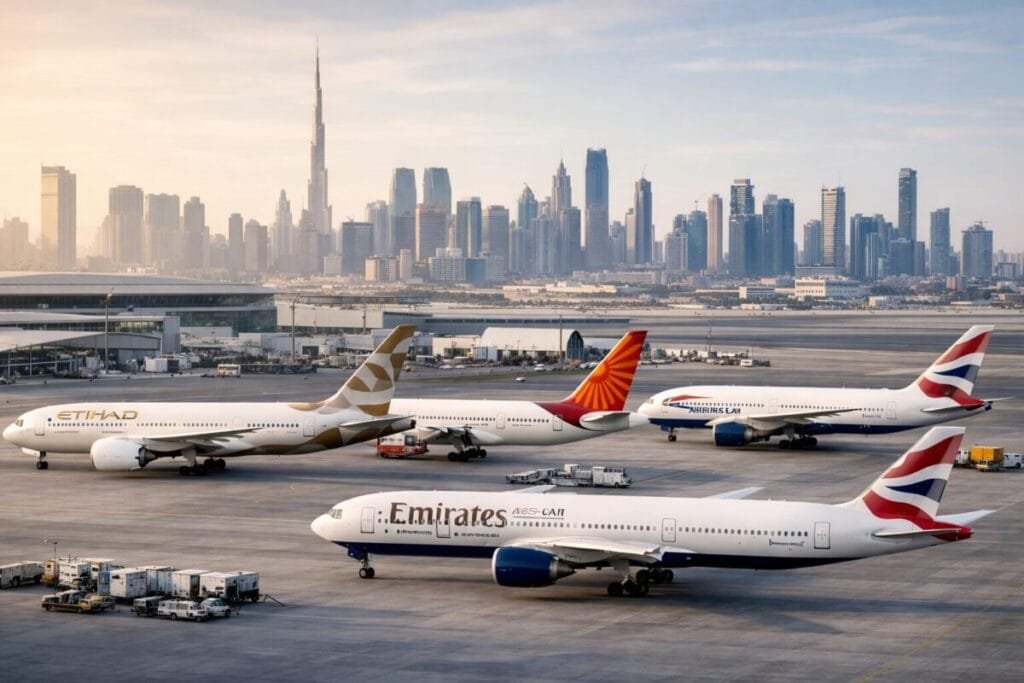
Dubai’s reputation as one of the world’s most seamless global transit hubs has been shaken after multiple international airlines suspended or rerouted flights, leaving thousands of passengers stranded at the height of travel demand. Major carriers including Emirates, Etihad Airways, Air India, British Airways, Lufthansa, Qatar Airways, Turkish Airlines and Delta Air Lines temporarily halted selected services following regional airspace restrictions triggered by escalating security tensions.
The sudden operational slowdown has placed Dubai International Airport at the center of a global aviation ripple effect, while the emirate’s world-famous hospitality sector — including luxury icons such as Burj Al Arab and leading Jumeirah properties — prepares for extended guest stays and booking uncertainty.
Dubai International Airport Faces Unprecedented Disruption
Dubai International Airport (DXB) has consistently ranked among the busiest international airports globally. In 2025, it handled over 95 million passengers, supported hundreds of thousands of flight movements, and connected travelers across six continents.
When precautionary airspace advisories were implemented across parts of the Gulf region, airlines responded immediately with safety-first decisions. Flights were canceled, diverted or returned to origin airports. Aircraft already en route were rerouted to avoid restricted corridors. The result: thousands of travelers from India, the United Kingdom, the United States, Russia, Germany, Saudi Arabia, Pakistan and other key markets found themselves unable to depart or connect onward.
For a hub designed around rapid transfers and tight global connections, even a short operational pause creates cascading delays across Europe–Asia, North America–Middle East and Africa–South Asia corridors.
Airlines Suspend Routes as Global Networks Adjust
The airlines affected represent some of the most influential players in international aviation. Hub carriers and long-haul operators alike were forced to adjust schedules in real time.
Key impacts included:
- Suspension of select long-haul and regional services
- Extended flight paths increasing travel time
- Delays in aircraft rotations across continents
- Missed onward connections for transit passengers
- Rebooking bottlenecks due to limited seat availability
Because Dubai functions as a strategic bridge between East and West, disruptions at DXB quickly affect traffic flows as far away as London, New York, Mumbai, Frankfurt and Istanbul.
Aviation analysts reported a significant percentage of flights in the affected region were canceled during peak disruption hours, reflecting strict compliance with official advisories.
Thousands Stranded as Hotels Absorb Extended Stays
Dubai’s hospitality sector is now managing the immediate human impact of the aviation pause. With more than 150,000 hotel rooms across hundreds of properties, the city is equipped for high visitor volume. In 2025, Dubai welcomed nearly 20 million international overnight guests, maintaining occupancy rates above 80 percent for much of the year.
When flights were suspended, many travelers extended their stays. Some were mid-vacation and unable to depart. Others were transit passengers forced to enter the city while waiting for rebooking.
Luxury properties, including the iconic Burj Al Arab and major Jumeirah resorts, alongside global brands such as Hilton, Marriott, Hyatt and Accor, moved quickly to accommodate extended reservations. Airport-area hotels experienced the most immediate surge in demand due to their proximity to terminals.
While occupancy remains strong in the short term, forward bookings may fluctuate depending on how quickly flight operations stabilize.
Why Dubai’s Aviation Disruption Has Global Consequences
Dubai’s visitor mix is highly diversified. Western Europe, South Asia, the GCC region, Eastern Europe and North America all contribute substantial visitor flows.
India represents the largest passenger market through DXB. The United Kingdom, Saudi Arabia, Pakistan, Germany and the United States are also major contributors. Russia remains a strong leisure source market.
Because of this diversity, disruptions affect multiple regions simultaneously. A delayed departure from Dubai may mean a missed cruise in Europe, a business meeting in Asia or a family reunion in North America.
Cargo operations are also impacted, influencing supply chains and increasing freight costs.
What Stranded Travelers Should Do
Passengers currently in Dubai or scheduled to transit through DXB should follow practical steps:
- Check airline flight status directly via official channels
- Avoid traveling to the airport without confirmed departure
- Retain written cancellation notices for insurance claims
- Confirm visa requirements if leaving transit zones
- Keep receipts for eligible reimbursements
Many airlines have introduced temporary waivers allowing free rebooking or refunds during the disruption period. Transit passengers from countries such as the United States, United Kingdom and EU member states typically qualify for visa-on-arrival in the UAE, though travelers should verify eligibility.
Patience remains critical, as global aircraft positioning and crew rotations require time to normalize.
Economic Impact on Dubai’s Tourism Ecosystem
Travel and tourism contribute significantly to Dubai’s economy, supporting hotels, restaurants, retail, events and transportation. The emirate recently recorded consecutive years of tourism growth, positioning itself as one of the fastest-recovering global destinations.
A prolonged aviation slowdown could affect:
- Leisure visitor arrivals
- International conferences and exhibitions
- Cruise embarkations
- Luxury retail sales
- Airline revenue performance
However, Dubai’s infrastructure and crisis response systems are well-developed. Previous global disruptions have demonstrated the city’s ability to rebound rapidly once operational stability returns.
Will Airfares Rise?
Short-term fare volatility is possible due to limited seat availability during rebooking phases. When operations resume, pent-up demand may temporarily elevate ticket prices on high-traffic routes.
Over time, airlines typically introduce competitive pricing to restore load factors and passenger confidence. The key determinant will be the duration of airspace restrictions.
Safety and City Operations Remain Stable
It is important to note that the disruption stems from regional airspace restrictions rather than internal instability within Dubai. Public transport, attractions, malls, beaches and business districts remain operational.
Authorities continue to coordinate passenger assistance, and security measures are precautionary in nature.
Outlook: Disruption, Not Collapse
Dubai’s aviation and hospitality systems are under strain but remain functional. Airlines are preparing to restore services once airspace advisories are lifted. Hotels are managing extended stays and assisting guests with logistical coordination.
The city’s status as a global connector ensures that demand will return once flight schedules stabilize. History suggests that international aviation rebounds quickly following temporary suspensions.
For now, thousands of travelers from India, the UK, the US, Russia and beyond remain in transition. Yet Dubai’s infrastructure, hospitality network and crisis management capabilities are working in tandem to manage the challenge.
This is a significant disruption — but not a structural breakdown.
Travelers are advised to stay informed, remain flexible and rely only on verified airline and official updates as Dubai’s aviation engine gradually moves toward full restoration.
For more travel news like this, keep reading Global Travel Wire