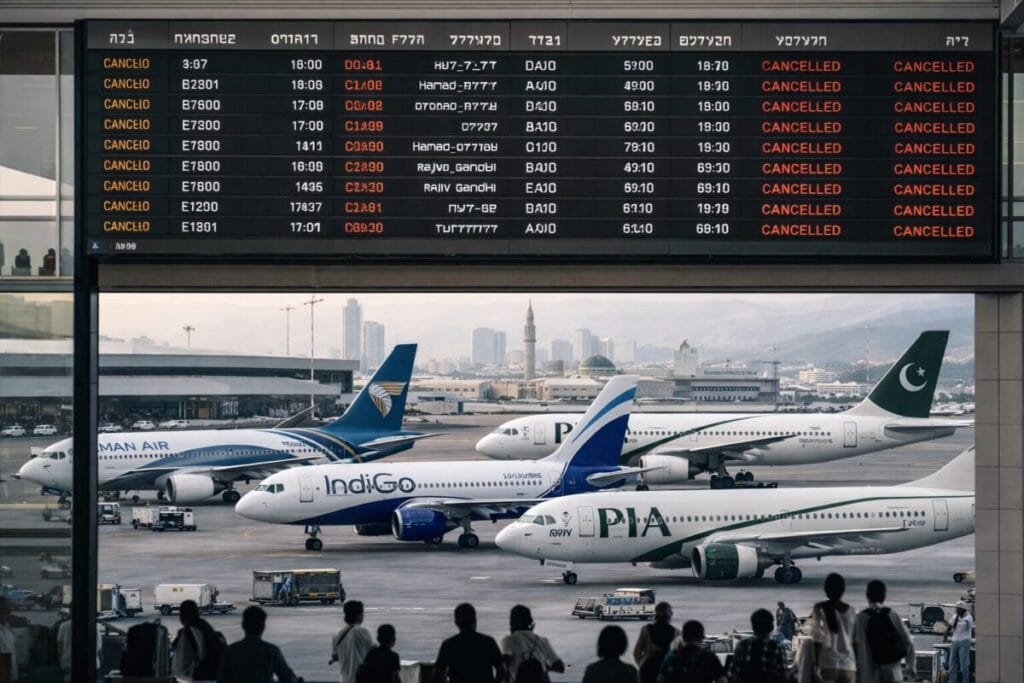
Muscat’s main aviation gateway has been thrust into turmoil after widespread flight cancellations at Seeb International Airport disrupted regional and international travel. Dozens of arrivals and departures were grounded over consecutive days, affecting airlines across the Gulf, South Asia and beyond as security concerns forced operational adjustments.
Passengers traveling to and from Oman suddenly faced uncertainty as carriers including Oman Air, Pakistan International Airlines, IndiGo, Qatar Airways, FlyDubai, Etihad Airways and Gulf Air suspended or delayed multiple services. The disruption has impacted key corridors linking Muscat with Dubai, Doha, Abu Dhabi, Kuwait, Mumbai, Hyderabad, Lahore, Amman and Istanbul.
For a nation that relies heavily on aviation connectivity to support tourism, business and transit flows, the cancellations represent a significant short-term shock.
Muscat’s Aviation Hub Under Strain
Seeb International Airport, officially known as Muscat International Airport, serves as Oman’s busiest airport and a vital link between the Arabian Peninsula, South Asia and Europe. In recent years, Oman has positioned itself as a growing tourism destination, supported by infrastructure expansion and airline route development.
The recent wave of cancellations has affected both inbound and outbound flights. Arrivals from Lahore, Hyderabad, Kochi and Mumbai were among those impacted, along with regional services from Dubai, Doha and Abu Dhabi. Flights connecting Muscat to Amman, Kuwait and Bahrain also experienced interruptions.
Airport authorities confirmed that operational changes were implemented in response to evolving regional security conditions. Airlines made precautionary decisions to ensure passenger and crew safety, resulting in a sharp drop in scheduled movements during peak travel windows.
Regional Routes Most Affected
The majority of cancellations occurred along high-frequency Gulf and South Asian routes. These corridors typically operate multiple daily services and form the backbone of Oman’s aviation network.
Key disruptions included:
- Suspended Dubai–Muscat rotations
- Delays and cancellations on Doha–Muscat services
- Grounded flights between Muscat and Abu Dhabi
- Paused services to Hyderabad, Kochi and Mumbai
- Cancelled connections to Lahore and Karachi
Because these routes are heavily used by expatriate workers, business travelers and visiting families, the ripple effect extended quickly across time zones.
Flights from Istanbul Sabiha Gökçen, Sheremetyevo in Moscow and Beijing Daxing were also affected during the disruption period, highlighting the global reach of Muscat’s air network.
Tourism and Hospitality Impact in Oman
Oman’s tourism industry has steadily expanded over the past decade, with Muscat serving as the primary entry point for international visitors. Attractions such as the Sultan Qaboos Grand Mosque, Mutrah Corniche and luxury beach resorts draw travelers from Europe, Asia and the GCC region.
When flights are suspended, the effects extend beyond airport terminals. Hotels in Muscat reported last-minute booking changes as some visitors extended stays while others postponed arrivals. Tour operators managing desert excursions and coastal itineraries adjusted schedules to accommodate delayed clients.
Short-term occupancy may remain stable due to stranded passengers requiring accommodation. However, forward bookings could soften if regional instability persists and traveler confidence weakens.
Tourism contributes significantly to Oman’s diversification strategy, making aviation stability a key economic priority.
Why the Disruptions Escalated Quickly
Modern aviation networks are highly sensitive to regional security developments. When airspace advisories are issued or missile activity is reported within flight corridors, airlines must reassess risk immediately.
Widebody and narrowbody aircraft operating in Gulf airspace depend on clearly defined routing structures. If those corridors become restricted or congested due to rerouting from neighboring countries, airlines may suspend services rather than risk delays or safety concerns.
Muscat’s position between the Strait of Hormuz and major Gulf hubs means it sits within one of the world’s busiest aviation zones. Even temporary instability can cause cascading scheduling complications.
Aircraft rotations are particularly vulnerable. A delayed inbound flight often prevents the outbound leg from operating on time, creating a domino effect.
Passenger Assistance and Rebooking Challenges
With dozens of flights cancelled across multiple days, passenger support systems were quickly activated. Airlines introduced flexible policies allowing free rebooking or refunds for affected segments.
Travelers were advised to:
- Confirm flight status directly with airlines
- Avoid traveling to the airport without verified departure times
- Retain cancellation confirmations for insurance purposes
- Keep receipts for accommodation if reimbursement applies
Embassies in Muscat also encouraged citizens to register for updates where necessary.
Because alternative seat capacity is limited during regional disruptions, some passengers may face extended waits before securing confirmed departures. Peak travel seasons further complicate re-accommodation efforts.
Broader Implications for Gulf Aviation
The Middle East hosts some of the busiest air corridors in the world, connecting Europe, Asia and Africa. When security concerns intensify in one part of the region, airlines reroute traffic across neighboring airspace, increasing congestion and flight times.
This can lead to:
- Higher fuel consumption due to longer routing
- Crew duty time challenges
- Aircraft repositioning delays
- Short-term fare increases on unaffected routes
Muscat’s disruptions are part of a broader regional recalibration as airlines adjust to evolving airspace conditions.
Economic Outlook for Oman
Oman has invested heavily in tourism infrastructure, airport modernization and national carrier expansion. The country’s Vision 2040 development strategy emphasizes diversification beyond oil revenues, with tourism and logistics playing central roles.
A prolonged aviation slowdown could impact:
- Leisure arrivals from Europe and India
- Cruise passenger connections
- Business and energy sector travel
- Hospitality revenue in Muscat and coastal resorts
However, Oman has demonstrated resilience in past disruptions. Once regional airspace stabilizes, airlines typically restore schedules quickly to recapture demand.
What Travelers Should Do Now
Passengers planning to travel through Muscat should monitor official airline announcements and consider flexible booking options. Travel insurance covering trip interruption is advisable during periods of regional uncertainty.
Travelers already in Oman are encouraged to stay informed through reliable sources and maintain communication with carriers regarding rebooking timelines.
A Critical Moment for Middle East Air Travel
The wave of cancellations at Seeb International Airport reflects how quickly geopolitical tensions can disrupt one of the world’s most interconnected aviation regions. For Oman, the challenge lies in balancing safety priorities with maintaining its growing reputation as a welcoming tourism destination.
While the current disruption is significant, it remains an operational response rather than a systemic breakdown. Airports remain open, and coordination between airlines and authorities continues.
As Gulf airspace conditions evolve, Muscat’s aviation network is expected to gradually stabilize. Until then, flexibility and verified information remain essential for travelers navigating this period of uncertainty.
For more travel news like this, keep reading Global Travel Wire