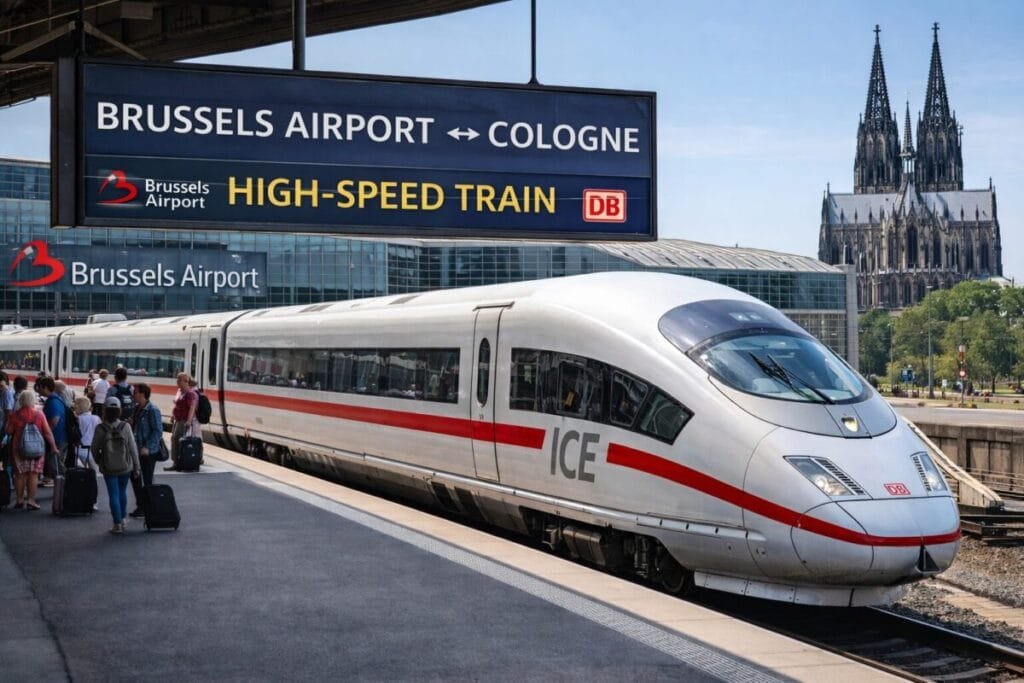
Brussels Airport is preparing to redefine cross-border travel with the launch of a direct high-speed train connection to Cologne beginning in September 2026. The new service, developed in cooperation with Deutsche Bahn, will link one of Belgium’s busiest aviation hubs with one of Germany’s most dynamic cities in just two hours, offering passengers a faster and more sustainable alternative to short-haul flights and car journeys.
The rail link will strengthen ties between Belgium and Germany while reinforcing Brussels Airport’s role as a multimodal gateway at the heart of Europe.
A Two-Hour Connection Between Key European Hubs
The upcoming service will operate directly between Brussels Airport and Cologne, with intermediate stops in Leuven, Liège and Aachen. The journey time of approximately two hours marks a significant improvement in convenience, particularly for business travelers and international passengers seeking efficient onward connections.
From Cologne, passengers will gain access to Germany’s extensive high-speed rail network, linking destinations such as Frankfurt, Düsseldorf and Berlin. On the Belgian side, the service will extend toward Antwerp, further expanding connectivity within the country.
By integrating the airport directly into the high-speed rail corridor, travelers will be able to move seamlessly between air and rail without lengthy transfers.
Strengthening Intermodal Travel Across Europe
The launch reflects a growing shift toward intermodal transport solutions in Europe. Increasingly, airports are partnering with rail operators to provide passengers with more sustainable and time-efficient travel options.
Brussels Airport already benefits from strong rail connectivity within Belgium, with multiple direct trains per hour connecting it to Brussels city center and other major cities. International rail services from the Netherlands and France also provide access to the airport, though often requiring transfers.
The direct Cologne link eliminates the need for additional changes, offering a streamlined route between Germany and Belgium’s capital region.
Collaboration with Deutsche Bahn and Airline Integration
A key element of the initiative is its integration with airline services. Through a codeshare-style partnership between Brussels Airlines and Deutsche Bahn, passengers will be able to book combined rail and air tickets in a single transaction.
This arrangement allows travelers to:
- Purchase one ticket covering both train and flight segments
- Benefit from coordinated schedules
- Receive assistance in the event of delays
- Earn loyalty rewards through airline programs
The seamless booking model mirrors systems already in place between airlines and rail operators in other European markets, reinforcing the concept of rail as an extension of the airport network.
For passengers flying long-haul from Brussels Airport, the new service provides a convenient alternative to regional feeder flights.
Boosting Regional Connectivity
Beyond Brussels and Cologne, the route strengthens links between mid-sized cities along the corridor. Leuven, home to one of Europe’s oldest universities, gains enhanced access to Germany. Liège, an important industrial and logistics hub, benefits from improved airport connectivity. Aachen, located near the Belgian border, becomes more closely tied to Brussels Airport’s global flight network.
Cologne itself is a major economic center, known for its cathedral, trade fairs and media industry. Improved rail access to Brussels Airport offers German travelers expanded international flight options without the need for domestic air travel.
The result is a more integrated regional transport ecosystem that supports tourism, business mobility and cross-border collaboration.
Advancing Sustainable Mobility
Environmental considerations play a central role in the development of the new service. Rail travel produces significantly lower carbon emissions per passenger compared to short-haul aviation. By providing a competitive two-hour rail alternative, Brussels Airport encourages travelers to choose climate-friendly transport options.
European transport policy increasingly emphasizes modal shift—encouraging passengers to use rail for shorter distances while reserving aviation for long-haul journeys. The Brussels–Cologne connection aligns with these objectives by reducing reliance on connecting flights and private vehicles.
As sustainability becomes a priority for both travelers and corporations, integrated rail-air solutions offer practical pathways toward greener mobility.
Supporting Business and Tourism Growth
The rail link is expected to stimulate both business travel and tourism flows. Cologne hosts numerous trade fairs and international events, while Brussels remains a key political and administrative center for the European Union.
Improved connectivity between these cities enhances opportunities for conferences, corporate partnerships and investment. Leisure travelers also benefit, with simplified access to Belgium’s cultural attractions and Germany’s Rhine region.
For inbound tourists arriving at Brussels Airport, the high-speed train opens up additional exploration possibilities without the need for car rentals or complex transfers.
Expanding Brussels Airport’s Rail Network
Brussels Airport has steadily expanded its rail connectivity over the years. Domestic services connect it to major Belgian cities, while international routes link it to destinations in the Netherlands and France.
The addition of Cologne represents a strategic expansion eastward, reinforcing the airport’s ambition to function as a central European mobility hub rather than solely an aviation facility.
By embedding high-speed rail directly into airport infrastructure, Brussels Airport enhances resilience and flexibility in its transport offering.
Looking Toward 2026
The September 2026 launch date gives operators time to finalize scheduling, ticket integration and infrastructure coordination. Once operational, the service is expected to run multiple times daily, ensuring reliable frequency for both daily commuters and international travelers.
The initiative reflects a broader European trend of closer cooperation between airports and rail networks. As passenger expectations evolve, seamless travel experiences across transport modes are becoming the new standard.
A New Era of Connected European Travel
The Brussels Airport–Cologne high-speed train connection marks a pivotal development in European mobility. By cutting journey times, strengthening cross-border links and promoting sustainable transport, the service offers a compelling alternative to traditional short-haul travel options.
As Europe continues to invest in integrated transport networks, the new rail corridor stands as a symbol of a more connected, efficient and environmentally responsible future.
When trains begin rolling between Brussels Airport and Cologne in 2026, travelers will experience not just a faster journey, but a transformation in how European cities connect.
For more travel news like this, keep reading Global Travel Wire