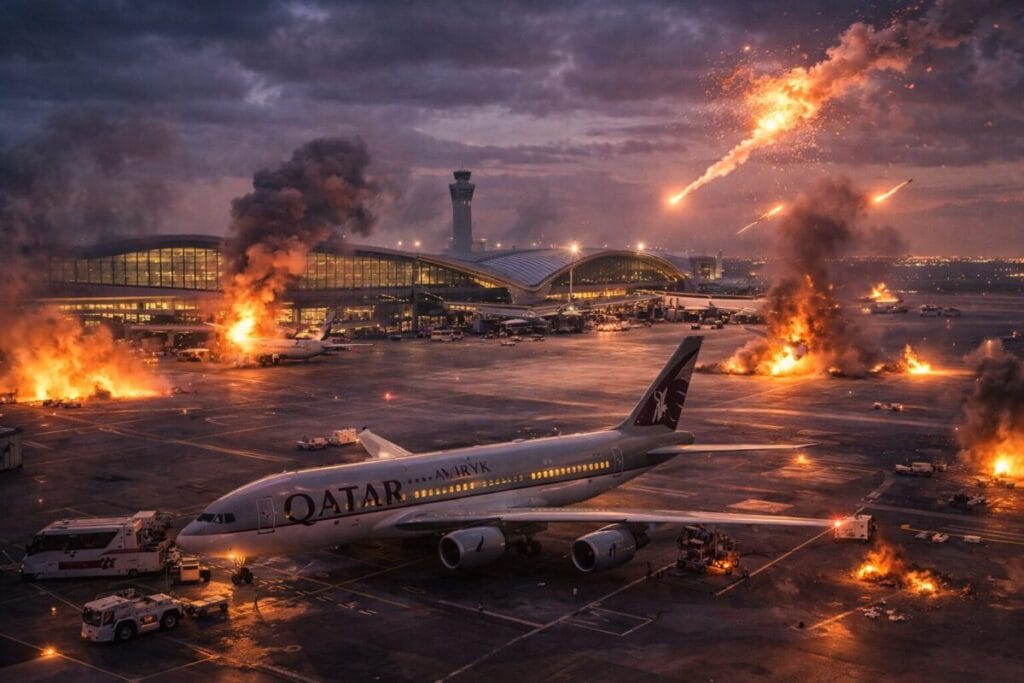
Hamad International Airport in Doha has faced severe disruption following regional missile escalation that targeted civilian infrastructure. The incident triggered widespread flight cancellations and airspace restrictions across Qatar.
Hamad International Airport ranks among the world’s top aviation hubs. The facility connects millions of passengers annually through Qatar Airways’ global network. The sudden security crisis disrupted operations and shook regional travel confidence.
Airspace Closure Forces Immediate Flight Groundings
Authorities implemented emergency airspace restrictions after missile activity raised safety concerns. Qatar’s air defense systems intercepted multiple projectiles. However, falling debris created risks for inbound and outbound aircraft.
Aviation regulators responded by suspending departures and holding inbound flights. Air traffic control diverted aircraft to alternate airports in neighboring countries. Airlines grounded planes to prevent exposure to unsafe corridors.
The airspace closure caused immediate ripple effects across the Gulf region. Doha serves as a critical transit hub linking Europe, Asia, and Africa. When operations halted, global flight schedules felt the impact within hours.
Qatar Airways Faces Major Operational Strain
Qatar Airways relies heavily on Hamad International Airport for its long-haul network. The disruption forced the airline to suspend numerous flights.
Passengers experienced delays, rerouting, and last-minute cancellations. Transit travelers faced uncertainty while awaiting updates from airline representatives.
The carrier initiated recovery measures to restore partial operations. Officials coordinated with aviation authorities to evaluate safe departure windows. Customer service teams worked to rebook stranded passengers.
Qatar Airways has built its reputation on punctuality and premium service. This crisis tested its operational resilience under unprecedented circumstances.
Regional Airports Experience Ripple Effects
The instability extended beyond Qatar’s borders. Airports across the Middle East reported heightened security alerts.
Major hubs in the United Arab Emirates, Saudi Arabia, Kuwait, and Bahrain adjusted flight paths to avoid sensitive airspace. Airlines rerouted long-haul flights through alternate corridors over Central Asia and Africa.
Such adjustments increased fuel consumption and extended travel times. Industry analysts noted that longer routes may raise operational costs in the short term.
Regional aviation authorities emphasized that passenger safety remains the top priority.
Economic Consequences Extend Beyond Aviation
The disruption impacted not only travel but also the broader economy. Qatar plays a key role in global energy exports, particularly liquefied natural gas.
Security concerns briefly affected industrial operations linked to energy infrastructure. Global markets reacted with fluctuations in energy pricing.
Tourism and hospitality sectors also felt immediate effects. Hotel occupancy rates in Doha dropped as travelers postponed visits. Conference organizers reviewed event schedules amid travel uncertainty.
The aviation and tourism industries contribute significantly to Qatar’s economy. Rapid stabilization remains essential to limit long-term economic impact.
Impact on Tourism and Global Connectivity
Hamad International Airport functions as a central gateway for international tourism. The airport supports inbound visitors exploring Qatar’s cultural landmarks and business districts.
Travel advisories issued by several governments urged caution for transit passengers. Tour operators adjusted itineraries and offered flexible booking options.
Despite the disruption, tourism officials expressed confidence in recovery. Qatar has invested heavily in infrastructure, including airport expansions and cultural attractions.
Landmarks such as the Museum of Islamic Art and the Doha Corniche continue to draw global interest. Authorities expect visitor numbers to rebound once stability returns.
Strengthened Security and Operational Recovery
Following the incident, Qatar reinforced airport security measures. Authorities increased surveillance and coordination between civil and defense agencies.
Aviation regulators continue monitoring airspace conditions in real time. Gradual resumption of commercial services has begun under controlled conditions.
Airlines prioritize repatriation flights and essential routes. Full restoration of normal schedules depends on regional stability.
Crisis management protocols implemented during the disruption reflect international aviation safety standards. These measures aim to prevent further risk to passengers and crew.
Broader Implications for Middle East Aviation
The incident highlights the vulnerability of global aviation to geopolitical tensions. The Middle East serves as a vital corridor for intercontinental flights.
Any instability in the region can disrupt global travel networks quickly. Airlines may reassess risk exposure and diversify routing strategies.
Insurance premiums and operational costs may increase if tensions persist. Aviation authorities worldwide continue evaluating risk assessments for Middle Eastern airspace.
Industry experts emphasize diplomatic solutions as essential for long-term stability. Sustained peace remains critical to maintaining reliable global connectivity.
Looking Ahead for Hamad International Airport
Hamad International Airport has earned recognition for efficiency, luxury retail, and passenger comfort. The recent disruption challenged its resilience but did not erase its strategic importance.
Authorities aim to restore full operations swiftly while maintaining heightened security. Qatar continues collaborating with international partners to ensure safe air travel.
Travelers planning to transit through Doha should monitor official airline communications. Airlines remain committed to minimizing inconvenience during the recovery phase.
Although the crisis created significant turbulence, Qatar’s aviation sector has demonstrated coordinated crisis management. The global travel industry now watches closely as Hamad International Airport works to stabilize operations and reaffirm its position as a leading international hub.
For more travel news like this, keep reading Global Travel Wire