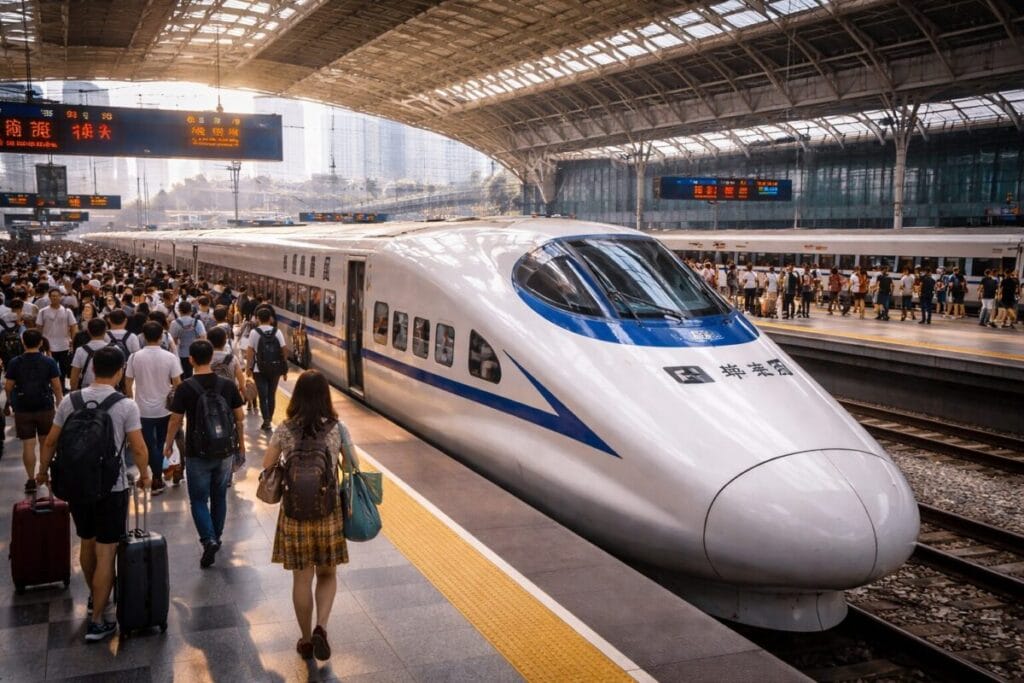
Travel across China has changed dramatically during the past two decades. High speed rail now connects major cities through one of the largest transportation networks in the world.
Passengers at stations in Beijing, Shanghai, and Guangzhou board sleek bullet trains throughout the day. These trains depart frequently and connect hundreds of destinations across the country.
Modern railway stations handle millions of travelers every week. Tourists, students, and business travelers rely heavily on high speed rail services.
What once required overnight train journeys now takes only a few hours. Travelers can explore distant cities comfortably within a single day.
This transformation has reshaped domestic tourism and business travel. China’s rail network now stands at the center of national mobility.
China Builds the World’s Largest High Speed Rail System
China began developing high speed rail later than countries such as Japan and France. However, the country expanded the system rapidly after the first major projects began.
Government infrastructure plans placed strong focus on modern railway development. National investment supported the construction of thousands of kilometers of new tracks.
By 2024 the country had built more than 48,000 kilometers of high speed railway lines. This network now represents the largest high speed rail system in the world.
China accounts for more than seventy percent of global high speed rail mileage. The scale of construction remains unmatched in modern transportation history.
National planning authorities continue expanding the network further. Long term transport strategies aim to extend high speed rail to around 60,000 kilometers by 2030.
These developments ensure that most major regions will gain access to fast rail travel.
Faster Travel Between Major Chinese Cities
The most visible benefit of high speed rail appears in reduced travel times. Journeys between major cities now take only a fraction of earlier travel durations.
Travel between Beijing and Shanghai once required over ten hours on conventional trains. High speed trains now complete the journey in about four and a half hours.
Passengers also travel quickly between northern and southern China. High speed services connect Beijing and Guangzhou in less than eight hours.
Several other routes provide similar time savings. Cities such as Chengdu, Xi’an, Hangzhou, Wuhan, and Shenzhen now connect through fast rail corridors.
These improvements support tourism and business travel across multiple provinces. Travelers often choose trains instead of flights for many domestic journeys.
High speed rail offers comfort and convenience for medium distance travel.
The Eight Vertical and Eight Horizontal Network
China designed its high speed rail expansion around a national transport blueprint. Authorities call this plan the Eight Vertical and Eight Horizontal network.
This framework creates major rail corridors across the country. The design includes eight north south lines and eight east west lines.
The network links economic hubs with inland cities and industrial centers. It also connects coastal regions with interior provinces.
Major routes link Beijing with manufacturing regions along the eastern coastline. Other corridors connect provincial capitals and fast growing technology hubs.
This structured grid improves national connectivity. It allows travelers to move quickly between distant cities.
Economic planners view the network as an important driver of regional development.
Bullet Trains Reach Speeds of 350 Kilometers Per Hour
China’s high speed trains rank among the fastest commercial rail services worldwide. Modern train models operate at speeds of up to 350 kilometers per hour.
The domestically developed Fuxing train series leads this advanced fleet. Engineers designed these trains using modern safety and monitoring systems.
Passengers enjoy quiet cabins, spacious seating, and stable rides. Digital systems continuously monitor train performance and safety conditions.
Railway engineers continue researching next generation train technology. New designs aim to reach speeds of around 400 kilometers per hour.
These innovations will strengthen China’s leadership in rail transport technology.
Advanced engineering also improves passenger comfort and operational efficiency.
Billions of Passengers Use China’s Rail System
Rail transport remains one of the most important travel methods in China. Millions of passengers rely on trains every day.
National railway statistics show that over four billion passenger trips occurred during 2024. High speed rail accounts for a large share of this activity.
Many travelers prefer trains over domestic flights for medium distance routes. High speed trains compete directly with airlines on journeys between 300 and 1,000 kilometers.
Rail stations located in city centers provide convenient access for passengers. Airport travel often requires longer transfers and additional security procedures.
Train boarding processes usually move faster than airport security lines. These advantages encourage many travelers to choose rail services.
High Speed Rail Boosts Domestic Tourism
The expansion of high speed rail has transformed tourism across China. Travelers now reach destinations that once seemed distant or difficult to access.
Scenic mountain regions and historic towns attract growing numbers of tourists. Many visitors arrive using fast train connections from major cities.
Weekend travel between cities has become increasingly popular. Families often take short trips using convenient high speed routes.
Cultural tourism also benefits from improved transportation networks. Travelers can visit multiple heritage sites during a single journey.
Regional tourism boards report rising visitor numbers along major rail corridors. Hotels, restaurants, and attractions benefit from these tourism flows.
High speed rail therefore supports economic growth across many regions.
Future Technologies Could Push Rail Speeds Higher
China continues researching advanced transportation technologies. Engineers and scientists explore new systems that could further increase travel speed.
Magnetic levitation trains represent one possible future innovation. These trains float above tracks using magnetic forces instead of wheels.
Maglev technology reduces friction and allows much higher travel speeds. Some experimental designs aim to exceed 600 kilometers per hour.
Although maglev systems remain under development, research continues actively. China already operates a maglev demonstration line in Shanghai.
Engineers also continue improving traditional high speed rail technology. Future upgrades may introduce faster trains and more efficient networks.
High Speed Rail Defines the Future of Travel in China
China’s high speed rail system has already transformed national travel patterns. Millions of passengers now experience faster and more comfortable journeys.
Families travel across provinces for holidays and tourism. Students and workers rely on rail networks for education and employment mobility.
The railway network supports economic integration across the country. Cities once separated by long distances now connect through rapid transport corridors.
As expansion continues, more regions will join the national network. Travel across China will become even faster and more convenient.
High speed rail has therefore become one of the most important transportation achievements in modern China.
For more travel news like this, keep reading Global Travel Wire