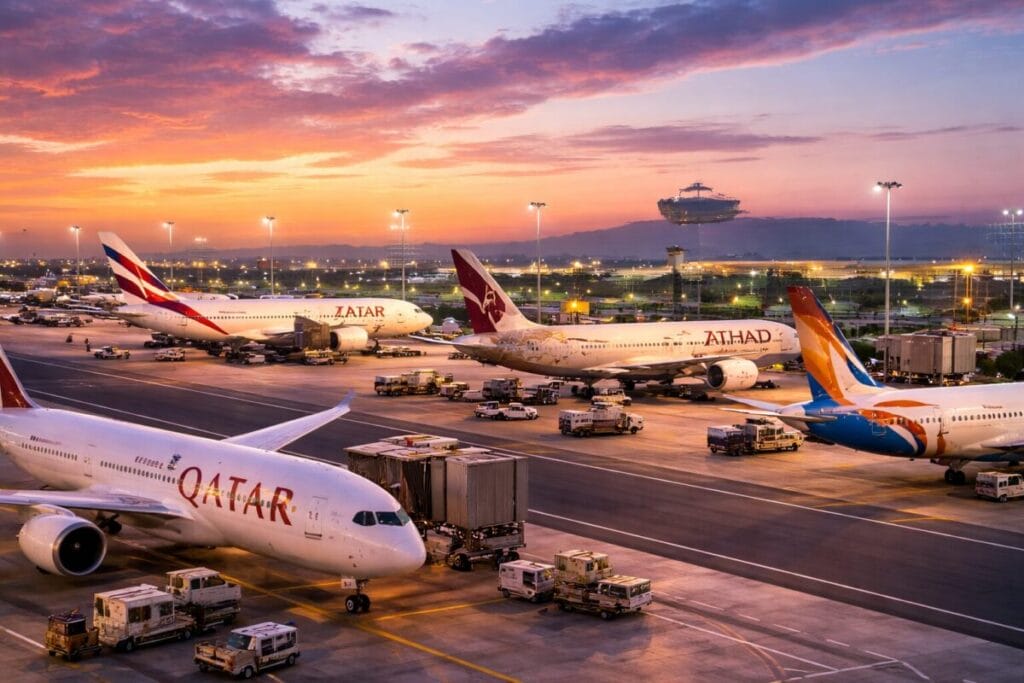
Major Gulf airlines have launched a large evacuation operation to help travelers leave the Middle East. Rising geopolitical tensions have disrupted normal travel across the region.
Airlines such as Etihad, Emirates, Qatar Airways, flydubai, and Air Arabia have expanded schedules rapidly. Together they have operated more than 6,600 flights from key Gulf hubs.
These flights connect the United Arab Emirates, Qatar, and Saudi Arabia with global destinations. Travelers are flying to countries including the United States, United Kingdom, Canada, China, and India.
The surge in flights has created a vital travel corridor for stranded passengers. Many travelers rely on these services to exit the region quickly and safely.
Aviation experts say Gulf carriers now play a central role in stabilizing global travel networks.
Emirates Leads Large Scale Global Evacuation Flights
Emirates has taken a leading role in evacuation operations across the Middle East. The airline expanded flight activity from Dubai International Airport significantly.
At the start of March, the airline operated only a few dozen departures each day. By mid March, operations increased to more than three hundred flights daily.
This rapid expansion allowed Emirates to transport thousands of passengers every day. The airline uses its large fleet of Airbus A380 and Boeing 777 aircraft.
Dubai has become a central transit point for travelers leaving the region. Many passengers arrive from nearby countries before continuing to other continents.
Emirates’ extensive global network connects travelers to Europe, North America, Asia, and Australia. The airline’s capacity makes it one of the strongest evacuation channels in the region.
Air Arabia Provides Affordable Exit Routes
Air Arabia has also played an important role during the travel disruption. The airline provides affordable travel options for passengers seeking quick departures.
Based in Sharjah in the United Arab Emirates, Air Arabia expanded its regional operations rapidly. Demand increased sharply as thousands of travelers searched for flights.
The airline operates Airbus A320 and A321 aircraft on short and medium routes. These aircraft allow frequent flights and fast airport turnaround times.
Air Arabia focuses on regional routes connecting the Gulf with nearby regions. Passengers can travel to South Asia, North Africa, Central Asia, and Eastern Europe.
Many migrant workers and regional travelers rely on these routes. Affordable tickets and frequent schedules make the airline an important evacuation lifeline.
Etihad Maintains Long Haul Travel Corridors
Etihad Airways has continued international operations through its Abu Dhabi hub. The airline provides long haul routes connecting the Gulf with global destinations.
Zayed International Airport in Abu Dhabi now serves as another key transit gateway. Many passengers travel through the airport before continuing to other continents.
Etihad operates modern aircraft including Boeing 787 Dreamliners and Airbus A350 jets. These planes carry large passenger numbers across long distances.
The airline’s network connects Abu Dhabi with Europe, North America, Asia, and Australia. Travelers can reach cities such as London, New York, Toronto, and Sydney.
Etihad also benefits from global airline partnerships. These partnerships allow passengers to reach additional destinations through connecting flights.
flydubai Expands Regional Connectivity
flydubai has strengthened regional connectivity during the evacuation effort. The airline connects smaller cities with major international hubs.
Operating from Dubai International Airport, flydubai focuses on regional and medium distance routes. The airline uses a fleet of Boeing 737 aircraft.
These aircraft provide flexibility and allow frequent scheduling. Travelers from secondary cities can reach Dubai quickly.
Once passengers arrive in Dubai, they can transfer to long haul flights. Many travelers connect to global destinations using larger airlines.
flydubai therefore plays a crucial supporting role in evacuation logistics.
Qatar Airways Maintains Global Travel Links
Qatar Airways continues to operate long distance flights from its hub in Doha. Hamad International Airport remains one of the world’s most connected aviation hubs.
The airline serves more than one hundred destinations across six continents. Its aircraft fleet includes Airbus A350, Boeing 787, and Boeing 777 jets.
These planes carry large passenger volumes across long distances. Travelers leaving the Middle East often transit through Doha.
From Doha, passengers can reach cities across Europe, Asia, North America, Africa, and Australia.
Qatar Airways’ strong international network helps maintain global travel flows during the crisis.
Over 6,600 Flights Support Global Evacuation Effort
Between March 1 and March 13, Gulf airlines operated over 6,600 flights. This large scale operation helped maintain global mobility during the regional disruption.
Emirates led the operation with more than 2,800 flights from Dubai. The airline transported the highest number of travelers across its network.
flydubai followed with over 1,500 flights connecting regional cities to Dubai. Air Arabia also played a major role with more than 1,200 flights from Sharjah.
Etihad Airways operated more than 500 flights from Abu Dhabi. Meanwhile, Qatar Airways maintained nearly 400 flights from Doha.
Together these airlines created a powerful evacuation network linking the Gulf to the rest of the world.
Global Aviation Network Supports Travelers
The massive airlift highlights the strategic importance of Gulf aviation hubs. Airports in Dubai, Doha, and Abu Dhabi act as global travel gateways.
During crises, these hubs help airlines move passengers quickly across continents. Large aircraft fleets and extensive route networks support rapid evacuation efforts.
Airlines have mobilized resources to ensure safe travel for thousands of passengers. Crew members, airport staff, and operations teams work continuously to maintain schedules.
Travel experts say cooperation among airlines remains essential during disruptions. Coordinated operations help maintain global connectivity.
Aviation Industry Responds to Regional Uncertainty
Geopolitical tensions often disrupt aviation networks across large regions. Airlines must respond quickly to protect passengers and maintain travel services.
Gulf carriers have demonstrated strong operational capacity during this crisis. Their global networks allow travelers to reach safe destinations worldwide.
Passengers continue to leave the region through major transit hubs. Flights connect travelers to countries across Europe, Asia, and the Americas.
The aviation industry will continue monitoring the situation closely. Airlines will adjust schedules and routes as regional conditions evolve.
For more travel news like this, keep reading Global Travel Wire