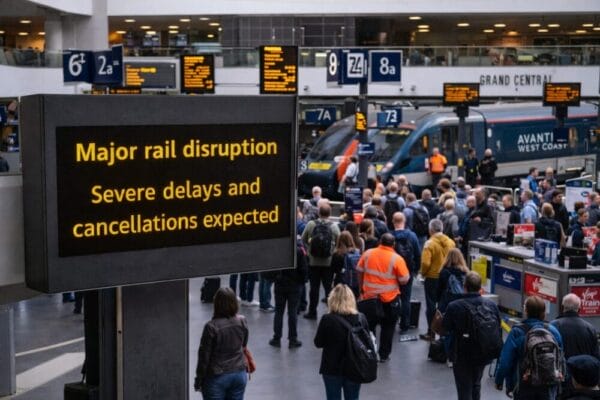
Thousands of rail passengers across the West Midlands experienced major travel disruption after damage to overhead electrical wires caused significant delays and cancellations between Birmingham New Street and Wolverhampton. The incident affected one of the busiest sections of the UK rail network, creating widespread delays for commuters, business travelers and tourists moving through the region.
The disruption began early on March 16, 2026, when railway engineers discovered faults in the overhead line equipment that supplies electricity to trains running along the route. Because electric trains rely on these power lines to operate, services had to be slowed, diverted or cancelled while repair teams worked to restore safe operations.
Rail authorities warned passengers that the disruption would likely continue throughout the morning, with full services expected to resume only after emergency maintenance work had been completed.
A Critical Transport Corridor Disrupted
Birmingham New Street is one of the most important railway hubs in the United Kingdom. Located in the heart of Birmingham city centre, the station handles tens of millions of passengers every year and serves as a major interchange for both regional and long-distance services.
The rail corridor connecting Birmingham New Street and Wolverhampton is particularly significant because it links the Midlands with major cities including London, Manchester, Liverpool and Glasgow. Many commuters rely on this route for daily travel between towns and employment centers across the region.
When overhead wire damage forced restrictions on the line, the impact was felt quickly across the wider rail network. Passengers attempting to reach workplaces, business meetings and travel connections experienced delays that in some cases exceeded one hour.
Cancellations and Diversions Affect Multiple Train Operators
Several train operators running services through Birmingham New Street were forced to adjust their schedules due to the infrastructure fault. Long-distance trains operating along the route had to be diverted to alternative tracks or bypass certain stations entirely.
In some cases, trains were unable to stop at Birmingham New Street as originally planned, forcing passengers to make additional connections through neighboring stations. Other services were cancelled outright because safe operating conditions could not be guaranteed.
Commuters traveling during the morning peak period were among the most heavily affected. Crowded platforms and last-minute timetable changes created additional challenges for passengers trying to reach their destinations on time.
Rail operators encouraged travelers to check live service updates before leaving home to avoid unnecessary delays.
Alternative Travel Options Introduced
To help passengers continue their journeys, rail companies introduced temporary travel flexibility across the affected routes. Tickets originally issued for cancelled services were accepted on alternative trains operated by other rail providers running through the region.
Passengers were also allowed to use additional transport options including tram services and other regional train lines connecting Birmingham with nearby cities.
Transport authorities requested replacement buses where possible to help bridge gaps in the rail network while repair teams worked on restoring the overhead wires.
These measures were designed to reduce congestion and help travelers reach their destinations despite the disruption.
The Role of Overhead Electrical Lines
Overhead wire systems are a critical part of modern railway infrastructure. Electric trains receive power through cables suspended above the track, which connect to the train through a device known as a pantograph.
When these wires become damaged due to mechanical faults, weather conditions or other technical issues, trains can no longer safely draw electricity from the network. As a result, rail operators must reduce speeds or suspend services entirely until repairs are completed.
Engineers responding to the Birmingham disruption focused on inspecting the damaged section of wiring and restoring stable electrical connections along the affected route.
Repair work often requires temporary closures of certain tracks to ensure worker safety while technicians operate near high-voltage equipment.
Ripple Effects Across the UK Rail Network
Because Birmingham New Street acts as a major interchange for multiple rail lines, disruptions at the station can quickly spread across the national rail system. Delays on one route often affect trains scheduled to continue onward to other destinations.
Passengers traveling between the Midlands and other regions of the United Kingdom experienced knock-on effects throughout the morning as train schedules were adjusted.
Tourists traveling through Birmingham on their way to major cities such as London or Manchester were also impacted. Many travelers had to rebook connections or adjust their itineraries to accommodate the disrupted services.
Transport experts note that large hub stations like Birmingham New Street play a central role in maintaining the efficiency of the national rail network. When issues occur at these key locations, widespread travel disruption can follow.
Commuters Adapt to Travel Challenges
Despite the disruption, many commuters adapted by using alternative routes, adjusting travel times or working remotely where possible. Real-time updates provided through mobile apps and station announcements helped passengers stay informed about the latest service changes.
Some travelers chose to delay their journeys until later in the day when services were expected to stabilize. Others used alternative transport such as local trams or bus services to bypass the affected rail corridor.
Rail staff were stationed at key locations within Birmingham New Street to assist passengers and direct them toward available travel options.
Importance of Infrastructure Investment
The incident has once again highlighted the importance of maintaining and upgrading railway infrastructure across the United Kingdom. Many sections of the national rail network rely on equipment installed decades ago, which requires regular inspection and modernization.
Investment in improved overhead line systems and advanced monitoring technology could help detect faults earlier and reduce the likelihood of sudden disruptions.
Transport authorities have emphasized the need for ongoing maintenance programs to ensure the reliability of key railway corridors serving major cities and commuter regions.
Modern infrastructure improvements are considered essential for supporting the growing demand for rail travel across the country.
Looking Ahead for Midlands Rail Travel
By midday, engineers were expected to complete repairs and restore normal service along the Birmingham to Wolverhampton route. However, some delays were likely to continue as trains returned to their scheduled positions across the network.
Passengers were advised to continue checking travel updates and allow additional time for their journeys throughout the day.
Although disruptions of this scale are frustrating for commuters, they also highlight the resilience of the rail network and the rapid response capabilities of engineering teams working to restore services.
For the millions of travelers who rely on Birmingham New Street each year, maintaining reliable rail connections remains a top priority as the UK continues to invest in modernizing its transport infrastructure.
For more travel news like this, keep reading Global Travel Wire