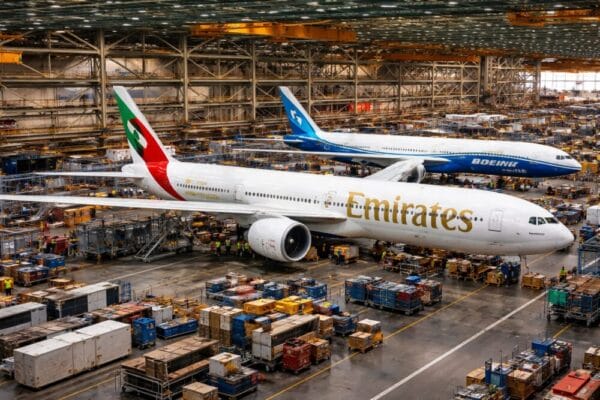
Global aviation markets now watch Boeing closely as geopolitical tensions reshape aircraft demand. Analysts recently highlighted a major concentration risk in Boeing’s order book. Around fourteen percent of the company’s aircraft backlog comes from Middle Eastern airlines and leasing companies. This heavy reliance creates uncertainty during rising regional instability.
The Middle East once represented the fastest growing aviation market for long-haul aircraft. Airlines across the Gulf region built powerful global networks using large widebody jets. However, growing geopolitical tensions now threaten the stability of these airline expansion plans. Boeing must navigate this challenge carefully to protect its future revenue and production schedule.
The Middle East: A Key Market for Widebody Aircraft
Airlines in the Middle East transformed global aviation during the past two decades. Major carriers such as Emirates, Qatar Airways, and Etihad Airways created massive transit hubs connecting Europe, Asia, Africa, and the Americas. These airlines rely heavily on large aircraft capable of carrying hundreds of passengers on long-haul routes.
Boeing benefited strongly from this growth. Gulf airlines placed large orders for widebody aircraft to support their global hub strategies. Many of these orders include the next-generation Boeing 777X, one of the largest passenger aircraft currently under development.
Industry data shows that fourteen percent of Boeing’s aircraft backlog sits within the Middle East region. Airbus holds a smaller exposure of roughly nine percent. This difference highlights Boeing’s deeper dependence on Gulf airline expansion.
While this strategy generated strong sales during stable years, the current geopolitical situation introduces new risks. Airspace restrictions, regional conflict, and fluctuating travel demand now influence airline investment decisions.
The Critical Role of the Boeing 777X Program
The Boeing 777X sits at the center of this market vulnerability. Boeing designed this aircraft as the successor to the highly successful 777-300ER. The aircraft features advanced engines, improved fuel efficiency, and folding wingtips that improve airport compatibility.
However, the program relies heavily on a small group of large customers. Emirates alone ordered hundreds of aircraft within the 777X family. Qatar Airways and Etihad Airways also committed to significant orders.
This concentrated customer base creates challenges during unstable market conditions. If Gulf airlines delay expansion plans, Boeing may face delivery deferrals or production adjustments. Large widebody aircraft require specialized configuration for each airline. Manufacturers cannot easily redirect these customized jets to different carriers.
Airlines may also reconsider the timing of their fleet upgrades. Economic pressure, fuel price fluctuations, and reduced passenger demand can force airlines to postpone aircraft deliveries.
Geopolitical Tensions Affect Aviation Growth
The aviation sector reacts quickly to geopolitical instability. Airspace restrictions across parts of the Middle East have disrupted long-established travel corridors. Airlines must adjust routes, increase fuel reserves, and review long-term fleet strategies.
These changes affect airline profitability and operational planning. Large widebody aircraft require consistent passenger demand to remain economically viable. When travel demand fluctuates, airlines often slow their fleet expansion programs.
Middle Eastern airlines built their business models around global transit traffic. Hubs such as Dubai and Doha connect passengers traveling between continents. Regional instability can reduce connecting traffic and weaken demand for large aircraft.
Government aviation authorities across the region continue to monitor safety conditions closely. Airlines must coordinate closely with regulators and international aviation organizations when planning routes or scheduling aircraft deliveries.
Potential Financial Impact on Boeing
Aircraft manufacturing depends on predictable delivery schedules and steady cash flow. Airlines typically pay for aircraft in stages throughout the production process. Delivery delays or deferrals can disrupt this financial structure.
If Middle Eastern airlines postpone aircraft deliveries, Boeing may face slower revenue recognition. Production planning may also require adjustments to avoid excess aircraft inventory.
The company must balance manufacturing capacity with changing customer demand. Widebody aircraft production already requires long development timelines and significant engineering investment.
Boeing also faces strong competition from Airbus in the global widebody market. Airlines often compare aircraft efficiency, delivery timelines, and pricing when selecting future fleet additions.
Industry analysts believe Boeing may explore new customers in other regions to diversify its order book. Airlines in Asia, Europe, and North America continue expanding long-haul operations as global travel demand recovers.
What This Means for International Travelers
Changes in aircraft deliveries eventually influence passenger travel experiences. Airline fleet plans determine the aircraft type passengers encounter during long-haul journeys.
Some travelers expected to see the next generation Boeing 777X enter service soon. Delivery delays could extend the timeline for these aircraft introductions. Airlines may continue operating older widebody jets for several additional years.
However, airlines often invest in cabin upgrades when aircraft deliveries slow. Many carriers now retrofit existing Boeing 787 Dreamliners and Boeing 777 aircraft with improved seats, upgraded entertainment systems, and modern lighting.
Travelers may also benefit from competitive pricing in some markets. Aircraft manufacturers sometimes offer incentives to airlines willing to accept earlier delivery slots. These incentives can lead to new aircraft entering service on different routes.
Airlines must balance fleet modernization with financial stability during uncertain market conditions. Passenger demand, fuel prices, and geopolitical developments will shape these decisions over the next several years.
Boeing Searches for Greater Market Balance
The current situation highlights the risks of relying heavily on a single geographic market. Aviation manufacturers must maintain diverse customer bases across multiple regions.
Boeing continues expanding relationships with airlines in Asia and Europe. Rapid economic growth and rising tourism demand drive aircraft purchases in several emerging markets.
Government aviation strategies also influence aircraft demand. Many countries invest in new airports, tourism infrastructure, and airline expansion programs to support economic growth.
Boeing must strengthen partnerships with these expanding aviation markets. A broader customer base can reduce vulnerability to regional geopolitical events.
A Crucial Moment for the Global Aviation Industry
The aviation industry now enters a period of careful strategic planning. Aircraft manufacturers, airlines, and regulators must adapt to a rapidly changing global environment.
Boeing’s order concentration in the Middle East illustrates the importance of geographic diversification. Airlines must also reconsider fleet strategies during uncertain geopolitical conditions.
Travel demand continues growing worldwide despite regional disruptions. Tourism authorities across many countries promote international travel as a key economic driver.
The next several years will determine how successfully aircraft manufacturers and airlines adapt to these changing conditions. Boeing’s ability to manage its widebody backlog will play a major role in shaping the future of global long-haul aviation.
For more travel news like this, keep reading Global Travel Wire