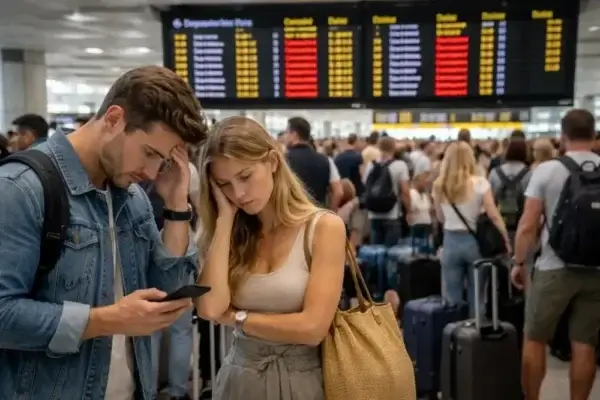
Europe’s major airports are struggling with severe travel disruptions as summer demand rises sharply. Hundreds of travelers remain stranded across key hubs due to cancellations and delays. Airports in London, Frankfurt, Amsterdam, and Reykjavik report major operational stress.
Recent data shows 39 flights cancelled and over 230 delayed across leading European airports. These disruptions highlight growing pressure on aviation infrastructure across the continent. Travelers now face longer waiting times and increased uncertainty during peak travel periods.
Airports once known for efficiency now deal with daily operational challenges. As a result, smooth travel has become less predictable across Europe.
Heathrow and Paris See Heavy Passenger Impact
London Heathrow continues to operate under intense pressure with multiple cancellations and dozens of delays. Even a small number of cancelled flights creates a ripple effect across global connections. Travelers often miss onward flights, which disrupts entire itineraries.
Paris Charles de Gaulle also reports significant disruption levels with dozens of delayed flights. High passenger volume and tight schedules increase congestion at terminals. These conditions make recovery from disruptions more difficult throughout the day.
Both airports act as global transit hubs, so delays quickly spread across international routes. This interconnected system amplifies the impact on travelers worldwide.
Schiphol Leads in Delays While Frankfurt Struggles
Amsterdam Schiphol stands out with the highest number of delays among major European airports. Airlines continue operations despite disruptions, which leads to extended waiting times. Passengers often remain onboard or inside terminals for long periods.
This strategy helps reduce cancellations but creates inconvenience for travelers. Missed connections and extended layovers have become common at Schiphol. The airport’s heavy traffic makes it sensitive to even minor disruptions.
Frankfurt Airport also faces challenges with cancellations affecting its complex connection system. As a major European hub, Frankfurt depends on tightly scheduled transfers. When one flight gets cancelled, several connecting journeys face disruption.
These patterns show how interconnected networks increase vulnerability during peak travel periods.
Reykjavik Chooses Cancellations Over Delays
Reykjavik presents a different disruption pattern compared to other European airports. Airlines have cancelled several flights instead of delaying them. This approach reduces waiting time at airports but increases travel uncertainty.
Passengers must often rebook flights or delay their trips entirely. This situation creates challenges, especially on routes with limited alternatives. Iceland serves as a key link between Europe and North America, which increases the impact of cancellations.
This strategy reflects a focus on operational reliability instead of prolonged delays. However, it places a heavier burden on travelers who must adjust their plans quickly.
Government Data Highlights Systemic Issues
Government aviation data reveals that delays and cancellations have become routine across global travel networks. Transport authorities regularly track airline performance and publish detailed reports. These reports show that flights rarely operate without delays.
Even in stable weather conditions, a significant number of flights arrive late. Authorities classify delays based on weather, airline operations, and air traffic control issues. This data helps identify patterns and recurring challenges in the system.
Airlines and airports rely on this information to improve operations. However, systemic issues continue to affect performance across major hubs.
Weather and Infrastructure Drive Delays
Weather remains a major cause of flight disruptions across Europe. Storms, fog, and poor visibility often affect flight schedules. These conditions reduce runway capacity and slow down air traffic flow.
However, infrastructure limitations also play a major role in delays. Many European airports operate near full capacity during peak seasons. Limited runway space and crowded airspace create bottlenecks.
Tight flight schedules leave little room for recovery when disruptions occur. As a result, even small delays can escalate into larger operational problems.
Global Network Adds More Pressure
European airports operate within a global aviation network that depends on precise timing. Disruptions in other regions quickly affect flights in Europe. Delays in North America or Asia often impact connecting flights across European hubs.
This global dependency increases pressure on already crowded airports. Airlines must manage complex schedules across multiple continents. As a result, recovery from disruptions becomes more difficult.
Travel demand continues to grow, which adds further strain on airport systems. Authorities must adapt quickly to handle this increasing volume.
What Travelers Should Expect Now
Travelers should expect delays and cancellations as part of modern air travel. Planning ahead has become essential for a smoother journey. Passengers should allow extra time for connections and airport procedures.
Understanding airline policies can also help during disruptions. Travelers should stay informed about rebooking options and compensation rules. These steps can reduce stress during unexpected changes.
Flexibility has become a key factor for travelers navigating Europe’s busy airports. Preparation can make a significant difference in handling disruptions.
Future Outlook for European Travel
European authorities continue to push for improvements in airport operations and infrastructure. Increased transparency and performance tracking aim to improve accountability. Airlines and airports must address bottlenecks to enhance efficiency.
Technology and better planning could help reduce delays in the future. However, rising travel demand will continue to challenge the system. Authorities must balance growth with operational capacity.
For now, disruptions remain a common part of the travel experience across Europe. Travelers and airlines must adapt to this evolving landscape.
For more travel news like this, keep reading Global Travel Wire