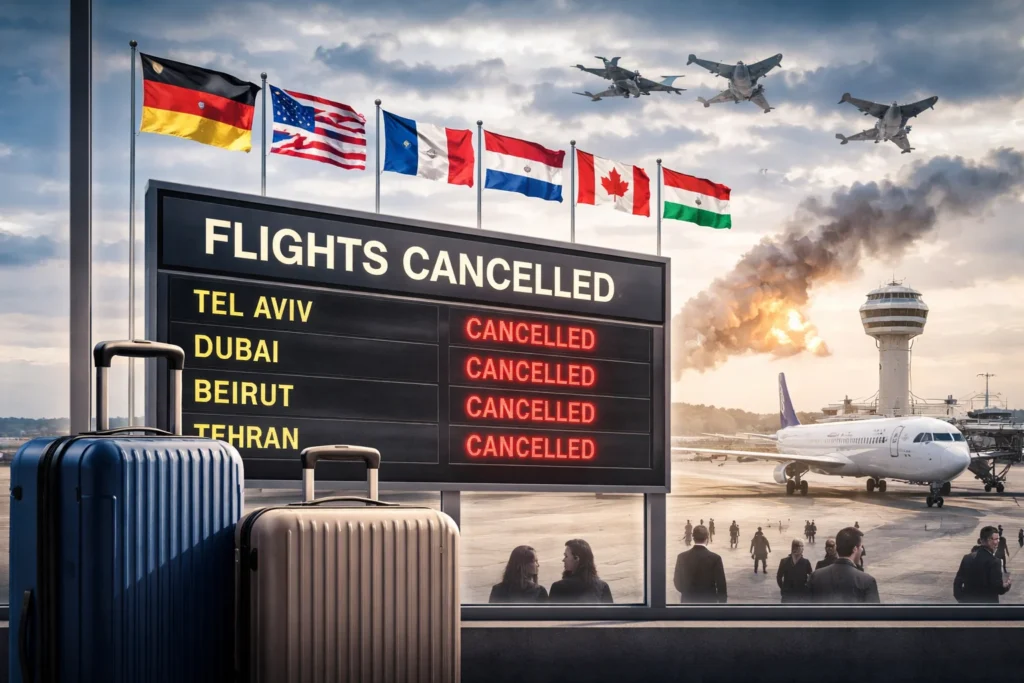
A major shift in global aviation is underway as Germany joins a coalition of countries including the United States, United Kingdom, France, Netherlands, Canada, and Hungary in suspending or limiting flights to key Middle Eastern destinations. The coordinated move comes amid escalating geopolitical tensions and growing concerns over airspace safety, triggering widespread disruption across international travel networks.
The suspension of routes to major hubs such as Dubai, Tel Aviv, Beirut, and Tehran is already affecting millions of passengers worldwide. Airlines are being forced to cancel flights, reroute aircraft, and adjust schedules, while travellers face uncertainty, delays, and rising costs.
Lufthansa Group Leads Germany’s Response
Germany’s aviation sector is playing a central role in the global response, largely driven by the Lufthansa Group, one of Europe’s largest airline conglomerates. The group has extended flight suspensions to several Middle Eastern destinations well into 2026, citing safety risks linked to ongoing regional instability.
Airlines under the Lufthansa umbrella—including Swiss International Air Lines, Austrian Airlines, Brussels Airlines, Eurowings, and ITA Airways—have halted services to cities such as Dubai, Tel Aviv, Abu Dhabi, Beirut, and Tehran. Some routes are suspended until late May 2026, while others remain paused through October.
The decision reflects growing concerns over missile threats, restricted airspace, and operational challenges at major regional airports. Airlines are prioritizing passenger and crew safety, even as the suspensions disrupt key international travel corridors.
US Carriers Extend Cancellations
Major US airlines have followed a similar path, extending flight cancellations to the Middle East. United Airlines, Delta Air Lines, and American Airlines have suspended services to destinations including Tel Aviv and Dubai through mid-2026.
These actions align with aviation safety advisories warning of heightened risks in Middle Eastern airspace. Airlines are increasingly avoiding affected zones altogether, opting for longer alternative routes that bypass conflict areas.
For passengers, this means fewer direct connections, longer travel times, and limited availability during peak travel seasons.
UK Airlines Suspend Key Routes
In the United Kingdom, leading carriers British Airways and Virgin Atlantic have also paused flights to several Middle Eastern destinations. Services to Dubai, Tel Aviv, and Amman have been suspended through at least May 2026.
The decision follows updated travel advisories urging caution due to regional instability. The impact is being felt not only in leisure travel but also in business travel, particularly to Israel and the Gulf region, which are key global business hubs.
Airlines are offering flexible options, including rebooking and refunds, but travellers are increasingly facing complex itineraries involving stopovers in cities such as Istanbul and Doha.
Air France-KLM and European Airlines Adjust Operations
European carriers are also scaling back operations. The Air France-KLM Group has suspended flights to Tel Aviv, Beirut, and Dubai for several weeks, with ongoing uncertainty about when normal operations will resume.
These disruptions highlight the interconnected nature of global aviation. When major hubs are affected, the ripple effects extend far beyond the region, impacting connecting flights and international tourism flows.
Canada and Hungary Join the Suspension Wave
Air Canada has extended its cancellations to Dubai and Tel Aviv through late May 2026, reflecting similar safety concerns. Meanwhile, Hungary’s low-cost carrier Wizz Air has suspended flights to Tel Aviv, further limiting travel options for budget-conscious passengers.
Low-cost carriers, in particular, face challenges in offering alternative routes, leaving travellers with fewer affordable options.
Asia-Pacific Airlines Respond to Instability
Airlines in the Asia-Pacific region are also adjusting operations. Cathay Pacific has paused flights to destinations such as Dubai and Riyadh, citing operational risks and safety concerns.
To maintain connectivity, some airlines are rerouting flights through alternative hubs like Doha or Istanbul. However, these changes often result in longer journeys and increased travel costs.
Tourism and Business Travel Face Major Setbacks
The widespread suspension of flights is having a significant impact on global tourism. Popular destinations such as Dubai and Abu Dhabi are experiencing reduced visitor numbers, while travel-dependent sectors—including hotels, tour operators, and local businesses—are facing cancellations and revenue losses.
Business travel is also being disrupted. Corporate travellers are encountering difficulties in reaching key markets in the Middle East, leading to postponed meetings, virtual alternatives, and increased travel expenses.
What Travellers Should Know
Passengers affected by the disruptions have several options, though flexibility is essential. Most airlines are offering free rebooking or full refunds for cancelled flights. Travellers can also explore alternative routes through unaffected hubs, though these may involve longer transit times.
Staying updated is critical, as flight schedules continue to change based on evolving conditions. Airlines are advising passengers to regularly check flight status updates and remain in contact for the latest information.
Aviation Industry Faces Ongoing Uncertainty
The coordinated suspension of Middle East air routes marks one of the most significant disruptions in recent aviation history. As geopolitical tensions persist, airlines and governments are prioritizing safety over connectivity, reshaping global travel patterns.
While these measures are temporary, the timeline for full recovery remains uncertain. The aviation industry, along with global tourism and business travel sectors, is expected to face continued challenges throughout 2026.
For now, travellers are advised to plan cautiously, remain flexible, and prepare for ongoing disruptions as the situation continues to evolve.
For more travel news like this, keep reading Global Travel Wire