The global aviation industry is undergoing a major shift as Qatar Airways responds to escalating tensions in the Middle East by reducing operations and placing a significant portion of its fleet into storage. The move highlights the growing impact of geopolitical instability on international travel, airline operations, and tourism demand.
With airspace restrictions tightening across the region, airlines are being forced to rethink their strategies. Qatar Airways, one of the world’s leading long-haul carriers, has taken a cautious approach by repositioning aircraft worldwide and temporarily scaling back services.
Fleet Reduction Reflects Uncertain Travel Environment
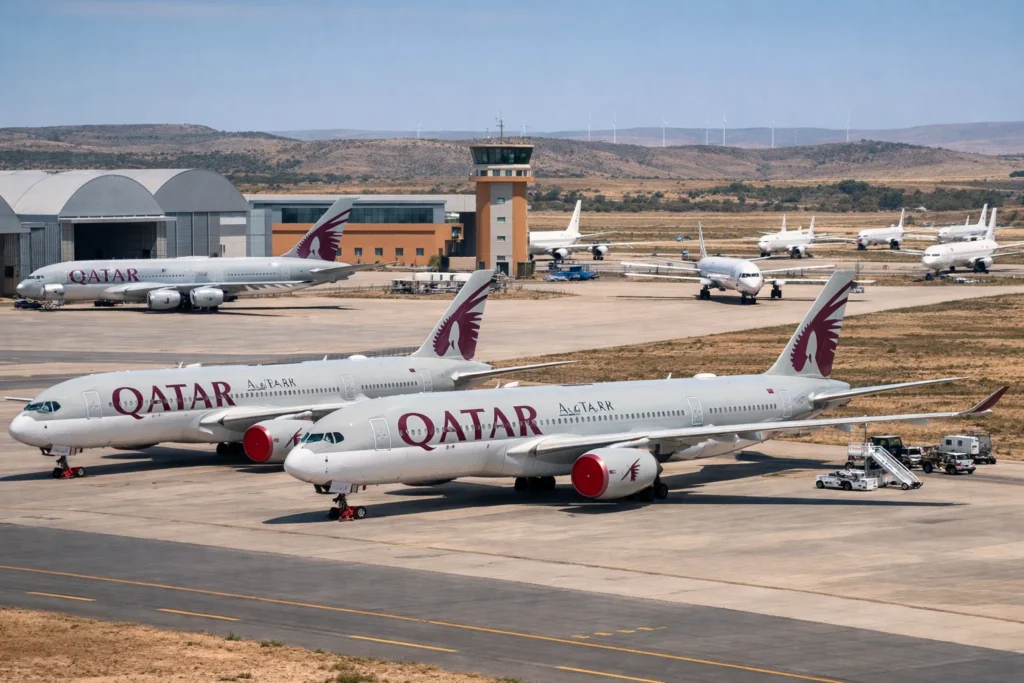
Qatar Airways has redistributed more than 100 aircraft across multiple international locations while placing many others into long-term storage. This strategic decision is aimed at minimizing operational costs during a period of reduced demand and limited airspace access.
Aircraft from its diverse fleet—including wide-body models used for long-haul routes—have been stationed at airports across Europe, Asia, and North America. At the same time, a large number of planes have been relocated to storage facilities designed to maintain aircraft during extended periods of inactivity.
This temporary downsizing reflects the airline’s effort to adapt to a rapidly changing travel landscape, where demand is fluctuating and operational challenges continue to grow.
Spain Emerges as Key Storage Hub
One of the most notable developments is the increased use of long-term aircraft storage facilities in Spain. Airports known for handling grounded aircraft have seen a surge in arrivals from Qatar Airways, with multiple jets parked for extended periods.
These facilities provide specialized maintenance and preservation services, ensuring that aircraft remain in operational condition while not in use. By moving planes to such locations, airlines can significantly reduce expenses related to daily operations, staffing, and airport handling.
The use of long-term storage is a well-established practice in aviation, often employed during periods of crisis or reduced demand. However, the scale of the current situation underscores the severity of the challenges facing the industry.
Airspace Restrictions Drive Operational Changes
The primary factor behind these adjustments is the growing complexity of air travel routes due to Middle East airspace restrictions. With certain corridors closed or deemed unsafe, airlines must reroute flights, often resulting in longer travel times and increased fuel consumption.
For Qatar Airways, whose network relies heavily on connecting global destinations through its hub, these restrictions have created significant logistical challenges. Maintaining regular schedules has become increasingly difficult, prompting the airline to reduce frequencies and suspend selected routes.
Safety remains the top priority, and the airline’s cautious approach reflects the need to navigate an unpredictable operating environment.
Financial and Industry Implications
The decision to scale down operations has financial consequences, but it also helps limit potential losses during a period of uncertainty. By reducing active fleet size, Qatar Airways can better align capacity with demand while controlling operational expenses.
The broader aviation industry is facing similar pressures. Airlines worldwide are adjusting schedules, cutting routes, and reassessing growth plans as geopolitical risks and rising costs reshape the sector.
While some carriers are attempting to maintain operations at near-normal levels, others are adopting more conservative strategies, prioritizing long-term sustainability over short-term recovery.
Impact on Global Travel and Tourism
The reduction in flights is having a noticeable effect on global travel. Passengers are experiencing fewer available routes, increased ticket prices, and longer journey times due to rerouted flights.
Tourism markets that rely on international connectivity are also feeling the impact. Destinations across Europe, Asia, and Africa that depend on transit traffic through major hubs are seeing changes in travel patterns.
Business travel is being affected as well, with companies adjusting plans to accommodate limited flight options and increased uncertainty. Conferences, meetings, and events that rely on seamless global connectivity are facing new challenges.
Passenger Experience and Travel Flexibility
For travellers, the current situation requires greater flexibility and planning. Flight schedules are subject to change, and passengers may need to adjust itineraries at short notice.
Airlines, including Qatar Airways, are offering flexible booking options, allowing travellers to modify or cancel trips with reduced penalties. These measures are designed to maintain customer confidence while navigating the ongoing disruptions.
Travellers are also encouraged to monitor flight updates regularly and consider alternative routes or travel dates to minimize inconvenience.
Signs of Gradual Recovery
Despite the challenges, there are indications that the situation may improve over time. Airlines are closely monitoring developments and preparing to restore services as conditions stabilize.
Qatar Airways has signaled its intention to gradually return stored aircraft to active service once airspace restrictions ease and demand recovers. The airline’s strong global network and modern fleet position it well for a rebound when the operating environment becomes more favorable.
A Transforming Aviation Landscape
The current crisis is reshaping the aviation industry in significant ways. Airlines are becoming more cautious in their operations, focusing on efficiency, flexibility, and risk management.
The use of aircraft storage, route adjustments, and capacity reductions reflects a broader shift toward adaptability in the face of uncertainty. These changes are likely to influence how airlines plan for future disruptions.
Outlook for Travellers and Industry
As the Middle East situation continues to evolve, the global travel industry remains in a state of transition. While disruptions are expected to persist in the short term, the long-term outlook will depend on the restoration of stability and confidence.
For now, travellers should remain informed and prepared for changes, while airlines continue to adapt to one of the most challenging periods in modern aviation.
Qatar Airways’ strategic response highlights both the scale of the disruption and the resilience of the industry as it navigates an uncertain path forward.
For more travel news like this, keep reading Global Travel Wire