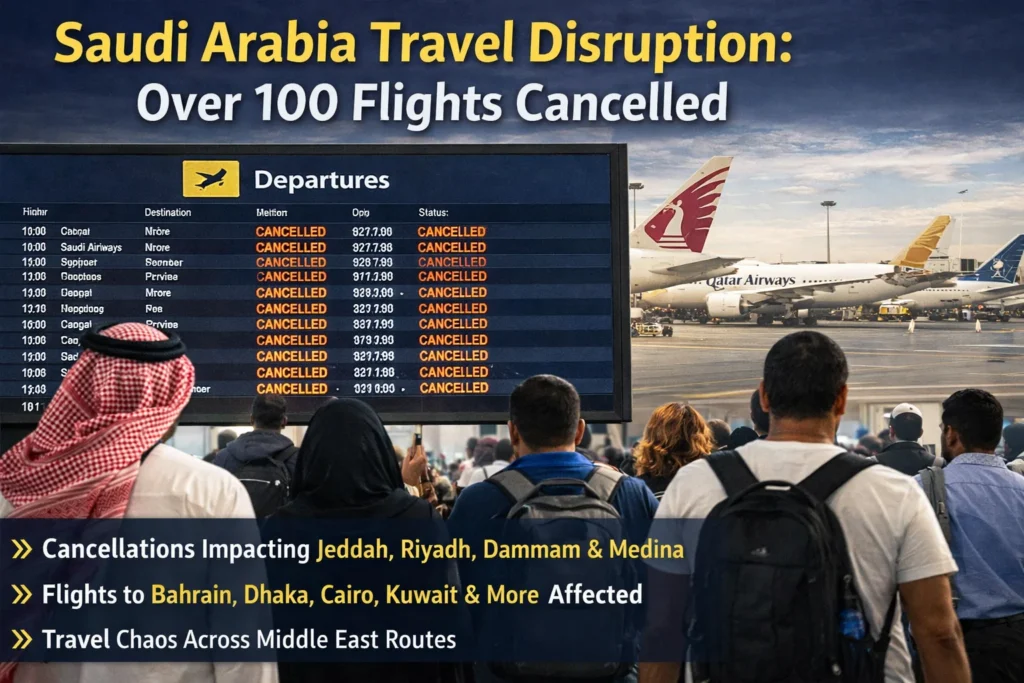
Saudi Arabia’s aviation network is currently facing significant disruption as more than 100 flights have been cancelled across major airports, impacting both domestic and international travel. The widespread cancellations have affected key routes linking the Kingdom to destinations across the Middle East, Asia, and beyond, creating uncertainty for thousands of passengers.
Major hubs including Jeddah, Riyadh, Dammam, and Medina have reported repeated service interruptions over several days. Airlines such as Saudia, Gulf Air, EgyptAir, Pegasus Airlines, Qatar Airways, and others have been forced to suspend services, highlighting operational strain across the region’s aviation sector.
Key Airports Under Pressure
King Abdulaziz International Airport in Jeddah has emerged as one of the focal points of disruption. Flights connecting to Bahrain and several Asian destinations have faced repeated cancellations, affecting both regional travellers and long-haul passengers. Early morning and late-night departures have been particularly impacted, indicating that disruptions are not limited to specific time windows.
In Riyadh, King Khalid International Airport has recorded the highest volume of cancellations. Domestic routes to smaller cities such as Al-Jouf, Gurayat, Rafha, and Arar have been repeatedly suspended, while international services to destinations including Cairo, Dhaka, Istanbul, and Islamabad have also been affected. Even high-frequency domestic routes between Riyadh and Jeddah have not been immune, underscoring the scale of the disruption.
King Fahd International Airport in Dammam has experienced a similar pattern, with a strong concentration of cancellations on short-haul regional routes, particularly those connecting to Bahrain. Meanwhile, Prince Mohammad Bin Abdulaziz Airport in Medina has seen ongoing interruptions on Gulf routes, affecting travel to Bahrain, Kuwait, and Egypt.
Widespread Impact on Regional and International Travel
The cancellations have disrupted a broad network of destinations, including Bahrain, Dhaka, Hong Kong, Tashkent, Cairo, Alexandria, Istanbul, Kuwait, Doha, and Lahore. Domestic routes have also been affected, limiting connectivity between major Saudi cities and smaller regional hubs.
For passengers, the impact has been immediate and far-reaching. Travellers have faced delays, missed connections, and last-minute itinerary changes. The situation has also led to increased congestion on alternative flights, as airlines attempt to accommodate affected passengers on limited available services.
International travellers connecting through Saudi Arabia have experienced additional complications, particularly those relying on transit flights. With schedules disrupted, many passengers have had to adjust travel plans, sometimes extending their journeys by several hours or even days.
Patterns Behind the Disruptions
A closer look at the cancellations reveals several consistent trends. Many of the same flights have been cancelled repeatedly over consecutive days, suggesting ongoing operational challenges rather than isolated incidents.
High-frequency routes, especially those linking Saudi Arabia with Bahrain, have been among the most affected. These routes are crucial for both business and leisure travel, making their disruption particularly significant.
Cancellations have also been concentrated during peak travel periods, including early morning departures and late afternoon services. This timing amplifies the impact, as these slots typically handle large volumes of passengers.
Industry observers suggest that the disruptions may be linked to a combination of factors, including aircraft availability, crew scheduling constraints, and broader operational pressures within airline networks. While exact causes have not been officially confirmed, the scale and consistency of the cancellations point to systemic challenges.
Airline Response and Operational Adjustments
Airlines operating in the region are working to stabilize schedules and minimize further disruption. This includes reallocating aircraft, adjusting flight timings, and consolidating services where possible.
Selective cancellations appear to be part of a broader strategy to maintain overall network functionality. By reducing certain flights, airlines can focus on operating remaining services more reliably. However, this approach places additional pressure on available flights, which are often operating at or near full capacity.
Airlines are also increasing communication with passengers, providing updates through digital platforms and customer service channels. Despite these efforts, high demand for assistance has made it challenging to respond quickly to all affected travellers.
Passenger Experience and Challenges
At airports across Saudi Arabia, the impact of the disruption is clearly visible. Departure halls are crowded with passengers seeking information, while airline counters are managing a surge in rebooking requests.
Travellers are facing extended waiting times and uncertainty, particularly those with connecting flights. Missed connections have become a common issue, forcing passengers to adjust travel plans and, in some cases, incur additional expenses.
For domestic travellers, reduced connectivity between cities has created challenges for both business and personal travel. International passengers, meanwhile, are dealing with the added complexity of visa requirements, transit rules, and time-sensitive itineraries.
Broader Implications for the Aviation Sector
The current situation highlights the interconnected nature of modern air travel. Disruptions at a few key airports can quickly ripple across regional and international networks, affecting multiple airlines and destinations.
Saudi Arabia’s aviation sector plays a critical role in connecting Asia, Europe, and Africa, making stability in its operations essential for global travel flows. The ongoing disruptions underscore the importance of resilience and flexibility within airline and airport systems.
For the tourism industry, the impact is significant. Saudi Arabia has been actively promoting tourism in recent years, and maintaining reliable air connectivity is crucial for sustaining growth in this sector.
Looking Ahead
As airlines and airport authorities work to restore normal operations, the focus remains on minimizing further disruption and ensuring passenger safety. Additional resources, improved coordination, and operational adjustments are expected to play a key role in stabilizing the situation.
Travellers planning to fly through Saudi Arabia in the coming days are advised to stay informed, monitor flight updates, and allow extra time for their journeys. Flexibility will be essential as the situation continues to evolve.
While the current wave of cancellations presents challenges, it also highlights the resilience of the aviation system. With coordinated efforts from airlines and authorities, operations are expected to gradually return to normal, restoring confidence among travellers and supporting the region’s vital air connectivity.