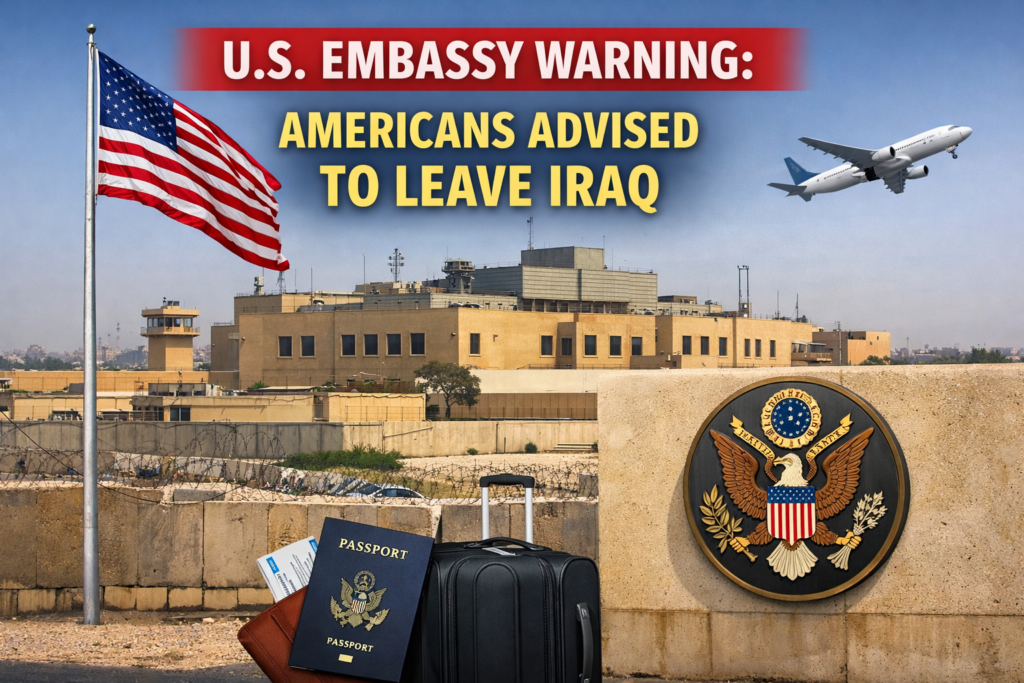
A fresh security alert issued by the US Embassy in Iraq has prompted renewed concern across the global travel sector, as American citizens are being urged to leave Iraq due to escalating regional risks. The advisory, released through official diplomatic channels, underscores heightened security threats and calls for immediate departure using commercial or private transportation where available.
The directive follows ongoing assessments by US authorities regarding safety conditions in the region. While the advisory is primarily aimed at American nationals, its ripple effects are being felt across the wider tourism and aviation industries, particularly in the Middle East corridor.
Government-issued travel advisories such as this one often trigger immediate operational responses from airlines. Carriers serving routes to and from Iraq, including those connecting through major Gulf hubs, are closely monitoring the situation. Depending on evolving security conditions, airlines may adjust flight schedules, reroute aircraft, or temporarily suspend services to ensure passenger and crew safety.
For travelers already in the region, the advisory introduces uncertainty into travel plans. Tour operators and hospitality providers in Iraq and neighboring destinations are preparing for possible cancellations or reduced bookings, especially from long-haul markets. Historically, such official warnings have led to short-term declines in inbound travel demand, particularly among risk-sensitive travelers from North America and Europe.
The tourism infrastructure within Iraq has been gradually rebuilding in recent years, with official initiatives aimed at promoting cultural and religious tourism. Sites of historical and spiritual significance have attracted a growing number of visitors, supported by government-led efforts to improve accessibility and visitor services. However, security advisories of this nature can quickly disrupt momentum, affecting not only international arrivals but also investor confidence in the destination’s tourism sector.
Regional tourism boards are also paying close attention. Neighboring countries that rely on multi-destination itineraries involving Iraq may experience indirect impacts. Travel planners often package Middle Eastern experiences across several countries, and any disruption in one destination can influence broader travel patterns.
Airlines operating in the Middle East are particularly sensitive to geopolitical developments. Aviation authorities and carriers routinely coordinate with government agencies to assess risk levels and implement precautionary measures. This can include adjusting flight paths to avoid certain airspaces or increasing security protocols at airports. While no widespread airspace closures have been officially mandated in this instance, the advisory adds to an already complex operational environment for airlines navigating regional tensions.
Hotels and hospitality providers in Iraq are also bracing for the impact. Occupancy rates, which had shown signs of recovery in select المدن, may face renewed pressure if international travelers heed the advisory and defer trips. Domestic tourism could provide some cushion, but the loss of international visitors often has a disproportionate economic effect, particularly in higher-end hospitality segments.
From a traveler experience perspective, advisories like this highlight the importance of flexible booking policies and comprehensive travel insurance. Many global tourism authorities and ministries consistently advise travelers to stay informed through official government channels and to register with their embassies when traveling abroad. This ensures access to timely updates and assistance in case of emergencies.
The broader Middle East tourism landscape remains resilient, supported by strong infrastructure, major international events, and continued investment in tourism development. However, localized advisories can influence perception, which plays a critical role in travel decision-making. Destinations across the region are likely to reinforce messaging around safety and stability to maintain traveler confidence.
Official statements emphasize that the advisory is precautionary and subject to change based on evolving conditions. Travelers planning to visit Iraq or transit through the region are encouraged to consult official government sources, including embassy updates and national travel advisories, before making arrangements.
For the global tourism industry, the situation serves as a reminder of how geopolitical developments intersect with travel dynamics. Airlines, hotels, and tourism boards must remain agile, adapting quickly to official guidance while ensuring clear communication with travelers.
As the situation develops, stakeholders across the travel ecosystem will continue to monitor official announcements closely. The coming weeks will be critical in determining whether this advisory results in temporary disruption or longer-term shifts in travel patterns within the region.