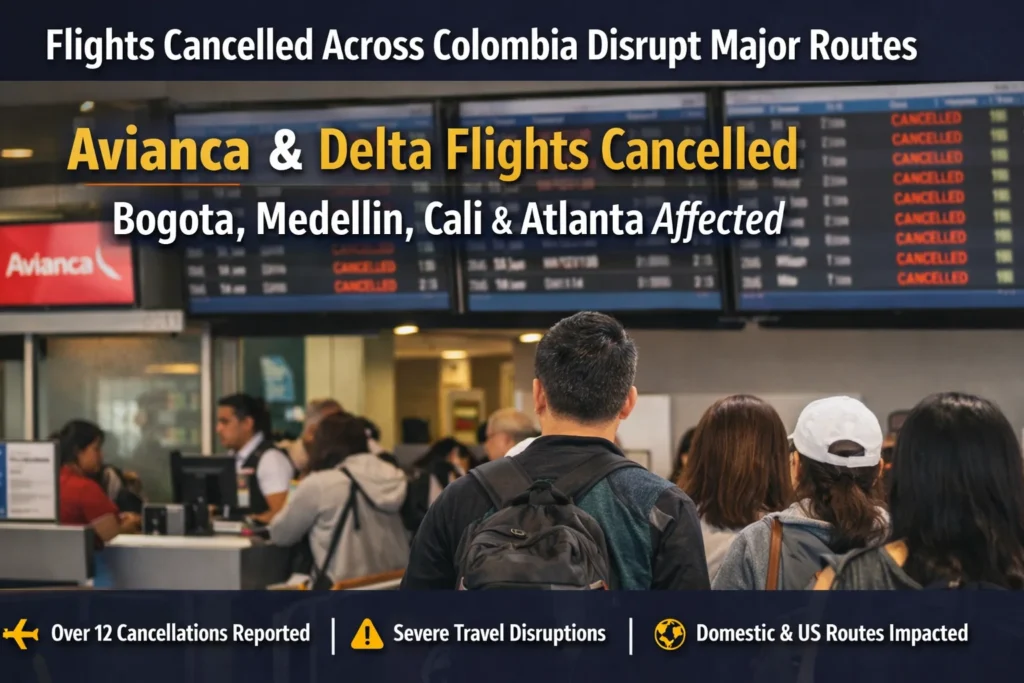
Air travel across Colombia has been significantly disrupted this week as a series of flight cancellations by Avianca and Delta Air Lines affected both domestic and international routes. The disruptions have impacted major cities including Bogota, Medellin, Cali and Cartagena, while also extending to international connections such as Atlanta in the United States.
A total of more than a dozen flights have been canceled across several key airports, creating widespread inconvenience for travelers and placing additional pressure on Colombia’s aviation network. The affected airports include El Dorado International Airport in Bogota, Jose Maria Cordova International Airport in Medellin, Alfonso Bonilla Aragon International Airport in Cali and Rafael Nunez International Airport in Cartagena.
Bogota, as the country’s primary aviation hub, experienced the most significant impact. El Dorado International Airport recorded the highest number of cancellations, particularly on domestic routes operated by Avianca. Flights connecting the capital to cities such as Medellin, Cali, Cartagena and Pasto were among those affected, leaving passengers scrambling to find alternative travel arrangements.
The timing of many of these cancellations, especially during evening hours, has amplified the disruption. Peak travel periods are crucial for both business and leisure passengers, and cancellations during these times have led to missed connections and longer waiting periods at the airport. Travelers relying on Bogota as a connecting hub for international flights have faced additional complications, with some forced to rebook entire itineraries.
International travel has also been affected, with Delta Air Lines canceling a scheduled flight between Bogota and Atlanta. This route is an important link between Colombia and the United States, used by both business travelers and tourists. The cancellation has reduced available capacity on the route and created challenges for passengers needing to reach North America on time.
Medellin’s Jose Maria Cordova International Airport also reported several cancellations, primarily on routes connecting to Bogota. These disruptions have had a cascading effect, as many passengers depend on Bogota for onward domestic and international travel. The inability to reach the capital on schedule has resulted in missed connections and extended travel times for many travelers.
In Cali, although the number of cancellations was smaller, the impact was still noticeable. A key evening flight to Bogota was canceled, affecting passengers planning to connect to other destinations. Evening departures appear to be particularly vulnerable, suggesting operational challenges during high-demand periods.
Cartagena, one of Colombia’s most popular tourist destinations, experienced a single but significant cancellation on a route to Bogota. While the number may seem limited, the importance of the route means that even one disruption can affect multiple travel plans, especially for visitors with tight schedules.
The pattern of cancellations indicates broader operational pressures within the aviation system. Experts suggest that factors such as aircraft availability, maintenance requirements, crew scheduling and high passenger demand could all contribute to the disruptions. When multiple factors coincide, airlines may be forced to cancel flights to maintain safety and operational stability.
Avianca, as Colombia’s largest airline, has been at the center of the disruptions due to its extensive domestic network. The airline operates a high volume of flights connecting major cities across the country, making it particularly susceptible to operational challenges that can affect multiple routes simultaneously. Delta’s involvement in international cancellations further highlights how disruptions can extend beyond national borders.
For passengers, the impact has been immediate and challenging. Many travelers have reported long queues at airline counters, limited availability of alternative flights and uncertainty regarding new departure times. Those traveling for business or with fixed schedules have been particularly affected, as delays and cancellations can disrupt important commitments.
Tourism, a key driver of Colombia’s economy, has also felt the effects of these disruptions. Cities like Cartagena and Medellin rely heavily on consistent air connectivity to attract both domestic and international visitors. Flight cancellations can lead to reduced visitor numbers, affecting hotels, tour operators and local businesses that depend on tourism revenue.
The disruption of domestic routes is especially concerning, as these flights serve as the backbone of Colombia’s internal travel network. Reliable connections between cities are essential for both economic activity and tourism growth. When these routes are interrupted, the effects are felt across multiple sectors.
Airlines and airport authorities are working to manage the situation and minimize further disruptions. Efforts include rescheduling flights, reallocating aircraft and improving communication with passengers. However, restoring normal operations may take time, particularly if underlying operational challenges persist.
Travelers are advised to stay informed by regularly checking flight updates and maintaining close contact with their airlines. Flexibility in travel plans is essential, as schedules may continue to change. Booking earlier flights in the day and allowing extra time for connections can help reduce the risk of further disruption.
Experts also recommend considering alternative routes or nearby airports when possible. Early communication with airline customer service can improve the chances of securing rebooking options and minimizing delays.
In summary, the recent wave of flight cancellations across Colombia has disrupted travel across major cities and international routes. With Avianca and Delta among the affected airlines, both domestic and global connections have been impacted. As the aviation sector works to stabilize operations, passengers are encouraged to remain proactive and adaptable in managing their travel plans.
The situation highlights the importance of resilience and coordination within the aviation industry, particularly in regions where air travel plays a vital role in connectivity and economic growth.
For more travel news like this, keep reading Global Travel Wire