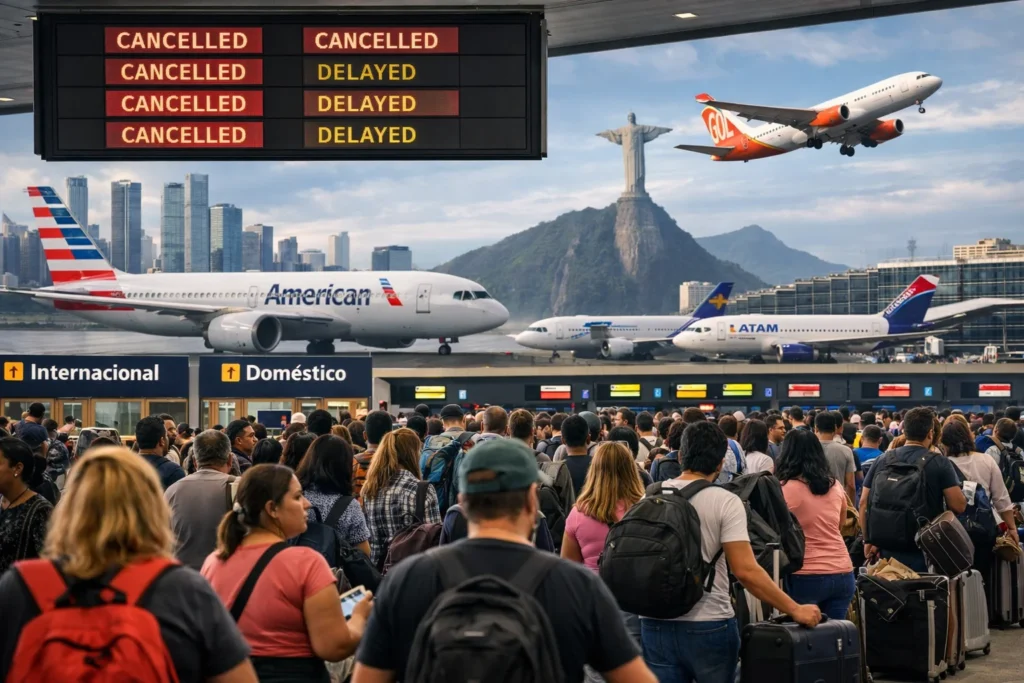
Air travel across Brazil has been thrown into disarray following a wave of flight cancellations that disrupted both domestic and international routes over the weekend. Major airlines, including American Airlines, Gol, Azul and LATAM, have been affected, leaving passengers stranded and forcing last-minute changes to travel plans across the country’s busiest aviation hubs.
More than a dozen flights were canceled within a short period, impacting routes connecting São Paulo, Rio de Janeiro, Brasília and several international destinations such as New York, Miami and Santiago. The widespread nature of these disruptions has highlighted operational challenges within Brazil’s aviation network, particularly during high-demand travel periods.
São Paulo, the country’s largest aviation hub, experienced the most significant disruptions. São Paulo-Guarulhos International Airport, a key gateway for international travel, recorded major cancellations involving long-haul flights. Services bound for New York and Miami were among those affected, creating difficulties for passengers traveling to North America. These routes are critical for both business and tourism, making their disruption particularly impactful.
In addition to international routes, domestic connections from São Paulo also faced challenges. Airports such as Congonhas and Viracopos, which serve as key hubs for regional travel, reported multiple cancellations. Flights linking São Paulo to cities like Rio de Janeiro and Brasília were disrupted, affecting passengers relying on these routes for onward connections across the country.
Brasília’s main airport also experienced disruptions, particularly during early morning departures. Flights scheduled for key domestic routes, including connections to São Paulo and Recife, were canceled, affecting travelers who depend on early departures for efficient connections. Morning flights are often critical for business travelers, and cancellations during this time can disrupt entire travel schedules.
Rio de Janeiro’s airports, including Galeão International and Santos Dumont, were also impacted. Both domestic and international routes were affected, including a canceled flight to Santiago, Chile. The disruption in Rio is significant given the city’s importance as a tourism destination and its role in connecting travelers to other parts of Brazil.
The pattern of cancellations suggests that peak travel periods, particularly early morning and late evening, were most affected. These time slots are often heavily utilized, and any operational issues during these periods can quickly lead to widespread disruption. Aviation experts indicate that factors such as aircraft availability, maintenance requirements, crew scheduling and air traffic congestion may all contribute to such challenges.
The involvement of multiple airlines highlights the scale of the disruption. American Airlines’ canceled international services demonstrate how the impact extends beyond Brazil’s borders, while domestic carriers such as Gol, Azul and LATAM reflect the strain within the country’s internal travel network. When several airlines face simultaneous challenges, the effects are magnified across the entire system.
For passengers, the consequences have been immediate and frustrating. Many travelers have encountered long queues at airport counters, difficulty securing alternative flights and uncertainty regarding revised departure times. Those with connecting flights have faced additional complications, including missed onward journeys and extended waiting periods.
Tourism, a vital component of Brazil’s economy, is also feeling the effects. Cities such as Rio de Janeiro and São Paulo attract millions of visitors each year, and reliable air connectivity is essential for maintaining this flow. Flight cancellations can lead to reduced visitor numbers, affecting hotels, tour operators and local businesses that depend on tourism revenue.
The disruption of international routes is particularly concerning, as these flights connect Brazil to major global markets. Travelers heading to destinations such as the United States and Chile may need to adjust their plans significantly, including rerouting through other airports or rescheduling their trips altogether.
Despite the challenges, Brazil’s aviation sector has demonstrated resilience in managing disruptions. Airlines and airport authorities are working to stabilize operations, reallocate resources and assist affected passengers. Efforts to improve communication and provide timely updates are also underway, helping travelers navigate the situation more effectively.
Passengers are advised to stay informed by regularly checking flight statuses and maintaining contact with their airlines. Flexibility is key during such disruptions, as schedules may continue to change. Travelers are encouraged to consider alternative routes or departure times and to allow extra time for connections.
Experts also recommend booking flights earlier in the day when possible, as these are generally less prone to cascading delays. Keeping travel documents readily accessible and using airline mobile apps for real-time updates can further ease the travel experience during periods of uncertainty.
The broader lesson from these disruptions is the importance of operational resilience in a rapidly growing aviation market. As demand for air travel continues to increase, airlines and airports must invest in systems that enhance reliability and improve coordination. This includes better contingency planning, improved scheduling systems and stronger communication channels with passengers.
In conclusion, the recent wave of flight cancellations across Brazil has disrupted travel across major cities and international routes. With key airlines affected and multiple airports impacted, passengers are facing significant challenges in navigating their journeys. As the situation stabilizes, travelers are encouraged to remain proactive and adaptable, ensuring they can manage disruptions with minimal inconvenience.
Brazil’s role as a major global and regional travel hub means that maintaining efficient air connectivity will remain a priority. While current disruptions pose short-term challenges, ongoing improvements in aviation infrastructure and operations are expected to support long-term growth and stability in the country’s travel sector.